 ChipApex | Global Electronic Components Supplier

SEARCH
Search Product
Search Post
— IC芯片 | 连接器 | 传感器 | 被动器件 —
Search productSearch post
— IC芯片 | 连接器 | 传感器 | 被动器件 —
Consult the customer manager about the wholesale price.
consultation hotline:86-132-6715-2157
email:[email protected]
Contact the product manager for consultation. One-stop consultation is available.
Do you want a lower wholesale price? Please send us your inquiry and we will reply immediately.
18QHTF21-34.093-OE is listed in the Oscillators range at ChipApex. The manufacturer field lists Mercury Electronics Ind. Co. Ltd. Its product description is 34.093 MHz XO 1.8V 2.0X1.6 MM OE. Review the specifications below when checking this part for your BOM.
The 18QHTF21-34.093-OE is a standard crystal oscillator (XO) manufactured by Mercury Electronics Ind. Co. Ltd. It operates at a frequency of 34.093 MHz and utilizes LVCMOS output logic. The device functions with a supply voltage of 1.8V and includes enable/disable control capabilities. It is housed in a compact 4-SMD, No Lead package, designed for surface-mount applications requiring precise timing signals.
Verify the specific frequency tolerance and load capacitance requirements against the target circuit design before procurement. Confirm that the 1.8V supply voltage aligns with the system power rails. Ensure the PCB footprint matches the 4-SMD no lead package dimensions specified in the official datasheet to guarantee proper soldering and electrical connection.
Select this component when a low-voltage 1.8V operation is required alongside LVCMOS outputs. The enable/disable feature supports dynamic power management strategies. Consider the small form factor of the 4-SMD package for space-constrained designs. Verify that the 34.093 MHz frequency meets the specific timing needs of the application without requiring additional frequency multiplication or division stages.
This part belongs to the 18QHTF21 series of standard crystal oscillators from Mercury Electronics. The series offers various frequencies within the same physical package and electrical specification framework. The -OE suffix typically denotes a specific ordering or packaging variant, though functional characteristics remain consistent with the base model specifications provided by the manufacturer.
Direct substitutes must match the 34.093 MHz frequency, 1.8V supply, LVCMOS output, and 4-SMD package. Check equivalent parts from other manufacturers offering identical pinout and electrical parameters. Ensure thermal and environmental operating ranges are compatible with the original Mercury Electronics specification.
Explore related parts through Crystals, Oscillators, Resonators, all product categories, ChipApex homepage.
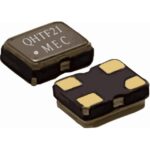 18QHTF21-34.093-OE
18QHTF21-34.093-OE is listed in the Oscillators range at ChipApex. The manufacturer field lists Mercury Electronics Ind. Co. Ltd. Its product description is 34.093 MHz…
Read More
18QHTF21-34.093-OE is listed in the Oscillators range at ChipApex. The manufacturer field lists Mercury Electronics Ind. Co. Ltd. Its product description is 34.093 MHz…
Read More
18QHTF21-34.093-OE is listed in the Oscillators range at ChipApex. The manufacturer field lists Mercury Electronics Ind. Co. Ltd. Its product description is 34.093 MHz…
Read More
18QHTF21-34.093-OE is listed in the Oscillators range at ChipApex. The manufacturer field lists Mercury Electronics Ind. Co. Ltd. Its product description is 34.093 MHz…
Read More
18QHTF21-34.093-OE is listed in the Oscillators range at ChipApex. The manufacturer field lists Mercury Electronics Ind. Co. Ltd. Its product description is 34.093 MHz…
Read More
18QHTF21-34.093-OE is listed in the Oscillators range at ChipApex. The manufacturer field lists Mercury Electronics Ind. Co. Ltd. Its product description is 34.093 MHz…
Read More
Compare thermistors, RTDs, thermocouples and temperature ICs. Learn how range, accuracy, response, interfaces and mounting affect component selection.
Read More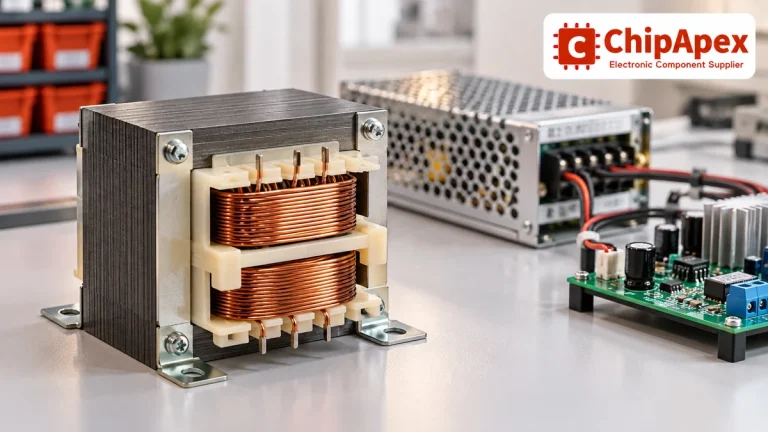
Select power transformers by input frequency, secondary VA, rectifier load, isolation, regulation and inrush. Build a clearer specification for your next RFQ.
Read More
18QHTF21-34.093-OE is listed in the Oscillators range at ChipApex. The manufacturer field lists Mercury Electronics Ind. Co. Ltd. Its product description is 34.093 MHz…
Read More
18QHTF21-34.093-OE is listed in the Oscillators range at ChipApex. The manufacturer field lists Mercury Electronics Ind. Co. Ltd. Its product description is 34.093 MHz…
Read More
See when an inductor behaves linearly, how DC bias and saturation reduce inductance, and which current and temperature curves to check.
Read More
Learn what an IMU measures, how accelerometers and gyroscopes work together, why orientation estimates drift, and what to compare.
Read More
The activity of extra discounts on wholesale prices is in full swing…
Please fill in your contact information and we will send you the latest wholesale price list.





