 ChipApex | Global Electronic Components Supplier

SEARCH
Search Product
Search Post
— IC芯片 | 连接器 | 传感器 | 被动器件 —
Search productSearch post
— IC芯片 | 连接器 | 传感器 | 被动器件 —
Consult the customer manager about the wholesale price.
consultation hotline:86-132-6715-2157
email:[email protected]
Contact the product manager for consultation. One-stop consultation is available.
Do you want a lower wholesale price? Please send us your inquiry and we will reply immediately.
402F1601XIJT is listed in the Crystals range at ChipApex. The manufacturer field lists CTS-Frequency Controls. Its product description is CRYSTAL 16.0000MHZ 9PF SMD. Review the specifications below when checking this part for your BOM.
The CTS-Frequency Controls 402F1601XIJT is a fundamental mode MHz crystal designed for surface mount applications. It operates at a nominal frequency of 16 MHz with a frequency tolerance and stability of ±10ppm. The component features a load capacitance of 9pF and an equivalent series resistance (ESR) of 120 Ohms. It is housed in a compact 4-SMD, No Lead package with dimensions of 2.00mm x 1.60mm and a maximum seated height of 0.55mm. The device supports an operating temperature range of -20°C to 70°C and complies with RoHS3 standards.
Verify the exact suffix against official CTS documentation to confirm pinout and electrical parameters. Ensure compatibility with existing PCB footprint and reflow soldering profiles. Check current availability status as components may be subject to supply chain fluctuations or obsolescence notices from the manufacturer.
Select this component when a 16 MHz fundamental crystal with ±10ppm stability is required. The 9pF load capacitance must match the oscillator circuit design. Consider the 120 Ohm ESR limit for driver strength requirements. The 4-SMD package size suits space-constrained designs requiring standard surface mount processes.
This part belongs to the CTS 402 series of surface mount crystals. The series offers various frequencies and packages optimized for consumer electronics and industrial applications. The 402F1601XIJT specifically targets applications needing reliable timing at 16 MHz with moderate stability requirements in a small form factor.
Consult official cross-reference guides for direct substitutes. Verify that alternative parts match the 16 MHz frequency, 9pF load capacitance, 120 Ohm ESR, and 4-SMD package dimensions. Ensure environmental ratings and mounting specifications are compatible with the original design constraints.
Explore related parts through Crystals, Oscillators, Resonators, all product categories, ChipApex homepage.
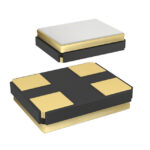 402F1601XIJT
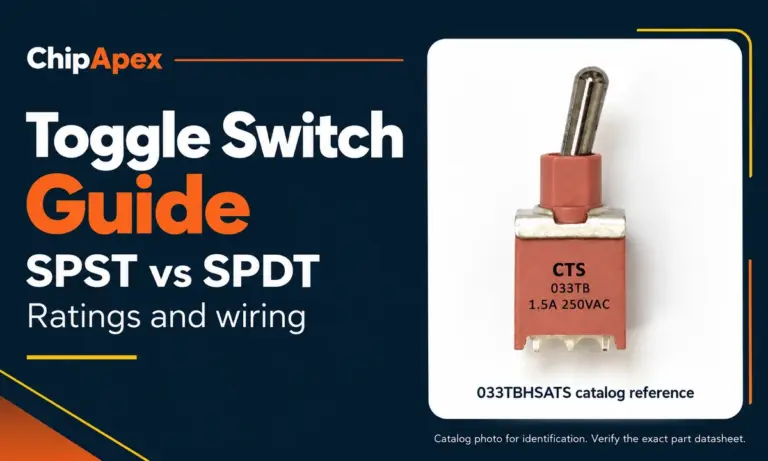
Compare SPST and SPDT toggle switches, understand AC/DC ratings, and follow wiring examples. Check contact action, mounting and parts in the ChipApex catalog.
Read More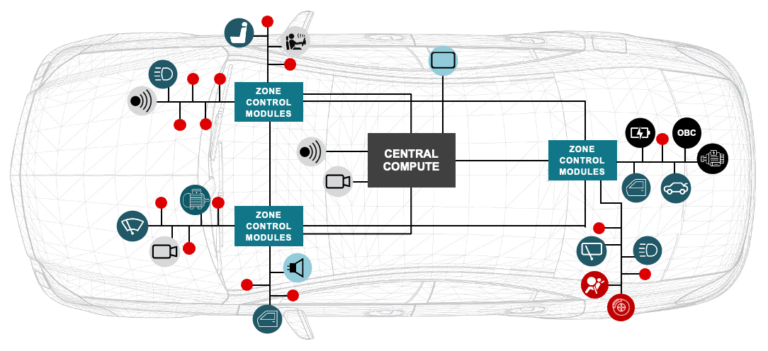
402F1601XIJT is listed in the Crystals range at ChipApex. The manufacturer field lists CTS-Frequency Controls. Its product description is CRYSTAL 16.0000MHZ 9PF SMD. Review…
Read More
Understand how a comparator switches at a voltage threshold, why hysteresis prevents chatter, and which output and input specs matter.
Read More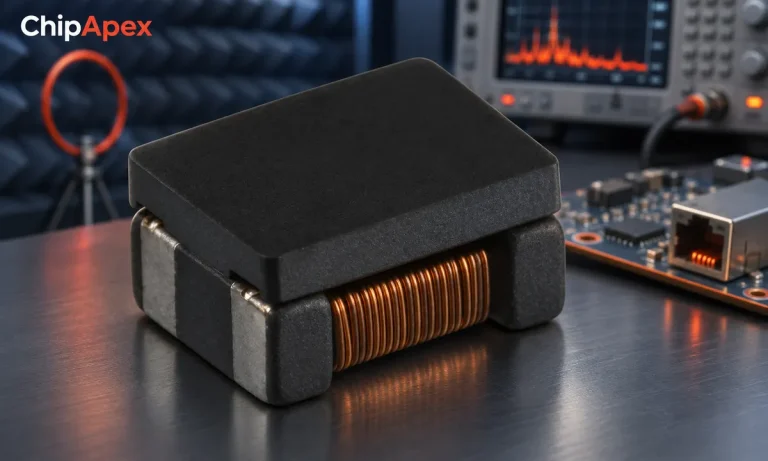
Select a common mode choke using noise frequency, current, insulation and signal integrity. Understand impedance curves, layout and filter limitations.
Read More
Understand load cell sensor output, bridge wiring and calibration. Learn how mV/V sensitivity, mechanics and ADC noise affect measurement accuracy.
Read More
402F1601XIJT is listed in the Crystals range at ChipApex. The manufacturer field lists CTS-Frequency Controls. Its product description is CRYSTAL 16.0000MHZ 9PF SMD. Review…
Read More
Learn how rectifiers convert AC to DC, compare half-wave and bridge circuits, and select voltage, current, recovery and thermal ratings for your design.
Read More
402F1601XIJT is listed in the Crystals range at ChipApex. The manufacturer field lists CTS-Frequency Controls. Its product description is CRYSTAL 16.0000MHZ 9PF SMD. Review…
Read More
402F1601XIJT is listed in the Crystals range at ChipApex. The manufacturer field lists CTS-Frequency Controls. Its product description is CRYSTAL 16.0000MHZ 9PF SMD. Review…
Read More
402F1601XIJT is listed in the Crystals range at ChipApex. The manufacturer field lists CTS-Frequency Controls. Its product description is CRYSTAL 16.0000MHZ 9PF SMD. Review…
Read More
402F1601XIJT is listed in the Crystals range at ChipApex. The manufacturer field lists CTS-Frequency Controls. Its product description is CRYSTAL 16.0000MHZ 9PF SMD. Review…
Read More
See when an inductor behaves linearly, how DC bias and saturation reduce inductance, and which current and temperature curves to check.
Read More
The activity of extra discounts on wholesale prices is in full swing…
Please fill in your contact information and we will send you the latest wholesale price list.





