 ChipApex | Global Electronic Components Supplier

SEARCH
Search Product
Search Post
— IC芯片 | 连接器 | 传感器 | 被动器件 —
Search productSearch post
— IC芯片 | 连接器 | 传感器 | 被动器件 —
Consult the customer manager about the wholesale price.
consultation hotline:86-132-6715-2157
email:[email protected]
Contact the product manager for consultation. One-stop consultation is available.
Do you want a lower wholesale price? Please send us your inquiry and we will reply immediately.
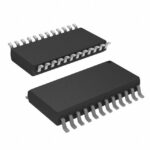
LM2577MX-ADJ is listed in the Voltage Regulators - DC DC Switching Regulators range at ChipApex. The manufacturer field lists Texas Instruments. Its product description is IC REG BST FLYBACK ADJ 3A 24SOIC. Review the specifications below when checking this part for your BOM.
The LM2577MX-ADJ is a SIMPLE SWITCHER step-up voltage regulator from Texas Instruments, designed for high-efficiency DC/DC conversion. It operates with an input voltage range of 3.5V to 40V and delivers up to 3A of output current. The device supports adjustable output voltages starting from 1.23V, utilizing a fixed 52kHz switching frequency. Packaged in the TO-263 (D2PAK) surface-mount format, it integrates internal feedback compensation and features thermal shutdown protection. This component functions as a boost, flyback, or forward converter suitable for various power management applications.
Verify the specific suffix and package variant when ordering, as the LM2577 series includes multiple pinout and thermal pad configurations. Confirm RoHS compliance status and ensure the selected part matches the required operating temperature range for your application environment. Cross-reference datasheet revision dates to guarantee compatibility with existing design files.
Select this component when a robust, high-current step-up solution is needed without complex external control loops. Ensure the input voltage remains above the minimum threshold for stable regulation. Evaluate the thermal performance of the TO-263 package relative to the expected load current and ambient temperature to determine if additional heatsinking is necessary for long-term reliability.
This part belongs to the LM2577 family of SIMPLE SWITCHER regulators, which are known for their ease of use and high efficiency. The MX suffix typically denotes a specific surface-mount package variation within the broader LM2577 product line, distinguishing it from through-hole or other SMD variants like the SX or T series.
LM2577SX-ADJ/NOPB: Pin-compatible alternative with similar electrical characteristics and updated manufacturing standards.
Explore related parts through Power Management (PMIC), Integrated Circuits (ICs), all product categories, ChipApex homepage.
 LM2577MX-ADJ

Learn what an IMU measures, how accelerometers and gyroscopes work together, why orientation estimates drift, and what to compare.
Read More
LM2577MX-ADJ is listed in the Voltage Regulators - DC DC Switching Regulators range at ChipApex. The manufacturer field lists Texas Instruments. Its product description…
Read More
LM2577MX-ADJ is listed in the Voltage Regulators - DC DC Switching Regulators range at ChipApex. The manufacturer field lists Texas Instruments. Its product description…
Read More
LM2577MX-ADJ is listed in the Voltage Regulators - DC DC Switching Regulators range at ChipApex. The manufacturer field lists Texas Instruments. Its product description…
Read More
LM2577MX-ADJ is listed in the Voltage Regulators - DC DC Switching Regulators range at ChipApex. The manufacturer field lists Texas Instruments. Its product description…
Read More
LM2577MX-ADJ is listed in the Voltage Regulators - DC DC Switching Regulators range at ChipApex. The manufacturer field lists Texas Instruments. Its product description…
Read More
LM2577MX-ADJ is listed in the Voltage Regulators - DC DC Switching Regulators range at ChipApex. The manufacturer field lists Texas Instruments. Its product description…
Read More
LM2577MX-ADJ is listed in the Voltage Regulators - DC DC Switching Regulators range at ChipApex. The manufacturer field lists Texas Instruments. Its product description…
Read More
Compare Pt100 and Pt1000 RTDs, two-, three- and four-wire connections, excitation and self-heating. Build an error budget from element to reported temperature.
Read More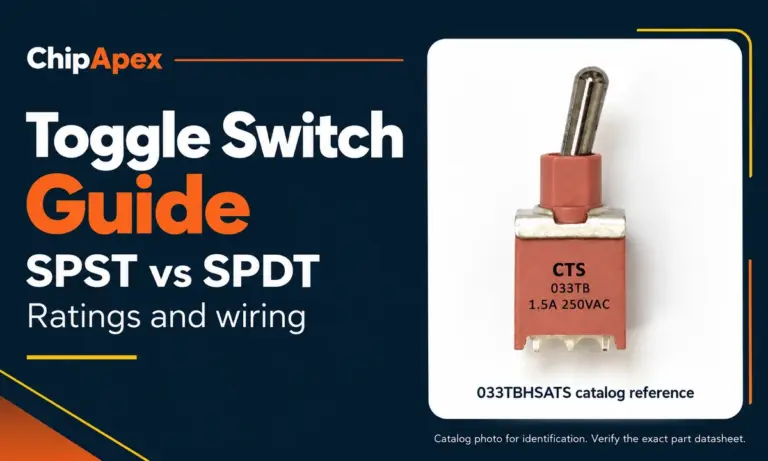
Compare SPST and SPDT toggle switches, understand AC/DC ratings, and follow wiring examples. Check contact action, mounting and parts in the ChipApex catalog.
Read More
Find out when a bare shock switch needs a pull resistor, when an MCU internal pull-up is enough, and why sensor modules and piezo…
Read More
Learn why PTC resistance rises with temperature, how it differs from NTC, and which ratings matter for sensing and protection.
Read More
The activity of extra discounts on wholesale prices is in full swing…
Please fill in your contact information and we will send you the latest wholesale price list.





