 ChipApex | Global Electronic Components Supplier

SEARCH
Search Product
Search Post
— IC芯片 | 连接器 | 传感器 | 被动器件 —
Search productSearch post
— IC芯片 | 连接器 | 传感器 | 被动器件 —
Consult the customer manager about the wholesale price.
consultation hotline:86-132-6715-2157
email:[email protected]
Contact the product manager for consultation. One-stop consultation is available.
Do you want a lower wholesale price? Please send us your inquiry and we will reply immediately.
SN74HCT374N is listed in the Flip Flops range at ChipApex. The manufacturer field lists Texas Instruments. Its product description is IC FF D-TYPE SNGL 8BIT 20DIP. Review the specifications below when checking this part for your BOM.
The SN74HCT374N is an octal D-type edge-triggered flip-flop manufactured by Texas Instruments. It features eight positive-edge triggered D-type flip-flops with three-state outputs in a 20-pin PDIP package. The device operates within a supply voltage range of 4.5 V to 5.5 V and supports TTL input levels. It exhibits a maximum propagation delay of 41 ns at 5.5 V with 150 pF load, and offers symmetric output drive currents of 6 mA. The component functions across an operating temperature range of -40°C to +85°C.
Verify the specific suffix against manufacturer documentation to confirm package type and tape/reel specifications. Ensure the ordering part number matches the required industrial temperature range and electrical characteristics. Cross-reference the datasheet revision date to validate current performance parameters before finalizing procurement decisions.
Select this component when TTL-compatible inputs are required alongside high-speed tri-state outputs. The HCT series bridges CMOS density with TTL noise margins. Consider the 20-PDIP package for through-hole prototyping or legacy board designs requiring robust mechanical mounting compared to surface-mount alternatives.
This device belongs to the SN74HCT374 family of octal flip-flops. It shares functional pinouts with other variants like SN74HC374N but differs in input threshold compatibility. The HCT technology specifically targets applications needing CMOS low power consumption while maintaining compatibility with older TTL-driven systems.
The SN74HCT374N features TTL-compatible inputs, allowing it to interface directly with standard TTL logic sources.
The Output Enable (OE) input controls the three-state condition, placing all eight outputs into a high-impedance state when activated.
Explore related parts through Logic, Integrated Circuits (ICs), all product categories, ChipApex homepage.
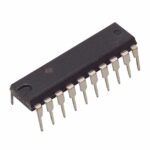 SN74HCT374N

SN74HCT374N is listed in the Flip Flops range at ChipApex. The manufacturer field lists Texas Instruments. Its product description is IC FF D-TYPE SNGL…
Read More
SN74HCT374N is listed in the Flip Flops range at ChipApex. The manufacturer field lists Texas Instruments. Its product description is IC FF D-TYPE SNGL…
Read More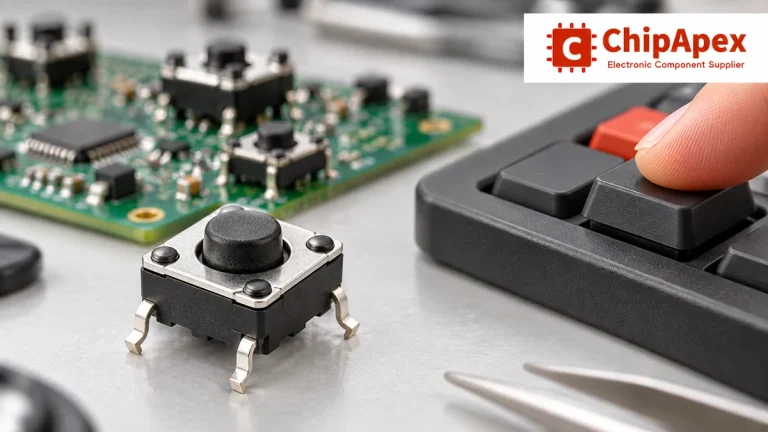
Understand tactile switches, PCB and keyboard differences, four-pin wiring, debounce, force, travel and replacement checks for reliable control inputs.
Read More
SN74HCT374N is listed in the Flip Flops range at ChipApex. The manufacturer field lists Texas Instruments. Its product description is IC FF D-TYPE SNGL…
Read More
SN74HCT374N is listed in the Flip Flops range at ChipApex. The manufacturer field lists Texas Instruments. Its product description is IC FF D-TYPE SNGL…
Read More
SN74HCT374N is listed in the Flip Flops range at ChipApex. The manufacturer field lists Texas Instruments. Its product description is IC FF D-TYPE SNGL…
Read More
Select MOV varistors by continuous voltage, clamping behavior, surge waveform and repetition. Check thermal disconnection, fuse coordination and replacements.
Read More
SN74HCT374N is listed in the Flip Flops range at ChipApex. The manufacturer field lists Texas Instruments. Its product description is IC FF D-TYPE SNGL…
Read More
SN74HCT374N is listed in the Flip Flops range at ChipApex. The manufacturer field lists Texas Instruments. Its product description is IC FF D-TYPE SNGL…
Read More
SN74HCT374N is listed in the Flip Flops range at ChipApex. The manufacturer field lists Texas Instruments. Its product description is IC FF D-TYPE SNGL…
Read More
SN74HCT374N is listed in the Flip Flops range at ChipApex. The manufacturer field lists Texas Instruments. Its product description is IC FF D-TYPE SNGL…
Read More
Understand how a comparator switches at a voltage threshold, why hysteresis prevents chatter, and which output and input specs matter.
Read More
The activity of extra discounts on wholesale prices is in full swing…
Please fill in your contact information and we will send you the latest wholesale price list.





