 ChipApex | Global Electronic Components Supplier

SEARCH
Search Product
Search Post
— IC芯片 | 连接器 | 传感器 | 被动器件 —
Search productSearch post
— IC芯片 | 连接器 | 传感器 | 被动器件 —
Consult the customer manager about the wholesale price.
consultation hotline:86-132-6715-2157
email:[email protected]
Contact the product manager for consultation. One-stop consultation is available.
Do you want a lower wholesale price? Please send us your inquiry and we will reply immediately.
TLV1391CDBV is listed in the Comparators range at ChipApex. The manufacturer field lists Texas Instruments. Its product description is SINGLE COMPARATOR. Review the specifications below when checking this part for your BOM.
The TLV1391CDBV is a single-channel differential comparator manufactured by Texas Instruments using a low-voltage, high-speed bipolar process. Designed for low-voltage, single-supply applications, it operates within a supply voltage range of 2 V to 7 V and features a common-mode input voltage range that includes ground. The device offers a typical response time of 0.7 µs and a typical supply current of 80 µA. It is fully specified at 3-V and 5-V supply voltages and serves as an enhanced replacement for the LM393 in improved system designs.
Verify the specific suffix 'C' indicates the commercial temperature range (0°C to 70°C) distinct from the industrial 'I' variant (-40°C to 85°C). Confirm the package type matches the DBV designation (SOT-23-5). Ensure compatibility with the required operating voltage range of 2 V to 7 V before integration into the design.
Select this component when a single-channel differential comparator is needed for low-voltage operation. Consider the 0.7 µs typical response time for speed requirements. Evaluate the 80 µA typical supply current against system power budgets. Verify that the 0°C to 70°C commercial temperature range meets environmental specifications.
The TLV1391 series consists of single differential comparators designed for low-voltage applications. The 'C' suffix denotes the commercial temperature grade, while 'IDBVR' or 'IDBV' variants cover the industrial temperature range. These devices utilize a specialized bipolar process to achieve performance improvements over legacy comparators like the LM393.
TLV1391IDBVR
No, the TLV1391 is specifically developed for low-voltage, single-supply applications.
The maximum supply voltage (VCC) is 7 V.
Explore related parts through Linear, Integrated Circuits (ICs), all product categories, ChipApex homepage.
 TLV1391CDBV
Learn how a JFET works and how to compare bias, leakage, noise and pinout. Review practical selection questions for high-impedance analog circuits.
Read More
Understand RF attenuator dB values, fixed and programmable types, impedance, power limits and noise tradeoffs before choosing parts for an RF signal path.
Read More
TLV1391CDBV is listed in the Comparators range at ChipApex. The manufacturer field lists Texas Instruments. Its product description is SINGLE COMPARATOR. Review the specifications…
Read More
TLV1391CDBV is listed in the Comparators range at ChipApex. The manufacturer field lists Texas Instruments. Its product description is SINGLE COMPARATOR. Review the specifications…
Read More
Choose an AC to DC converter by input range, output demand, isolation, efficiency and thermal derating. Compare architectures and check installation needs.
Read More
TLV1391CDBV is listed in the Comparators range at ChipApex. The manufacturer field lists Texas Instruments. Its product description is SINGLE COMPARATOR. Review the specifications…
Read More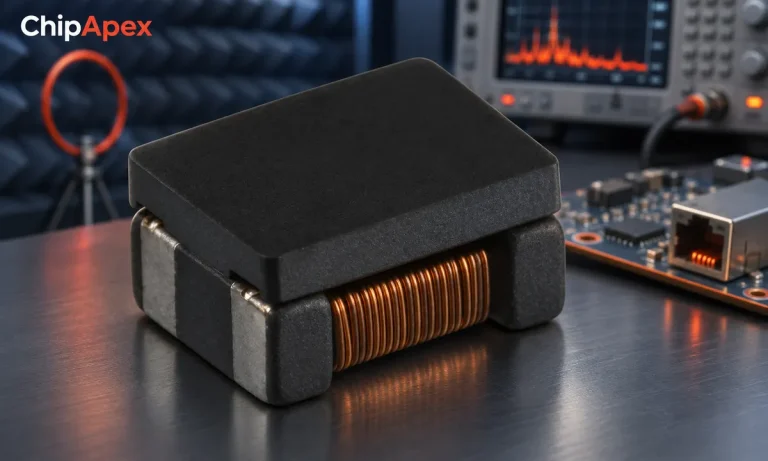
Select a common mode choke using noise frequency, current, insulation and signal integrity. Understand impedance curves, layout and filter limitations.
Read More
TLV1391CDBV is listed in the Comparators range at ChipApex. The manufacturer field lists Texas Instruments. Its product description is SINGLE COMPARATOR. Review the specifications…
Read More
TLV1391CDBV is listed in the Comparators range at ChipApex. The manufacturer field lists Texas Instruments. Its product description is SINGLE COMPARATOR. Review the specifications…
Read More
Compare RC, crystal and MEMS oscillator circuits. Check ppm, jitter, load capacitance, startup margin and output compatibility before choosing a clock source.
Read More
TLV1391CDBV is listed in the Comparators range at ChipApex. The manufacturer field lists Texas Instruments. Its product description is SINGLE COMPARATOR. Review the specifications…
Read More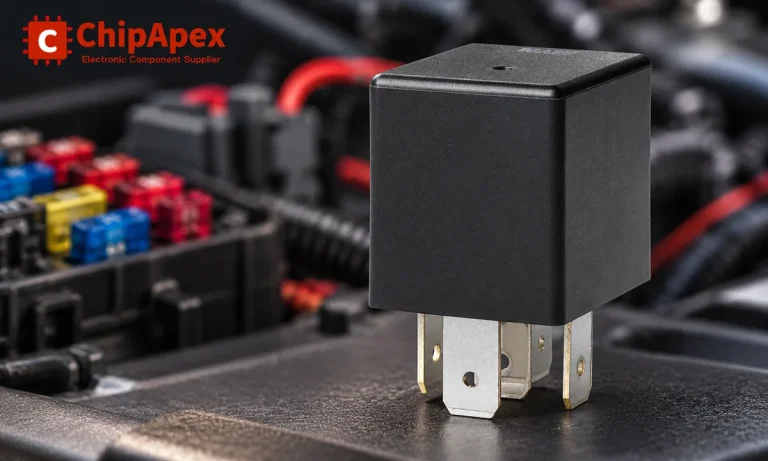
Learn the relay definition, coil and contact operation, NO and NC forms, load ratings and suppression choices. Compare mechanical, reed and solid-state types.
Read More
The activity of extra discounts on wholesale prices is in full swing…
Please fill in your contact information and we will send you the latest wholesale price list.




