 ChipApex | Global Electronic Components Supplier

SEARCH
Search Product
Search Post
— IC芯片 | 连接器 | 传感器 | 被动器件 —
Search productSearch post
— IC芯片 | 连接器 | 传感器 | 被动器件 —
Consult the customer manager about the wholesale price.
consultation hotline:86-132-6715-2157
email:[email protected]
Contact the product manager for consultation. One-stop consultation is available.
Do you want a lower wholesale price? Please send us your inquiry and we will reply immediately.
Phoenix Contact part number 1408513 is a shielded cable reel from the SAC series, designed for industrial automation and control applications. The cable features four positions with a conductor cross-section of 4x 0.25 mm². It utilizes a PUR halogen-free black outer jacket, specifically colored black-gray RAL 7021. The internal wiring consists of single wires in brown, white, blue, and black. The cable has an outer diameter of 4.70 mm ±0.15 mm and a wire diameter including insulation of 1.17 mm ±0.02 mm. The UL AWM style rating is 20549, and the cable weight is 31 kg/km.
Verify the specific cable length requirement before ordering, as this item is sold by the meter or on reels with customizable lengths. Confirm that the 4-position configuration and 0.25 mm² conductor size match your system's electrical specifications. Ensure compatibility with existing connector interfaces if termination is required. Check for any specific regional certification requirements such as UL or CE marking depending on the deployment location.
Select this component when a flexible, shielded connection is needed for low-power signal lines. The 4x 0.25 mm² gauge is suitable for standard I/O devices. Consider the PUR material for applications requiring resistance to oils, chemicals, and mechanical wear. The shielding is critical for noise-sensitive environments. Compare against other SAC series variants if different pin counts or conductor sizes are required.
This cable belongs to Phoenix Contact's SAC series of pre-assembled cables, widely used in factory automation. It complements terminal blocks and connectors like the SP series. The design supports quick installation and reliable data/power transfer in harsh industrial settings. It is part of a broader ecosystem of standardized connectivity solutions.
Check for direct substitutes within the SAC series with different lengths or conductor gauges. Verify compatibility with mating connectors. No specific alternative part numbers are confirmed in the provided documentation.
The outer jacket is made of PUR (Polyurethane) and is halogen-free.
Yes, the cable is shielded to reduce electromagnetic interference.
The wire colors are brown, white, blue, and black.
 1408513

Learn how a diode conducts, how to identify anode and cathode, and when to choose rectifier, TVS, Zener or photodiode types for a circuit.
Read More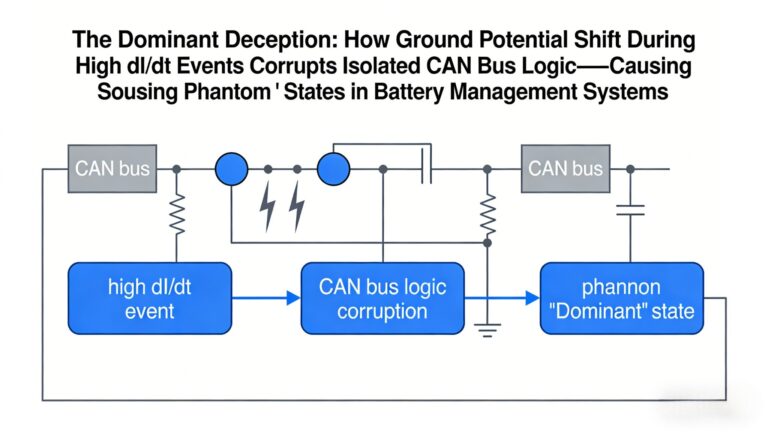
Stay ahead with ChipApex Insights — technical deep dives, market trends, and sourcing tips for memory, microcontrollers, power management, and industrial-grade components. Trusted by…
Read More
Understand how a comparator switches at a voltage threshold, why hysteresis prevents chatter, and which output and input specs matter.
Read More
Geneva, Switzerland – August 20, 2026 – Global leading semiconductor manufacturer STMicroelectronics (ST) has officially issued a new global price adjustment notice to global…
Read More
Choose a DIP switch by contact type, coded positions, footprint and signal ratings. Check logic polarity, assembly conditions and PCB configuration behavior.
Read More
ON Semiconductor (onsemi), a global leader in intelligent power and sensing technologies, has announced plans to implement price adjustments for select product lines, effective…
Read More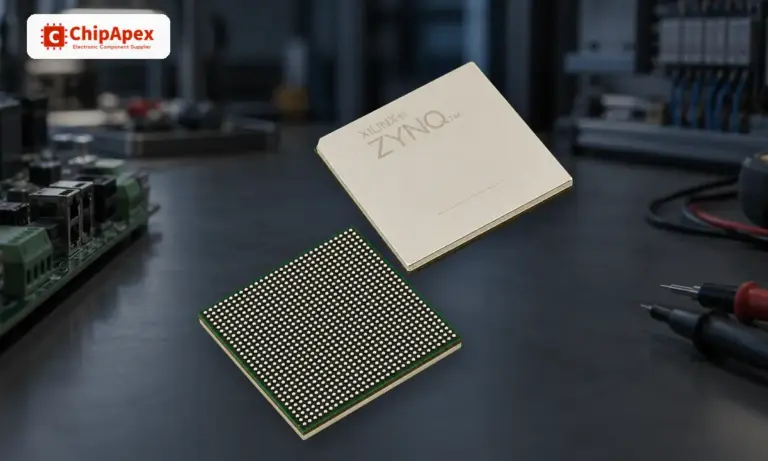
Learn what an integrated circuit is, how ICs work, the main types and the specs to check before choosing a part for your design…
Read More
Hsinchu, Taiwan – April 18, 2026 – United Microelectronics Corporation (UMC, NYSE: UMC), a leading global semiconductor foundry specializing in mature process technologies, has…
Read More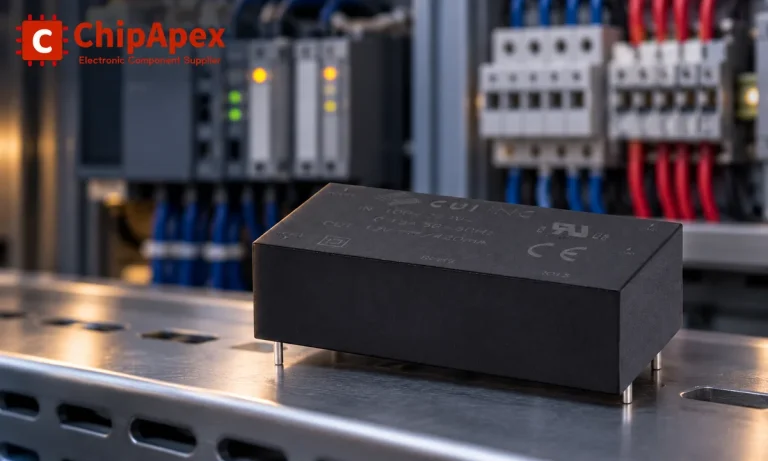
Choose an AC to DC converter by input range, output demand, isolation, efficiency and thermal derating. Compare architectures and check installation needs.
Read More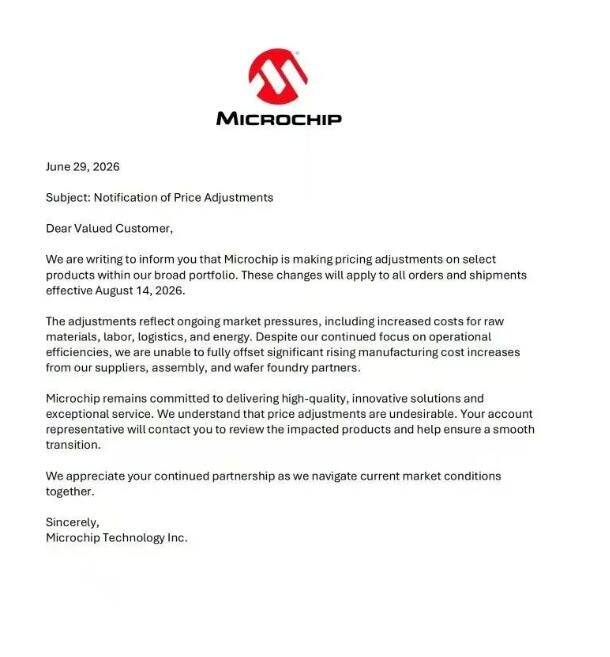
Tempe, Arizona‑based semiconductor giant Microchip Technology has formally rolled out selective product price increases across its MCU, power‑management IC, memory controller and analog component…
Read More
Choose tactile switches by operating force, travel, actuator height, footprint and lifetime. Check debounce, sealing and the assembled button mechanism.
Read More
See when an inductor behaves linearly, how DC bias and saturation reduce inductance, and which current and temperature curves to check.
Read More
The activity of extra discounts on wholesale prices is in full swing…
Please fill in your contact information and we will send you the latest wholesale price list.




