 ChipApex | Global Electronic Components Supplier

SEARCH
Search Product
Search Post
— IC芯片 | 连接器 | 传感器 | 被动器件 —
Search productSearch post
— IC芯片 | 连接器 | 传感器 | 被动器件 —
Consult the customer manager about the wholesale price.
consultation hotline:86-132-6715-2157
email:[email protected]
Contact the product manager for consultation. One-stop consultation is available.
Do you want a lower wholesale price? Please send us your inquiry and we will reply immediately.
18QHTF21-27.1631-PD is listed in the Oscillators range at ChipApex. The manufacturer field lists Mercury Electronics Ind. Co. Ltd. Its product description is 27.1631 MHz XO 1.8V 2.0X1.6MM PD. Review the specifications below when checking this part for your BOM.
The 18QHTF21-27.1631-PD is a standard crystal oscillator (XO) manufactured by Mercury Electronics Ind. Co. Ltd. It operates at a frequency of 27.1631 MHz with an LVCMOS output logic level. The device requires a supply voltage of 1.8V and features a standby or power-down mode for energy efficiency. It is housed in a compact 4-SMD, No Lead package with dimensions of 2.0mm x 1.6mm.
Verify the specific frequency tolerance and load capacitance requirements against your circuit design before ordering. Confirm that the 1.8V supply voltage aligns with your system's power rails. Ensure the 2.0x1.6mm SMD footprint matches your PCB layout constraints. Check for any specific RoHS compliance documentation if required by your manufacturing standards.
Select this component when a small form factor and low voltage operation are critical. The LVCMOS output is suitable for direct interfacing with most digital logic families. Consider the power-down feature if battery life is a primary concern. Compare against other frequencies in the 18QHTF21 series to ensure the exact 27.1631 MHz rate meets your system's timing needs.
This part belongs to the 18QHTF21 series of surface-mount oscillators from Mercury Electronics. The series offers various frequencies within a consistent 2.0x1.6mm package. These components are designed for applications where space is limited and power efficiency is important. The 'PD' suffix indicates the inclusion of power-down capabilities.
Direct replacements must match the 27.1631 MHz frequency, 1.8V supply, and 2.0x1.6mm package. Verify output logic compatibility. Other Mercury parts in the same series may offer different frequencies but share similar physical characteristics.
Explore related parts through Crystals, Oscillators, Resonators, all product categories, ChipApex homepage.
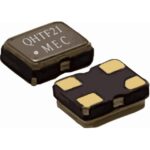 18QHTF21-27.1631-PD

18QHTF21-27.1631-PD is listed in the Oscillators range at ChipApex. The manufacturer field lists Mercury Electronics Ind. Co. Ltd. Its product description is 27.1631 MHz…
Read More
18QHTF21-27.1631-PD is listed in the Oscillators range at ChipApex. The manufacturer field lists Mercury Electronics Ind. Co. Ltd. Its product description is 27.1631 MHz…
Read More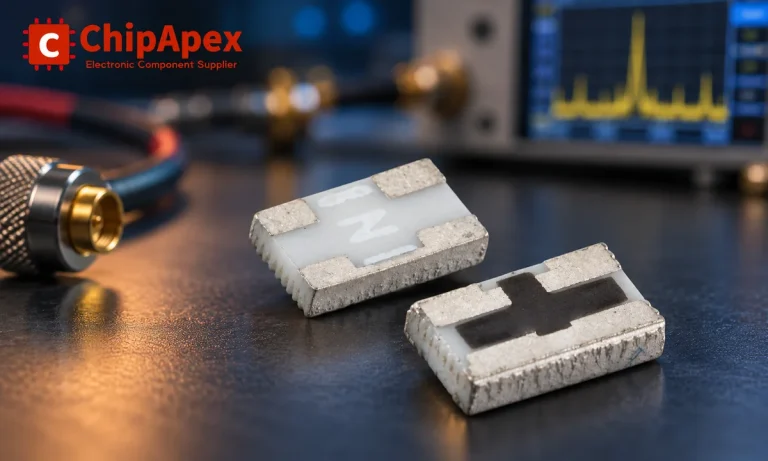
Understand RF attenuator dB values, fixed and programmable types, impedance, power limits and noise tradeoffs before choosing parts for an RF signal path.
Read More
18QHTF21-27.1631-PD is listed in the Oscillators range at ChipApex. The manufacturer field lists Mercury Electronics Ind. Co. Ltd. Its product description is 27.1631 MHz…
Read More
See how a MEMS gyroscope measures angular rate, why its angle estimate drifts, and which range, noise, interface and temperature specs to compare.
Read More
18QHTF21-27.1631-PD is listed in the Oscillators range at ChipApex. The manufacturer field lists Mercury Electronics Ind. Co. Ltd. Its product description is 27.1631 MHz…
Read More
18QHTF21-27.1631-PD is listed in the Oscillators range at ChipApex. The manufacturer field lists Mercury Electronics Ind. Co. Ltd. Its product description is 27.1631 MHz…
Read More
Compare Pt100 and Pt1000 RTDs, two-, three- and four-wire connections, excitation and self-heating. Build an error budget from element to reported temperature.
Read More
18QHTF21-27.1631-PD is listed in the Oscillators range at ChipApex. The manufacturer field lists Mercury Electronics Ind. Co. Ltd. Its product description is 27.1631 MHz…
Read More
18QHTF21-27.1631-PD is listed in the Oscillators range at ChipApex. The manufacturer field lists Mercury Electronics Ind. Co. Ltd. Its product description is 27.1631 MHz…
Read More
18QHTF21-27.1631-PD is listed in the Oscillators range at ChipApex. The manufacturer field lists Mercury Electronics Ind. Co. Ltd. Its product description is 27.1631 MHz…
Read More
Understand how oscillators generate timing signals, how they differ from crystals, and which frequency, output and stability specs matter when choosing one.
Read More
The activity of extra discounts on wholesale prices is in full swing…
Please fill in your contact information and we will send you the latest wholesale price list.





