 ChipApex | Global Electronic Components Supplier

SEARCH
Search Product
Search Post
— IC芯片 | 连接器 | 传感器 | 被动器件 —
Search productSearch post
— IC芯片 | 连接器 | 传感器 | 被动器件 —
Consult the customer manager about the wholesale price.
consultation hotline:86-132-6715-2157
email:[email protected]
Contact the product manager for consultation. One-stop consultation is available.
Do you want a lower wholesale price? Please send us your inquiry and we will reply immediately.
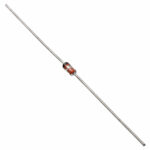
1N4615-1/TR is listed in the Single Zener Diodes range at ChipApex. The manufacturer field lists Microchip Technology. Its product description is DIODE ZENER 2V 500MW DO7. Review the specifications below when checking this part for your BOM.
The Microchip Technology 1N4615-1/TR is a 2.0 V Zener diode in the 1N4614-1 through 1N4627-1 series, housed in an axial-lead glass DO-35 package. It features an internal metallurgical bond and operates within a temperature range of -65°C to +175°C. The device provides a nominal Zener voltage of 2.0 V at a test current of 250 µA, with a maximum dynamic impedance of 1250 Ohms and a reverse leakage current of 2.5 µA. Rated for 500 mW power dissipation, it offers a tight voltage tolerance of 5% and a negative temperature coefficient of -0.075 %/°C.
Verify that the TR suffix indicates tape and reel packaging per EIA-296 standards. Confirm the specific reliability level (commercial, JAN, JANTX, JANTXV, or JANS) required for the application, as qualification levels vary across the product family. Ensure compatibility with MIL-STD-750 soldering methods if high-reliability grades are selected.
Select this component for applications requiring low-voltage regulation with strict tolerance requirements. The internal metallurgical bond distinguishes it from non-bonded variants. Consider the negative temperature coefficient when designing for wide thermal operating ranges. Verify that the 5% standard tolerance meets circuit specifications before choosing tighter tolerance options like 2% or 1%.
This part belongs to the 1N4614-1 through 1N4627-1 series of 500 mW metallurgically bonded glass Zener diodes. The series covers voltages from 1.8 V to 100 V and is JEDEC registered. It is available in multiple packages including DO-35, DO-213AA, and DO-216, with various military qualification levels available.
Non-bonded equivalents exist without the "-1" suffix. Surface mount alternatives include the 1N4614UR-1 through 1N4627UR-1 series in DO-213AA packages.
Explore related parts through Zener, Diodes, Discrete Semiconductor Products, all product categories.
 1N4615-1/TR

1N4615-1/TR is listed in the Single Zener Diodes range at ChipApex. The manufacturer field lists Microchip Technology. Its product description is DIODE ZENER 2V…
Read More
1N4615-1/TR is listed in the Single Zener Diodes range at ChipApex. The manufacturer field lists Microchip Technology. Its product description is DIODE ZENER 2V…
Read More
1N4615-1/TR is listed in the Single Zener Diodes range at ChipApex. The manufacturer field lists Microchip Technology. Its product description is DIODE ZENER 2V…
Read More
1N4615-1/TR is listed in the Single Zener Diodes range at ChipApex. The manufacturer field lists Microchip Technology. Its product description is DIODE ZENER 2V…
Read More
1N4615-1/TR is listed in the Single Zener Diodes range at ChipApex. The manufacturer field lists Microchip Technology. Its product description is DIODE ZENER 2V…
Read More
1N4615-1/TR is listed in the Single Zener Diodes range at ChipApex. The manufacturer field lists Microchip Technology. Its product description is DIODE ZENER 2V…
Read More
1N4615-1/TR is listed in the Single Zener Diodes range at ChipApex. The manufacturer field lists Microchip Technology. Its product description is DIODE ZENER 2V…
Read More
1N4615-1/TR is listed in the Single Zener Diodes range at ChipApex. The manufacturer field lists Microchip Technology. Its product description is DIODE ZENER 2V…
Read More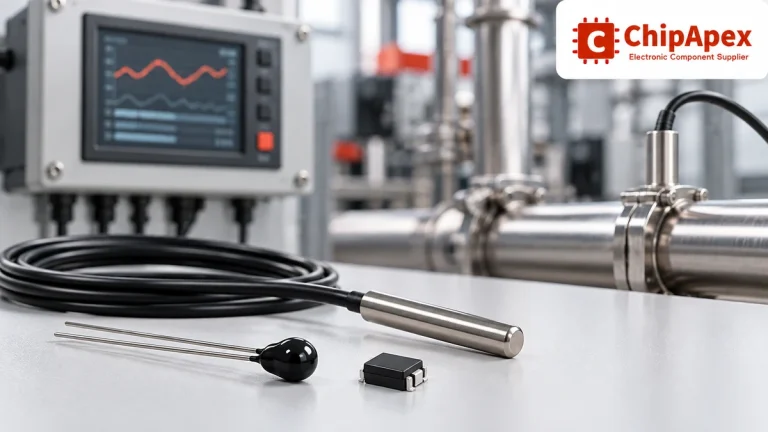
Compare thermistors, RTDs, thermocouples and temperature ICs. Learn how range, accuracy, response, interfaces and mounting affect component selection.
Read More
See how a MEMS gyroscope measures angular rate, why its angle estimate drifts, and which range, noise, interface and temperature specs to compare.
Read More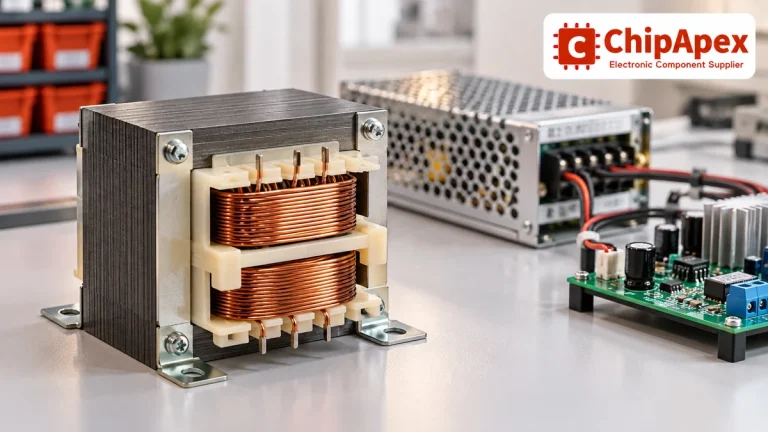
Select power transformers by input frequency, secondary VA, rectifier load, isolation, regulation and inrush. Build a clearer specification for your next RFQ.
Read More
See when an inductor behaves linearly, how DC bias and saturation reduce inductance, and which current and temperature curves to check.
Read More
The activity of extra discounts on wholesale prices is in full swing…
Please fill in your contact information and we will send you the latest wholesale price list.





