 ChipApex | Global Electronic Components Supplier

SEARCH
Search Product
Search Post
— IC芯片 | 连接器 | 传感器 | 被动器件 —
Search productSearch post
— IC芯片 | 连接器 | 传感器 | 被动器件 —
Consult the customer manager about the wholesale price.
consultation hotline:86-132-6715-2157
email:[email protected]
Contact the product manager for consultation. One-stop consultation is available.
Do you want a lower wholesale price? Please send us your inquiry and we will reply immediately.
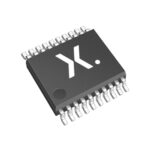
74LVT240PW,112 is listed in the Buffers, Drivers, Receivers, Transceivers range at ChipApex. The manufacturer field lists Nexperia USA Inc.. Its product description is IC BUFFER INVERT 3.6V 20TSSOP. Review the specifications below when checking this part for your BOM.
The Nexperia 74LVT240PW,112 is a 3.3 V octal inverting buffer and line driver featuring 3-state outputs housed in a TSSOP20 package. It operates within a supply voltage range of 2.7 V to 3.6 V and supports overvoltage tolerant inputs up to 5.5 V. The device provides high output drive capabilities with +64 mA low-level and -32 mA high-level currents. Propagation delays are specified at 2.5 ns typical at 3.3 V. It includes bus hold inputs and IOFF circuitry for partial power-down mode operation.
Verify the specific ordering suffix matches the required package type, as the base part number covers multiple variants. Confirm the temperature range aligns with operational requirements, noting that standard versions cover -40 °C to +85 °C. Check current production status and longevity program details directly with Nexperia or authorized distributors before finalizing procurement plans.
Select this component when an inverting function is required for octal data buses. Ensure the design utilizes the dual enable pins to manage separate 4-bit sections if needed. Verify that the 5.5 V input tolerance meets the source signal levels. Consider the TSSOP20 footprint constraints during layout planning.
This device belongs to the 74LVT logic family, designed for 3.3 V applications. It serves as a high-performance alternative to older logic families, offering faster switching speeds and lower power dissipation. The octal configuration allows for efficient management of wide data paths in digital systems.
Direct pin-compatible substitutes include the 74LVT240D variant in an SO20 package. Other 74LVT series buffers may serve as functional replacements if package differences are acceptable.
Explore related parts through Logic, Integrated Circuits (ICs), all product categories, ChipApex homepage.
 74LVT240PW,112
Compare Hall, shunt, current transformer and Rogowski sensing. Check AC/DC capability, accuracy, isolation, heat and response before selecting a sensor.
Read More
Select a bridge rectifier by reverse voltage, capacitor charging current, startup surge and cooling. Work through a stated DC voltage and ripple example.
Read More
74LVT240PW,112 is listed in the Buffers, Drivers, Receivers, Transceivers range at ChipApex. The manufacturer field lists Nexperia USA Inc.. Its product description is IC…
Read More
74LVT240PW,112 is listed in the Buffers, Drivers, Receivers, Transceivers range at ChipApex. The manufacturer field lists Nexperia USA Inc.. Its product description is IC…
Read More
Learn how a diode conducts, how to identify anode and cathode, and when to choose rectifier, TVS, Zener or photodiode types for a circuit.
Read More
Learn what data acquisition means, from sensors and conditioning to sampling and storage. Review channel timing, wiring, calibration and data quality.
Read More
74LVT240PW,112 is listed in the Buffers, Drivers, Receivers, Transceivers range at ChipApex. The manufacturer field lists Nexperia USA Inc.. Its product description is IC…
Read More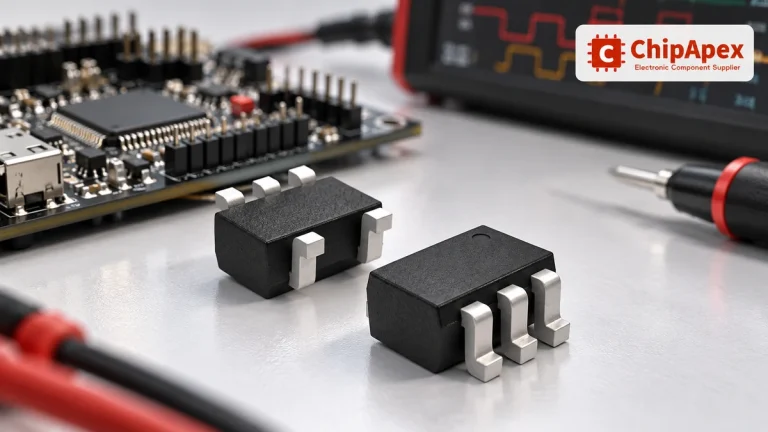
Choose logic inverter ICs by thresholds, supply, output drive and delay. Compare standard and Schmitt-trigger inputs, power sequencing and replacement checks.
Read More
Understand tactile switches, PCB and keyboard differences, four-pin wiring, debounce, force, travel and replacement checks for reliable control inputs.
Read More
74LVT240PW,112 is listed in the Buffers, Drivers, Receivers, Transceivers range at ChipApex. The manufacturer field lists Nexperia USA Inc.. Its product description is IC…
Read More
Learn how a pressure transducer converts pressure into voltage, current, or digital output, and compare pressure references and key selection specs.
Read More
Understand how a comparator switches at a voltage threshold, why hysteresis prevents chatter, and which output and input specs matter.
Read More
The activity of extra discounts on wholesale prices is in full swing…
Please fill in your contact information and we will send you the latest wholesale price list.





