 ChipApex | Global Electronic Components Supplier

SEARCH
Search Product
Search Post
— IC芯片 | 连接器 | 传感器 | 被动器件 —
Search productSearch post
— IC芯片 | 连接器 | 传感器 | 被动器件 —
Consult the customer manager about the wholesale price.
consultation hotline:86-132-6715-2157
email:[email protected]
Contact the product manager for consultation. One-stop consultation is available.
Do you want a lower wholesale price? Please send us your inquiry and we will reply immediately.
CW25-GDO-DK1-010.0.M is listed in the Application Specific Clock/Timing range at ChipApex. The manufacturer field lists Connor Winfield. Its product description is IC GPS BASED TIMING MOD (TCXO). Review the specifications below when checking this part for your BOM.
The CW25-GDO-DK1-010.0M is a GPS receiver and disciplined oscillator module designed for time and frequency synchronization. It integrates a 72-channel GPS receiver with an NS2D04 synchronizing ASIC, providing phase-aligned outputs including a 1PPS signal and two 10MHz clock signals. The module operates on a 3.3V supply within a -20°C to +70°C temperature range. It features a programmable frequency output from 150Hz to 80MHz and supports holdover via an onboard TCXO or external reference inputs.
Verify the specific suffix DK1 against the datasheet SG203 to confirm the 10MHz LVCMOS output configuration. Ensure the host system provides a stable 3.3V supply with less than 50mV peak-to-peak noise on RF and digital rails. Confirm antenna interface requirements match the RF_IN castellation or connector options.
Select this module when phase-aligned timing and UTC synchronization are required. The DK1 variant specifically provides dual 10MHz LVCMOS outputs. Consider the optional external 10MHz input for improved holdover performance if higher stability is needed during GPS signal loss. Verify that the operating temperature range of -20°C to +70°C meets environmental constraints.
This component belongs to the CW25-GDO-DK series of GPS receiver and disciplined oscillator modules. It utilizes Connor-Winfield's NS2D04 synchronizing ASIC to combine GNSS reception with digital PLL disciplining. The series is designed for compact surface-mount integration in synchronization applications.
Publicly confirmed substitute part numbers are not available in the provided documentation. The CW25-GDO-DK2 variant offers different output logic (LVPECL/LVDS) and frequencies; verify electrical compatibility before substitution.
Explore related parts through Clock/Timing, Integrated Circuits (ICs), all product categories, ChipApex homepage.
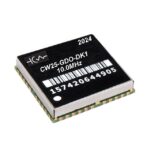 CW25-GDO-DK1-010.0.M

CW25-GDO-DK1-010.0.M is listed in the Application Specific Clock/Timing range at ChipApex. The manufacturer field lists Connor Winfield. Its product description is IC GPS BASED…
Read More
See how a MEMS gyroscope measures angular rate, why its angle estimate drifts, and which range, noise, interface and temperature specs to compare.
Read More
CW25-GDO-DK1-010.0.M is listed in the Application Specific Clock/Timing range at ChipApex. The manufacturer field lists Connor Winfield. Its product description is IC GPS BASED…
Read More
CW25-GDO-DK1-010.0.M is listed in the Application Specific Clock/Timing range at ChipApex. The manufacturer field lists Connor Winfield. Its product description is IC GPS BASED…
Read More
CW25-GDO-DK1-010.0.M is listed in the Application Specific Clock/Timing range at ChipApex. The manufacturer field lists Connor Winfield. Its product description is IC GPS BASED…
Read More
Learn how a diode conducts, how to identify anode and cathode, and when to choose rectifier, TVS, Zener or photodiode types for a circuit.
Read More
Understand how a comparator switches at a voltage threshold, why hysteresis prevents chatter, and which output and input specs matter.
Read More
CW25-GDO-DK1-010.0.M is listed in the Application Specific Clock/Timing range at ChipApex. The manufacturer field lists Connor Winfield. Its product description is IC GPS BASED…
Read More
CW25-GDO-DK1-010.0.M is listed in the Application Specific Clock/Timing range at ChipApex. The manufacturer field lists Connor Winfield. Its product description is IC GPS BASED…
Read More
CW25-GDO-DK1-010.0.M is listed in the Application Specific Clock/Timing range at ChipApex. The manufacturer field lists Connor Winfield. Its product description is IC GPS BASED…
Read More
Choose logic inverter ICs by thresholds, supply, output drive and delay. Compare standard and Schmitt-trigger inputs, power sequencing and replacement checks.
Read More
See when an inductor behaves linearly, how DC bias and saturation reduce inductance, and which current and temperature curves to check.
Read More
The activity of extra discounts on wholesale prices is in full swing…
Please fill in your contact information and we will send you the latest wholesale price list.






