 ChipApex | Global Electronic Components Supplier

SEARCH
Search Product
Search Post
— IC芯片 | 连接器 | 传感器 | 被动器件 —
Search productSearch post
— IC芯片 | 连接器 | 传感器 | 被动器件 —
Consult the customer manager about the wholesale price.
consultation hotline:86-132-6715-2157
email:[email protected]
Contact the product manager for consultation. One-stop consultation is available.
Do you want a lower wholesale price? Please send us your inquiry and we will reply immediately.
EPC1PI8 is listed in the Configuration PROMs For FPGAs range at ChipApex. The manufacturer field lists Altera. Its product description is IC CONFIG DEVICE 1MBIT 8DIP. Review the specifications below when checking this part for your BOM.
The Altera EPC1PI8 is a serial configuration memory device designed for Intel (Altera) FPGAs. It provides 1 Mbit of non-volatile flash memory storage for FPGA configuration data. The device supports system-in-programmable (ISP) capabilities, allowing reconfiguration without removing the chip from the board. It operates at a recommended voltage of 3.3V and features on-chip decompression support to enhance effective configuration density. The component utilizes a serial interface architecture suitable for space-constrained designs.
Verify the specific suffix 'I8' against the official datasheet to confirm temperature range and package type. Confirm current lifecycle status as distribution channels may list discontinued or obsolete inventory. Ensure compatibility with the target FPGA's configuration mode requirements before procurement.
Select this component when a compact serial configuration solution is required for Altera FPGAs. Consider the 1 Mbit capacity limit relative to the target FPGA's bitstream size. Evaluate the need for ISP capabilities versus one-time programmable options. Verify that the 3.3V operating voltage aligns with the system power design.
The EPC1PI8 belongs to the Enhanced Configuration (EPC) device family produced by Altera, now part of Intel. These devices are dedicated non-volatile memory solutions intended to store configuration data for Programmable Logic Devices (PLDs). The EPC series replaces older PROM technologies with more flexible flash-based architectures supporting reprogramming.
Check for direct pin-to-pin replacements within the EPC family such as EPC1P4 or EPC1S4 if capacity allows. Verify that any substitute maintains the same serial interface protocol and voltage levels. Consult the official replacement guide for end-of-life notifications regarding the EPC1P series.
Explore related parts through Memory, Integrated Circuits (ICs), all product categories, ChipApex homepage.
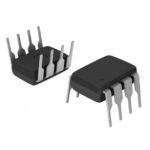 EPC1PI8
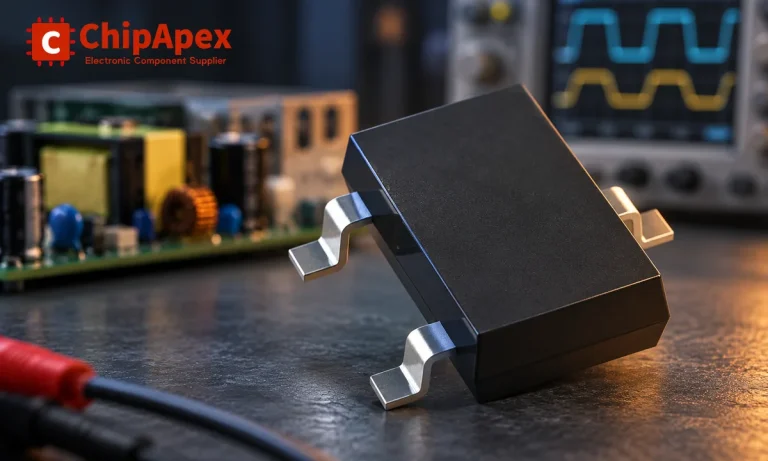
Learn how rectifiers convert AC to DC, compare half-wave and bridge circuits, and select voltage, current, recovery and thermal ratings for your design.
Read More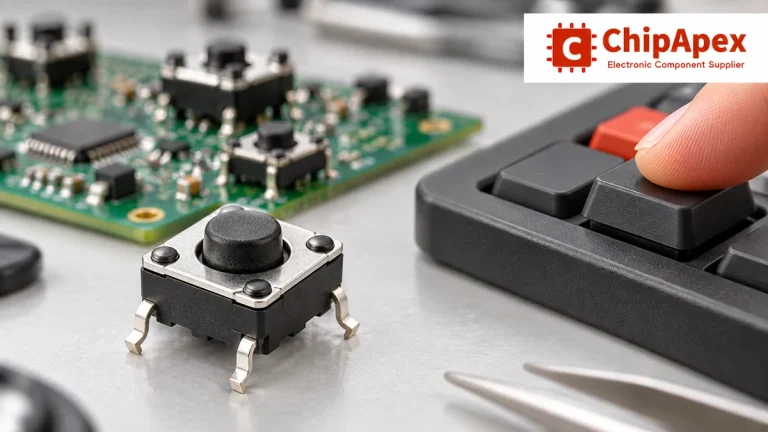
Understand tactile switches, PCB and keyboard differences, four-pin wiring, debounce, force, travel and replacement checks for reliable control inputs.
Read More
EPC1PI8 is listed in the Configuration PROMs For FPGAs range at ChipApex. The manufacturer field lists Altera. Its product description is IC CONFIG DEVICE…
Read More
EPC1PI8 is listed in the Configuration PROMs For FPGAs range at ChipApex. The manufacturer field lists Altera. Its product description is IC CONFIG DEVICE…
Read More
EPC1PI8 is listed in the Configuration PROMs For FPGAs range at ChipApex. The manufacturer field lists Altera. Its product description is IC CONFIG DEVICE…
Read More
EPC1PI8 is listed in the Configuration PROMs For FPGAs range at ChipApex. The manufacturer field lists Altera. Its product description is IC CONFIG DEVICE…
Read More
EPC1PI8 is listed in the Configuration PROMs For FPGAs range at ChipApex. The manufacturer field lists Altera. Its product description is IC CONFIG DEVICE…
Read More
EPC1PI8 is listed in the Configuration PROMs For FPGAs range at ChipApex. The manufacturer field lists Altera. Its product description is IC CONFIG DEVICE…
Read More
EPC1PI8 is listed in the Configuration PROMs For FPGAs range at ChipApex. The manufacturer field lists Altera. Its product description is IC CONFIG DEVICE…
Read More
Learn what an integrated circuit is, how ICs work, the main types and the specs to check before choosing a part for your design…
Read More
EPC1PI8 is listed in the Configuration PROMs For FPGAs range at ChipApex. The manufacturer field lists Altera. Its product description is IC CONFIG DEVICE…
Read More
See when an inductor behaves linearly, how DC bias and saturation reduce inductance, and which current and temperature curves to check.
Read More
The activity of extra discounts on wholesale prices is in full swing…
Please fill in your contact information and we will send you the latest wholesale price list.





