ChipApex | Global Electronic Components Supplier

SEARCH
Search Product
Search Post
— IC芯片 | 连接器 | 传感器 | 被动器件 —
Search productSearch post
— IC芯片 | 连接器 | 传感器 | 被动器件 —
Consult the customer manager about the wholesale price.
consultation hotline:86-132-6715-2157
email:[email protected]
Contact the product manager for consultation. One-stop consultation is available.
Do you want a lower wholesale price? Please send us your inquiry and we will reply immediately.
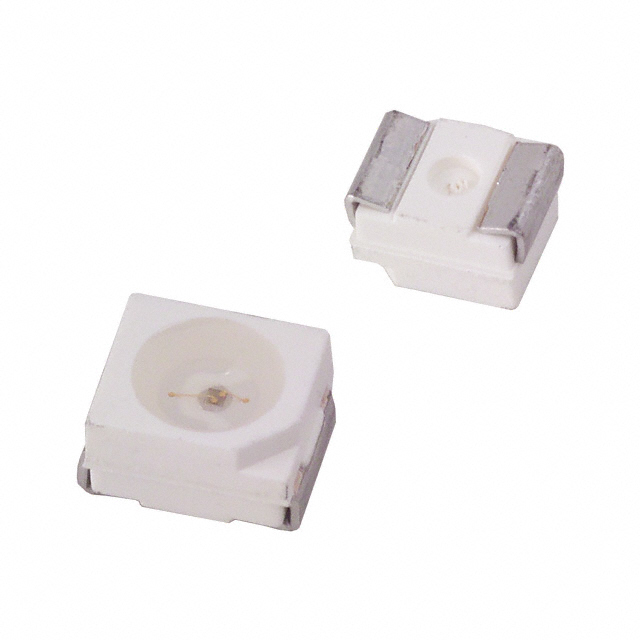
LTST-T680UBWT is listed in the LED Indication - Discrete range at ChipApex. The manufacturer field lists Lite-On Inc.. Its product description is LED BLUE DIFFUSED 2SMD. Review the specifications below when checking this part for your BOM.
The LTST-T680UBWT is a single-color blue surface-mount LED manufactured by Lite-On Inc. It utilizes a PLCC2 (3528 metric) package with dimensions of 3.2 mm length, 2.8 mm width, and 1.9 mm height. The component emits light at a peak wavelength of 470 nm with a viewing angle of 120 degrees. Key electrical parameters include a forward current of 20 mA, a forward voltage of 3.4 V, and a power rating of 102 mW. The optical intensity is rated at 280 mcd. It features a water-clear, round flat lens and operates within a temperature range of -40°C to +85°C.
Verify the specific ordering suffix to ensure the correct lens color and packaging configuration match project requirements. Confirm moisture sensitivity level handling procedures during storage and assembly. Check RoHS compliance status against current environmental regulations. Validate that the reel quantity aligns with production volume needs. Ensure the supplier provides official datasheets for final technical confirmation before purchase.
Select this component when a standard blue SMD LED with a 3528 footprint is required. Consider the 3.4 V forward voltage drop for circuit design compatibility. Evaluate the 280 mcd intensity against visibility requirements for the intended application environment. Verify that the operating temperature range meets the system's thermal constraints. Compare the physical dimensions against available PCB space to ensure proper fitment.
The LTST-T680UBWT belongs to the LTST-T680 series of single-color LEDs from Lite-On Inc. This series offers various color options including red, green, yellow, and blue within the same PLCC2 package form factor. The consistent mechanical dimensions allow for flexible design-in across different product lines while maintaining standardized mounting processes.
LTST-T680TBWT: Blue LED with 475 nm wavelength and 140 mcd intensity.
Explore related parts through Optoelectronics, all product categories, ChipApex homepage.
 LTST-T680UBWT

LTST-T680UBWT is listed in the LED Indication - Discrete range at ChipApex. The manufacturer field lists Lite-On Inc.. Its product description is LED BLUE…
Read More
LTST-T680UBWT is listed in the LED Indication - Discrete range at ChipApex. The manufacturer field lists Lite-On Inc.. Its product description is LED BLUE…
Read More
LTST-T680UBWT is listed in the LED Indication - Discrete range at ChipApex. The manufacturer field lists Lite-On Inc.. Its product description is LED BLUE…
Read More
See when an inductor behaves linearly, how DC bias and saturation reduce inductance, and which current and temperature curves to check.
Read More
Compare Pt100 and Pt1000 RTDs, two-, three- and four-wire connections, excitation and self-heating. Build an error budget from element to reported temperature.
Read More
LTST-T680UBWT is listed in the LED Indication - Discrete range at ChipApex. The manufacturer field lists Lite-On Inc.. Its product description is LED BLUE…
Read More
LTST-T680UBWT is listed in the LED Indication - Discrete range at ChipApex. The manufacturer field lists Lite-On Inc.. Its product description is LED BLUE…
Read More
LTST-T680UBWT is listed in the LED Indication - Discrete range at ChipApex. The manufacturer field lists Lite-On Inc.. Its product description is LED BLUE…
Read More
Learn what data acquisition means, from sensors and conditioning to sampling and storage. Review channel timing, wiring, calibration and data quality.
Read More
LTST-T680UBWT is listed in the LED Indication - Discrete range at ChipApex. The manufacturer field lists Lite-On Inc.. Its product description is LED BLUE…
Read More
LTST-T680UBWT is listed in the LED Indication - Discrete range at ChipApex. The manufacturer field lists Lite-On Inc.. Its product description is LED BLUE…
Read More
See how a MEMS gyroscope measures angular rate, why its angle estimate drifts, and which range, noise, interface and temperature specs to compare.
Read More
The activity of extra discounts on wholesale prices is in full swing…
Please fill in your contact information and we will send you the latest wholesale price list.