 ChipApex | Global Electronic Components Supplier

SEARCH
Search Product
Search Post
— IC芯片 | 连接器 | 传感器 | 被动器件 —
Search productSearch post
— IC芯片 | 连接器 | 传感器 | 被动器件 —
Consult the customer manager about the wholesale price.
consultation hotline:86-132-6715-2157
email:[email protected]
Contact the product manager for consultation. One-stop consultation is available.
Do you want a lower wholesale price? Please send us your inquiry and we will reply immediately.
MCP111T-240E/TT is listed in the Supervisors range at ChipApex. The manufacturer field lists Microchip Technology. Its product description is IC SUPERVISOR 1 CHANNEL SOT23-3. Review the specifications below when checking this part for your BOM.
The MCP111T-240E/TT is a micropower voltage supervisor manufactured by Microchip Technology, designed to monitor a single power supply rail. It features an active-low open-drain reset output and operates within an extended temperature range of -40°C to +125°C. The device triggers a reset when the monitored voltage drops below a threshold of 2.32V. It includes a typical reset delay timer of 120 ms to ensure stable operation during power transitions. Packaged in a compact SOT-23-3 surface-mount case, it supports supply voltages up to 5.5V with ultra-low quiescent current.
Verify the specific suffix 'TT' against official Microchip documentation to confirm package type and tape-and-reel specifications. Ensure the operating environment remains within the specified -40°C to +125°C range. Confirm RoHS compliance status through the manufacturer's latest datasheet or environmental declaration before finalizing procurement.
Select this component when a simple, low-power solution is required for monitoring a single voltage rail. The fixed 2.32V threshold suits applications where the supply voltage does not drop below this level during normal operation. Consider the open-drain output requirement for external pull-up resistor implementation in the design phase.
This part belongs to the MCP111 family of micropower voltage supervisors from Microchip Technology. The family offers various threshold options and packaging styles, including SOT-23-3 and TO-92. The MCP111 series is characterized by its low supply current and ability to reset microcontrollers during brown-out conditions.
Compatible alternatives within the same family include MCP111T-240E/MB (SOT-89-3 package) and MCP111T-240E/LB (SC-70 package). Verify pinout compatibility and thermal performance differences when substituting packages.
Explore related parts through Power Management (PMIC), Integrated Circuits (ICs), all product categories, ChipApex homepage.
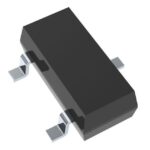 MCP111T-240E/TT
 is listed in the Supervisors range at ChipApex. The manufacturer field lists Microchip Technology. Its product description is IC SUPERVISOR 1 CHANNEL SOT23-3.…
Read More
Choose logic inverter ICs by thresholds, supply, output drive and delay. Compare standard and Schmitt-trigger inputs, power sequencing and replacement checks.
Read More
MCP111T-240E/TT is listed in the Supervisors range at ChipApex. The manufacturer field lists Microchip Technology. Its product description is IC SUPERVISOR 1 CHANNEL SOT23-3.…
Read More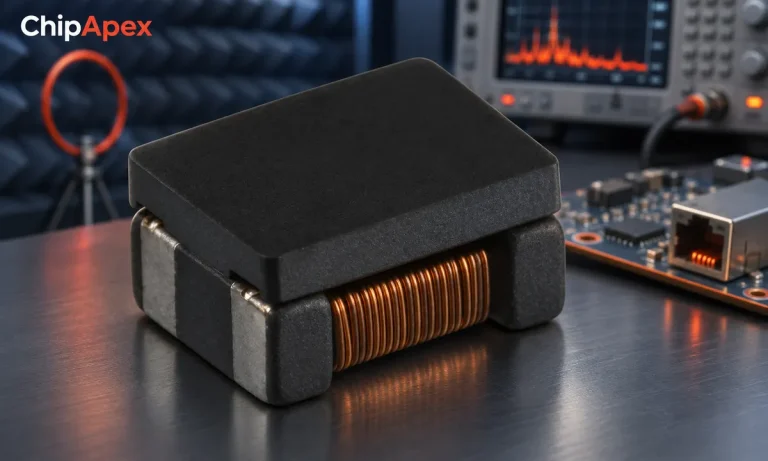
Select a common mode choke using noise frequency, current, insulation and signal integrity. Understand impedance curves, layout and filter limitations.
Read More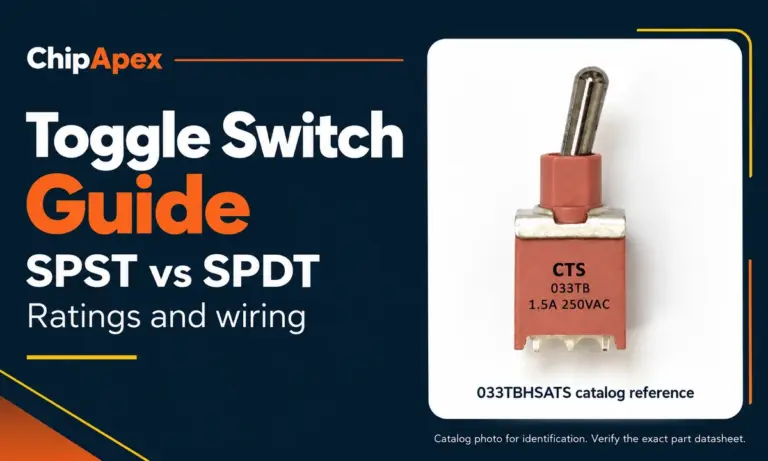
Compare SPST and SPDT toggle switches, understand AC/DC ratings, and follow wiring examples. Check contact action, mounting and parts in the ChipApex catalog.
Read More
MCP111T-240E/TT is listed in the Supervisors range at ChipApex. The manufacturer field lists Microchip Technology. Its product description is IC SUPERVISOR 1 CHANNEL SOT23-3.…
Read More
MCP111T-240E/TT is listed in the Supervisors range at ChipApex. The manufacturer field lists Microchip Technology. Its product description is IC SUPERVISOR 1 CHANNEL SOT23-3.…
Read More
MCP111T-240E/TT is listed in the Supervisors range at ChipApex. The manufacturer field lists Microchip Technology. Its product description is IC SUPERVISOR 1 CHANNEL SOT23-3.…
Read More
Understand how a comparator switches at a voltage threshold, why hysteresis prevents chatter, and which output and input specs matter.
Read More
MCP111T-240E/TT is listed in the Supervisors range at ChipApex. The manufacturer field lists Microchip Technology. Its product description is IC SUPERVISOR 1 CHANNEL SOT23-3.…
Read More
Learn how a diode conducts, how to identify anode and cathode, and when to choose rectifier, TVS, Zener or photodiode types for a circuit.
Read More
Learn why PTC resistance rises with temperature, how it differs from NTC, and which ratings matter for sensing and protection.
Read More
The activity of extra discounts on wholesale prices is in full swing…
Please fill in your contact information and we will send you the latest wholesale price list.





