ChipApex | Global Electronic Components Supplier

SEARCH
Search Product
Search Post
— IC芯片 | 连接器 | 传感器 | 被动器件 —
Search productSearch post
— IC芯片 | 连接器 | 传感器 | 被动器件 —
Consult the customer manager about the wholesale price.
consultation hotline:86-132-6715-2157
email:[email protected]
Contact the product manager for consultation. One-stop consultation is available.
Do you want a lower wholesale price? Please send us your inquiry and we will reply immediately.
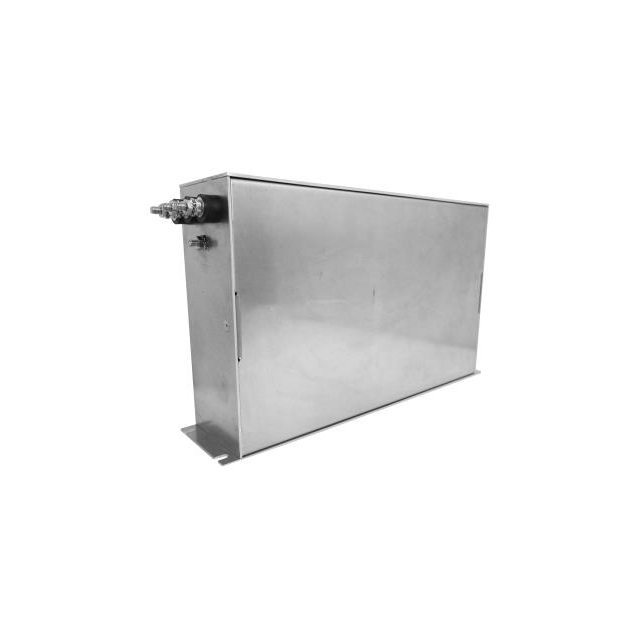
RP327-100-2000-C is listed in the Power Line Filter Modules range at ChipApex. The manufacturer field lists Astrodyne TDI. Its product description is LINE FLTR 480VAC 100A CHASS MNT. Review the specifications below when checking this part for your BOM.
The RP327-100-2000-C is a bookshelf-style, three-phase delta dual-stage power line filter manufactured by Astrodyne TDI. It is rated for 480 VAC and supports a continuous current of 100 A. The unit features touchproof connectors and chassis mount installation via studs. Electrical parameters include a maximum leakage current of 1 mA and capacitance of 100 nF. Operating temperature range spans from -25°C to +50°C. Physical dimensions are 90 mm in height and 350 mm in length.
Verify the specific suffix 'C' against official Astrodyne TDI documentation to confirm exact terminal configuration and compliance certifications. Confirm physical mounting hole patterns match the chassis design. Ensure the 100 A rating aligns with the system's peak load requirements. Check for regional availability restrictions as distribution may be limited.
Select this component when a high-current 100 A solution is required for three-phase delta networks. The dual-stage design provides enhanced attenuation compared to single-stage units. Verify that the 480 VAC rating matches the supply voltage. Consider the 90 mm height and 350 mm length for enclosure space planning. Ensure stud mounting hardware is compatible with the chassis material.
This model belongs to the RP327 series of bookshelf filters from Astrodyne TDI. These units are engineered for robust industrial environments. The series offers various current ratings and voltage options. The RP327-100-2000-C represents the 100 A variant within this product family.
Consult official cross-reference lists for direct substitutes. Verify that any alternative maintains the 100 A current rating and 480 VAC voltage specification. Ensure the replacement also supports three-phase delta topology and dual-stage filtering.
Explore related parts through Filters, all product categories, ChipApex homepage.
 RP327-100-2000-C
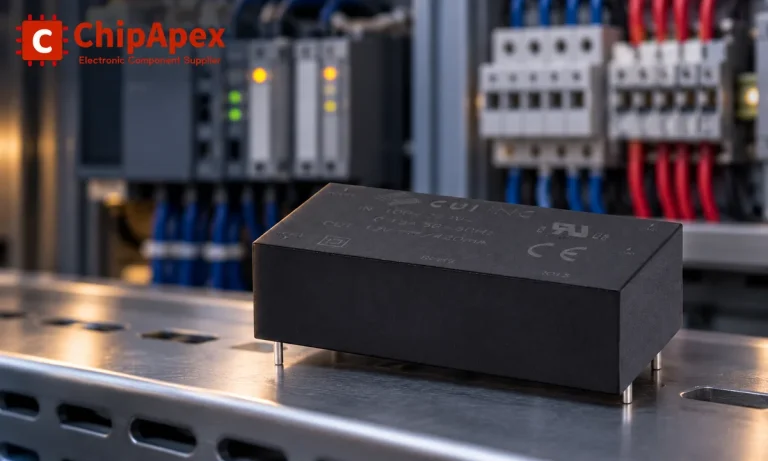
Choose an AC to DC converter by input range, output demand, isolation, efficiency and thermal derating. Compare architectures and check installation needs.
Read More
RP327-100-2000-C is listed in the Power Line Filter Modules range at ChipApex. The manufacturer field lists Astrodyne TDI. Its product description is LINE FLTR…
Read More
RP327-100-2000-C is listed in the Power Line Filter Modules range at ChipApex. The manufacturer field lists Astrodyne TDI. Its product description is LINE FLTR…
Read More
RP327-100-2000-C is listed in the Power Line Filter Modules range at ChipApex. The manufacturer field lists Astrodyne TDI. Its product description is LINE FLTR…
Read More
RP327-100-2000-C is listed in the Power Line Filter Modules range at ChipApex. The manufacturer field lists Astrodyne TDI. Its product description is LINE FLTR…
Read More
RP327-100-2000-C is listed in the Power Line Filter Modules range at ChipApex. The manufacturer field lists Astrodyne TDI. Its product description is LINE FLTR…
Read More
RP327-100-2000-C is listed in the Power Line Filter Modules range at ChipApex. The manufacturer field lists Astrodyne TDI. Its product description is LINE FLTR…
Read More
RP327-100-2000-C is listed in the Power Line Filter Modules range at ChipApex. The manufacturer field lists Astrodyne TDI. Its product description is LINE FLTR…
Read More
Learn how a pressure transducer converts pressure into voltage, current, or digital output, and compare pressure references and key selection specs.
Read More
RP327-100-2000-C is listed in the Power Line Filter Modules range at ChipApex. The manufacturer field lists Astrodyne TDI. Its product description is LINE FLTR…
Read More
See when an inductor behaves linearly, how DC bias and saturation reduce inductance, and which current and temperature curves to check.
Read More
Compare RC, crystal and MEMS oscillator circuits. Check ppm, jitter, load capacitance, startup margin and output compatibility before choosing a clock source.
Read More
The activity of extra discounts on wholesale prices is in full swing…
Please fill in your contact information and we will send you the latest wholesale price list.