 ChipApex | Global Electronic Components Supplier

SEARCH
Search Product
Search Post
— IC芯片 | 连接器 | 传感器 | 被动器件 —
Search productSearch post
— IC芯片 | 连接器 | 传感器 | 被动器件 —
Consult the customer manager about the wholesale price.
consultation hotline:86-132-6715-2157
email:[email protected]
Contact the product manager for consultation. One-stop consultation is available.
Do you want a lower wholesale price? Please send us your inquiry and we will reply immediately.
SN74AC240DW is listed in the Buffers, Drivers, Receivers, Transceivers range at ChipApex. The manufacturer field lists Texas Instruments. Its product description is IC BUFF INVERT 6V 20SOIC. Review the specifications below when checking this part for your BOM.
The SN74AC240DW is an octal buffer and line driver manufactured by Texas Instruments, belonging to the SN74AC logic series. It features eight inverting outputs with three-state capability, housed in a 20-pin SOIC package. The device operates within a supply voltage range of 2 V to 6 V. Key electrical specifications include a propagation delay of 8 ns, high-level output current of -24 mA, low-level output current of 24 mA, and static current of 4 µA. It supports surface mount installation and functions reliably across an operating temperature range of -40°C to +85°C.
Verify the specific package type and manufacturer details against official datasheets before procurement. Confirm that the component meets required environmental standards and operational temperature ranges for the intended application environment. Ensure compatibility with existing circuit designs regarding voltage levels and drive currents.
Select this component when designing systems requiring octal buffering with three-state output control. Consider the 2V to 6V operating range and 8 ns propagation delay for timing constraints. Evaluate the TSSOP or SOIC package options based on board space and thermal requirements compared to other variants in the SN74AC family.
This part belongs to the SN74AC family of high-speed CMOS logic devices. It serves as an octal buffer/driver variant, distinct from non-inverting counterparts like the SN74AC241. The device is designed for general-purpose digital logic applications where signal integrity and bus driving are critical requirements.
SN74AC240PWR: Octal Buffer/Driver With 3-State Outputs in TSSOP-20 package.
Explore related parts through Logic, Integrated Circuits (ICs), all product categories, ChipApex homepage.
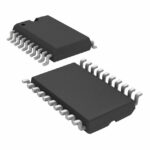 SN74AC240DW
Compare rheostat and potentiometer wiring and functions. Understand divider loading, wiper current, track power and practical component selection.
Read More
SN74AC240DW is listed in the Buffers, Drivers, Receivers, Transceivers range at ChipApex. The manufacturer field lists Texas Instruments. Its product description is IC BUFF…
Read More
See how a MEMS gyroscope measures angular rate, why its angle estimate drifts, and which range, noise, interface and temperature specs to compare.
Read More
Compare RC, crystal and MEMS oscillator circuits. Check ppm, jitter, load capacitance, startup margin and output compatibility before choosing a clock source.
Read More
SN74AC240DW is listed in the Buffers, Drivers, Receivers, Transceivers range at ChipApex. The manufacturer field lists Texas Instruments. Its product description is IC BUFF…
Read More
Learn what a shift register does, how bits move and when to use SIPO or PISO devices. Review latch timing, logic levels, output drive…
Read More
SN74AC240DW is listed in the Buffers, Drivers, Receivers, Transceivers range at ChipApex. The manufacturer field lists Texas Instruments. Its product description is IC BUFF…
Read More
SN74AC240DW is listed in the Buffers, Drivers, Receivers, Transceivers range at ChipApex. The manufacturer field lists Texas Instruments. Its product description is IC BUFF…
Read More
SN74AC240DW is listed in the Buffers, Drivers, Receivers, Transceivers range at ChipApex. The manufacturer field lists Texas Instruments. Its product description is IC BUFF…
Read More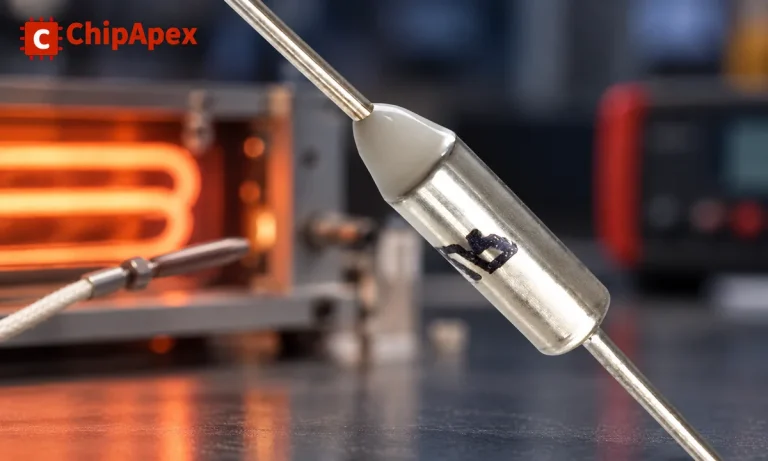
Understand thermal fuse operation, Tf, Th and Tm, electrical ratings and mounting. Check temperature limits and replacement requirements for your design.
Read More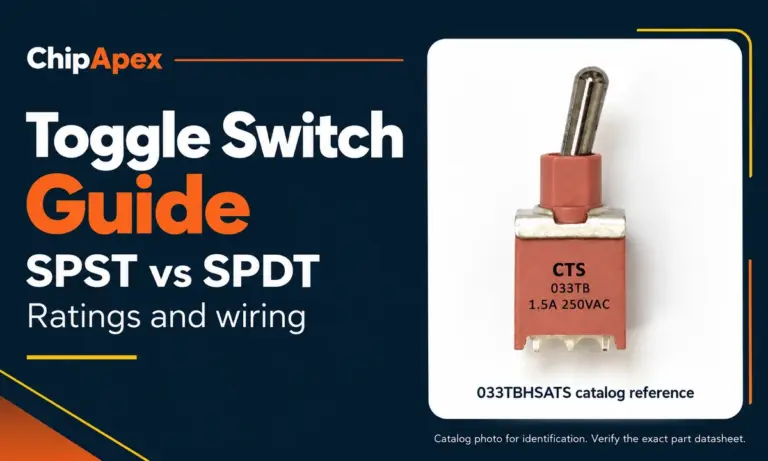
Compare SPST and SPDT toggle switches, understand AC/DC ratings, and follow wiring examples. Check contact action, mounting and parts in the ChipApex catalog.
Read More
Compare Pt100 and Pt1000 RTDs, two-, three- and four-wire connections, excitation and self-heating. Build an error budget from element to reported temperature.
Read More
The activity of extra discounts on wholesale prices is in full swing…
Please fill in your contact information and we will send you the latest wholesale price list.





