 ChipApex | Global Electronic Components Supplier

SEARCH
Search Product
Search Post
— IC芯片 | 连接器 | 传感器 | 被动器件 —
Search productSearch post
— IC芯片 | 连接器 | 传感器 | 被动器件 —
Consult the customer manager about the wholesale price.
consultation hotline:86-132-6715-2157
email:[email protected]
Contact the product manager for consultation. One-stop consultation is available.
Do you want a lower wholesale price? Please send us your inquiry and we will reply immediately.
SN74HCT00ANS is listed in the Inverter Gates range at ChipApex. The manufacturer field lists Texas Instruments. Its product description is QUAD 2-INPUT POSITIVE-NAND GATES. Review the specifications below when checking this part for your BOM.
The SN74HCT00ANS is a quadruple 2-input positive-NAND gate from the Texas Instruments 74HCT logic family. It operates within a supply voltage range of 4.5 V to 5.5 V and features a maximum propagation delay of 18 ns at 5.5 V with a 50 pF load. The device supports low-level input voltages of 0.8 V and high-level input thresholds of 2 V. It is housed in an SOIC-14 surface-mount package and functions reliably across an operating temperature range of -40°C to +85°C.
Verify the specific suffix 'ANS' against official Texas Instruments documentation to confirm the exact package type, tape-and-reel specifications, and environmental compliance status. Ensure the component matches the required operating temperature range and electrical characteristics for your specific application before procurement.
Select this component when a quad 2-input NAND gate is required with HCT compatibility for interfacing with TTL-based systems. Consider the SOIC-14 package constraints and the 4.5 V to 5.5 V supply voltage requirement. Evaluate the 18 ns propagation delay against system timing requirements to ensure adequate performance margins.
This part belongs to the SN74HCT series, which provides CMOS density with TTL-compatible inputs. The 'ANS' designation typically indicates a specific variant within the broader SN74HCT00 family, often relating to package style or manufacturing lot specifics defined by Texas Instruments.
Direct substitutes include other SN74HCT00 variants such as SN74HCT00PWR or SN74HCT00N, provided pinouts and electrical parameters match. Verify that alternative packages maintain the same functional integrity and thermal performance.
Explore related parts through Logic, Integrated Circuits (ICs), all product categories, ChipApex homepage.
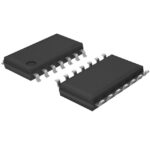 SN74HCT00ANS

Learn why PTC resistance rises with temperature, how it differs from NTC, and which ratings matter for sensing and protection.
Read More
SN74HCT00ANS is listed in the Inverter Gates range at ChipApex. The manufacturer field lists Texas Instruments. Its product description is QUAD 2-INPUT POSITIVE-NAND GATES.…
Read More
Compare Pt100 and Pt1000 RTDs, two-, three- and four-wire connections, excitation and self-heating. Build an error budget from element to reported temperature.
Read More
SN74HCT00ANS is listed in the Inverter Gates range at ChipApex. The manufacturer field lists Texas Instruments. Its product description is QUAD 2-INPUT POSITIVE-NAND GATES.…
Read More
SN74HCT00ANS is listed in the Inverter Gates range at ChipApex. The manufacturer field lists Texas Instruments. Its product description is QUAD 2-INPUT POSITIVE-NAND GATES.…
Read More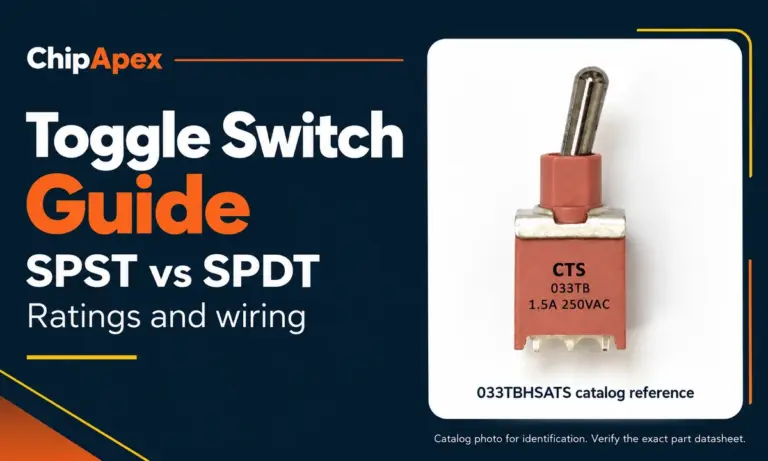
Compare SPST and SPDT toggle switches, understand AC/DC ratings, and follow wiring examples. Check contact action, mounting and parts in the ChipApex catalog.
Read More
SN74HCT00ANS is listed in the Inverter Gates range at ChipApex. The manufacturer field lists Texas Instruments. Its product description is QUAD 2-INPUT POSITIVE-NAND GATES.…
Read More
SN74HCT00ANS is listed in the Inverter Gates range at ChipApex. The manufacturer field lists Texas Instruments. Its product description is QUAD 2-INPUT POSITIVE-NAND GATES.…
Read More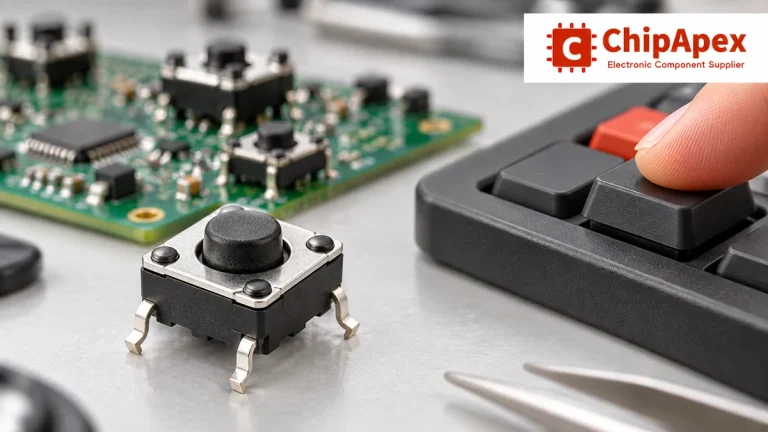
Choose tactile switches by operating force, travel, actuator height, footprint and lifetime. Check debounce, sealing and the assembled button mechanism.
Read More
SN74HCT00ANS is listed in the Inverter Gates range at ChipApex. The manufacturer field lists Texas Instruments. Its product description is QUAD 2-INPUT POSITIVE-NAND GATES.…
Read More
SN74HCT00ANS is listed in the Inverter Gates range at ChipApex. The manufacturer field lists Texas Instruments. Its product description is QUAD 2-INPUT POSITIVE-NAND GATES.…
Read More
Compare RC, crystal and MEMS oscillator circuits. Check ppm, jitter, load capacitance, startup margin and output compatibility before choosing a clock source.
Read More
The activity of extra discounts on wholesale prices is in full swing…
Please fill in your contact information and we will send you the latest wholesale price list.





