 ChipApex | Global Electronic Components Supplier

SEARCH
Search Product
Search Post
— IC芯片 | 连接器 | 传感器 | 被动器件 —
Search productSearch post
— IC芯片 | 连接器 | 传感器 | 被动器件 —
Consult the customer manager about the wholesale price.
consultation hotline:86-132-6715-2157
email:chipapex@foxmail.com
Contact the product manager for consultation. One-stop consultation is available.
Do you want a lower wholesale price? Please send us your inquiry and we will reply immediately.
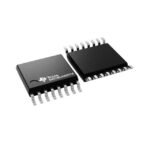
SN74LV8T594QPWRQ1 is listed in the Shift Registers range at ChipApex. The manufacturer field lists Texas Instruments. Its product description is VOLTAGE TRANSLATING FLIP-FLOPS,. Review the specifications below when checking this part for your BOM.
The SN74LV8T594QPWRQ1 is an automotive-grade octal shift register with output registers. It operates on a single supply voltage ranging from 1.65V to 5.5V and features 5.5V tolerant input pins. The device includes LVxT enhanced input voltage capabilities for up-translation and down-translation between various CMOS logic levels. It provides balanced CMOS push-pull outputs and supports data rates up to 150Mbps at 5V or 3.3V VCC.
Verify that the component meets AEC-Q100 qualification requirements for the intended automotive application environment. Confirm that the operating temperature range aligns with system specifications. Ensure proper handling procedures are followed due to electrostatic discharge sensitivity classifications. Validate that the package type matches the design footprint constraints.
Select this component when serial-to-parallel conversion is required in automotive environments. Consider its capability to interface between different voltage domains using the LVxT feature. Evaluate the need for separate clocks for shift and storage registers to manage data loading independently. Assess the thermal performance requirements based on the TSSOP package configuration.
This part belongs to the Texas Instruments SN74LV8T594-Q1 family, which consists of automotive octal shift registers with output registers. The series is designed to provide reliable data shifting and storage functionality in harsh automotive conditions while maintaining compatibility with standard logic interfaces.
Consult official documentation for confirmed substitute part numbers. Verify pinout compatibility and electrical characteristics before substitution.
Explore related parts through Logic, Integrated Circuits (ICs), all product categories, ChipApex homepage.
 SN74LV8T594QPWRQ1

SN74LV8T594QPWRQ1 is listed in the Shift Registers range at ChipApex. The manufacturer field lists Texas Instruments. Its product description is VOLTAGE TRANSLATING FLIP-FLOPS,. Review…
Read More
SN74LV8T594QPWRQ1 is listed in the Shift Registers range at ChipApex. The manufacturer field lists Texas Instruments. Its product description is VOLTAGE TRANSLATING FLIP-FLOPS,. Review…
Read More
SN74LV8T594QPWRQ1 is listed in the Shift Registers range at ChipApex. The manufacturer field lists Texas Instruments. Its product description is VOLTAGE TRANSLATING FLIP-FLOPS,. Review…
Read More
SN74LV8T594QPWRQ1 is listed in the Shift Registers range at ChipApex. The manufacturer field lists Texas Instruments. Its product description is VOLTAGE TRANSLATING FLIP-FLOPS,. Review…
Read More
Choose a DIP switch by contact type, coded positions, footprint and signal ratings. Check logic polarity, assembly conditions and PCB configuration behavior.
Read More
Understand RF attenuator dB values, fixed and programmable types, impedance, power limits and noise tradeoffs before choosing parts for an RF signal path.
Read More
SN74LV8T594QPWRQ1 is listed in the Shift Registers range at ChipApex. The manufacturer field lists Texas Instruments. Its product description is VOLTAGE TRANSLATING FLIP-FLOPS,. Review…
Read More
SN74LV8T594QPWRQ1 is listed in the Shift Registers range at ChipApex. The manufacturer field lists Texas Instruments. Its product description is VOLTAGE TRANSLATING FLIP-FLOPS,. Review…
Read More
Compare thermistors, RTDs, thermocouples and temperature ICs. Learn how range, accuracy, response, interfaces and mounting affect component selection.
Read More
SN74LV8T594QPWRQ1 is listed in the Shift Registers range at ChipApex. The manufacturer field lists Texas Instruments. Its product description is VOLTAGE TRANSLATING FLIP-FLOPS,. Review…
Read More
Learn what an integrated circuit is, how ICs work, the main types and the specs to check before choosing a part for your design…
Read More
Understand how a comparator switches at a voltage threshold, why hysteresis prevents chatter, and which output and input specs matter.
Read More
The activity of extra discounts on wholesale prices is in full swing…
Please fill in your contact information and we will send you the latest wholesale price list.






