 ChipApex | Global Electronic Components Supplier

SEARCH
Search Product
Search Post
— IC芯片 | 连接器 | 传感器 | 被动器件 —
Search productSearch post
— IC芯片 | 连接器 | 传感器 | 被动器件 —
Consult the customer manager about the wholesale price.
consultation hotline:86-132-6715-2157
email:[email protected]
Contact the product manager for consultation. One-stop consultation is available.
Do you want a lower wholesale price? Please send us your inquiry and we will reply immediately.
SN74LVC07ADR is listed in the Buffers, Drivers, Receivers, Transceivers range at ChipApex. The manufacturer field lists Texas Instruments. Its product description is IC BUF NON-INVERT 5.5V 14SOIC. Review the specifications below when checking this part for your BOM.
The SN74LVC07ADR is a hex buffer and driver featuring open-drain outputs, designed for operation from 1.65 V to 5.5 V. It accepts input voltages up to 5.5 V, enabling voltage translation in mixed-system environments. The device supports Ioff for live insertion and partial-power-down modes. It offers a maximum propagation delay of 2.6 ns at 5 V and latch-up performance exceeding 250 mA per JESD 17. Packaged in a 14-pin SOIC (D) with dimensions of 8.65 mm x 3.91 mm, it operates within a temperature range of -40°C to +125°C.
Verify the specific ordering suffix 'ADR' corresponds to the 14-pin SOIC package and tape-and-reel carrier configuration. Confirm that the required operating temperature range includes the extended upper limit of +125°C if applicable to the design environment. Ensure compatibility with the specified supply voltage range of 1.65 V to 5.5 V.
Select this component when high-drive capability with open-drain topology is required for bus sharing or voltage translation. The LVC series provides low power consumption while maintaining fast switching speeds suitable for high-speed applications up to 100 MHz. Consider the 14-pin SOIC package constraints regarding board space and thermal dissipation requirements.
This device belongs to the Texas Instruments SN74LVC07A family of hex buffers and drivers. The 'ADR' designation specifically identifies the SOIC package variant supplied in a large tape-and-reel format. It shares functional characteristics with other packages in the family, such as SSOP and TVSOP, differing primarily in physical dimensions and mounting style.
SN74LVC07ADGVR
Explore related parts through Logic, Integrated Circuits (ICs), all product categories, ChipApex homepage.
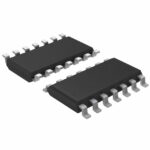 SN74LVC07ADR

Understand RF attenuator dB values, fixed and programmable types, impedance, power limits and noise tradeoffs before choosing parts for an RF signal path.
Read More
Understand voltage controlled oscillator tuning, phase noise and PLL operation. Check supply noise, output loading and requirements before selection.
Read More
SN74LVC07ADR is listed in the Buffers, Drivers, Receivers, Transceivers range at ChipApex. The manufacturer field lists Texas Instruments. Its product description is IC BUF…
Read More
SN74LVC07ADR is listed in the Buffers, Drivers, Receivers, Transceivers range at ChipApex. The manufacturer field lists Texas Instruments. Its product description is IC BUF…
Read More
Understand automotive relay terminals, coil suppression and load ratings. Check inrush, socket compatibility and temperature before selecting a replacement.
Read More
SN74LVC07ADR is listed in the Buffers, Drivers, Receivers, Transceivers range at ChipApex. The manufacturer field lists Texas Instruments. Its product description is IC BUF…
Read More
SN74LVC07ADR is listed in the Buffers, Drivers, Receivers, Transceivers range at ChipApex. The manufacturer field lists Texas Instruments. Its product description is IC BUF…
Read More
SN74LVC07ADR is listed in the Buffers, Drivers, Receivers, Transceivers range at ChipApex. The manufacturer field lists Texas Instruments. Its product description is IC BUF…
Read More
Understand UART protocol framing, baud rate and electrical interfaces. Learn 8N1 timing, TX/RX wiring, buffering and practical troubleshooting steps.
Read More
SN74LVC07ADR is listed in the Buffers, Drivers, Receivers, Transceivers range at ChipApex. The manufacturer field lists Texas Instruments. Its product description is IC BUF…
Read More
Learn how an analog front end conditions sensor signals. Compare gain, noise, filtering, ADC settling and integration options before selecting components.
Read More
Learn how a pressure transducer converts pressure into voltage, current, or digital output, and compare pressure references and key selection specs.
Read More
The activity of extra discounts on wholesale prices is in full swing…
Please fill in your contact information and we will send you the latest wholesale price list.





