 ChipApex | Global Electronic Components Supplier

SEARCH
Search Product
Search Post
— IC芯片 | 连接器 | 传感器 | 被动器件 —
Search productSearch post
— IC芯片 | 连接器 | 传感器 | 被动器件 —
Consult the customer manager about the wholesale price.
consultation hotline:86-132-6715-2157
email:[email protected]
Contact the product manager for consultation. One-stop consultation is available.
Do you want a lower wholesale price? Please send us your inquiry and we will reply immediately.
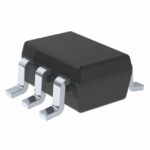
SN74LVC2G17DCKR is listed in the Buffers, Drivers, Receivers, Transceivers range at ChipApex. The manufacturer field lists Texas Instruments. Its product description is IC BUF NON-INVERT 5.5V SC70-6. Review the specifications below when checking this part for your BOM.
The SN74LVC2G17DCKR is a dual Schmitt-trigger buffer from the Texas Instruments LVC logic family, housed in a SC-70-6 surface-mount package. It operates within a supply voltage range of 1.65 V to 5.5 V and features non-inverting push-pull outputs capable of sourcing and sinking 32 mA. The device exhibits low static current of 10 uA and propagation delays of 5.4 ns at 3.3 V and 4.3 ns at 5 V. Designed for robust signal integrity, it includes an Ioff circuit to prevent damage during partial power-down conditions.
Verify the specific ordering suffix DCKR to confirm the SC-70-6 package type and tape-and-reel quantity. Ensure compatibility with the target PCB footprint and reflow soldering profile. Confirm RoHS compliance status matches project requirements. Validate that the operating temperature range meets environmental specifications.
Select this component when noise immunity is critical due to its Schmitt-trigger input characteristics. The wide supply voltage range supports both low-power and 5V legacy systems. The compact SC-70-6 package is suitable for space-constrained designs requiring dual buffering functions.
This part belongs to the SN74LVC2G17 series of dual Schmitt-trigger buffers. It shares functional similarities with other LVC family members but is distinguished by its specific input hysteresis and output drive capabilities. The DCKR suffix denotes the specific SC-70-6 packaging configuration used in this variant.
SN74LVC2G17DBVR offers identical functionality in a SOT-23-6 package. SN74LVC2G17DRYR provides the same electrical performance in a SON-6 package. Verify pinout compatibility before substituting these variants.
Explore related parts through Logic, Integrated Circuits (ICs), all product categories, ChipApex homepage.
 SN74LVC2G17DCKR

SN74LVC2G17DCKR is listed in the Buffers, Drivers, Receivers, Transceivers range at ChipApex. The manufacturer field lists Texas Instruments. Its product description is IC BUF…
Read More
SN74LVC2G17DCKR is listed in the Buffers, Drivers, Receivers, Transceivers range at ChipApex. The manufacturer field lists Texas Instruments. Its product description is IC BUF…
Read More
SN74LVC2G17DCKR is listed in the Buffers, Drivers, Receivers, Transceivers range at ChipApex. The manufacturer field lists Texas Instruments. Its product description is IC BUF…
Read MoreSN74LVC2G17DCKR is listed in the Buffers, Drivers, Receivers, Transceivers range at ChipApex. The manufacturer field lists Texas Instruments. Its product description is IC BUF…
Read More
Understand how a comparator switches at a voltage threshold, why hysteresis prevents chatter, and which output and input specs matter.
Read More
SN74LVC2G17DCKR is listed in the Buffers, Drivers, Receivers, Transceivers range at ChipApex. The manufacturer field lists Texas Instruments. Its product description is IC BUF…
Read More
SN74LVC2G17DCKR is listed in the Buffers, Drivers, Receivers, Transceivers range at ChipApex. The manufacturer field lists Texas Instruments. Its product description is IC BUF…
Read More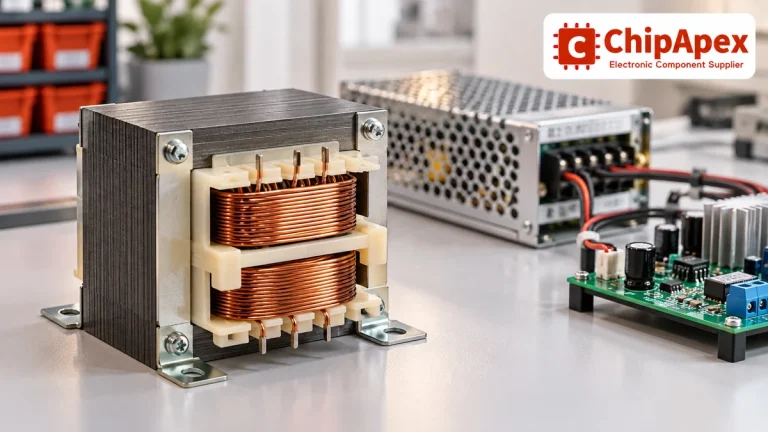
Select power transformers by input frequency, secondary VA, rectifier load, isolation, regulation and inrush. Build a clearer specification for your next RFQ.
Read More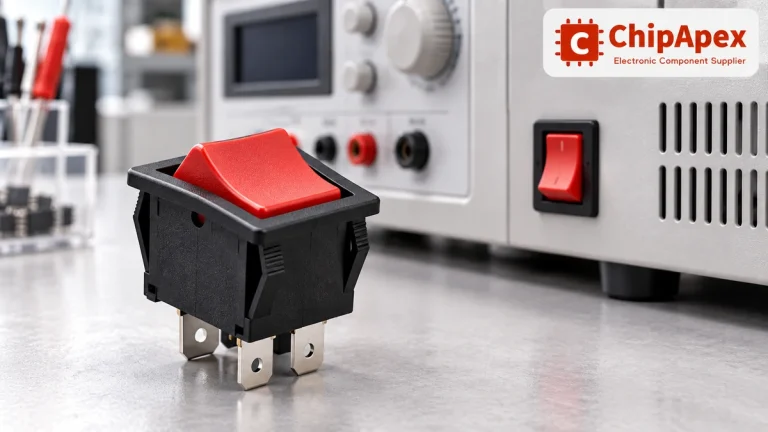
Choose a rocker switch by AC/DC ratings, contact arrangement, illumination, panel fit and sealing. Get practical checks for engineering and component sourcing.
Read More
SN74LVC2G17DCKR is listed in the Buffers, Drivers, Receivers, Transceivers range at ChipApex. The manufacturer field lists Texas Instruments. Its product description is IC BUF…
Read More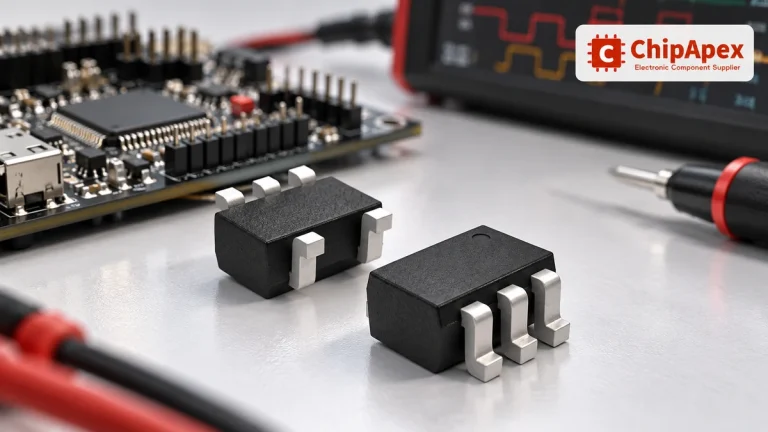
Choose logic inverter ICs by thresholds, supply, output drive and delay. Compare standard and Schmitt-trigger inputs, power sequencing and replacement checks.
Read More
Select a bridge rectifier by reverse voltage, capacitor charging current, startup surge and cooling. Work through a stated DC voltage and ripple example.
Read More
The activity of extra discounts on wholesale prices is in full swing…
Please fill in your contact information and we will send you the latest wholesale price list.





