 ChipApex | Global Electronic Components Supplier

SEARCH
Search Product
Search Post
— IC芯片 | 连接器 | 传感器 | 被动器件 —
Search productSearch post
— IC芯片 | 连接器 | 传感器 | 被动器件 —
Consult the customer manager about the wholesale price.
consultation hotline:86-132-6715-2157
email:[email protected]
Contact the product manager for consultation. One-stop consultation is available.
Do you want a lower wholesale price? Please send us your inquiry and we will reply immediately.
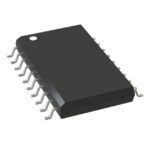
SY100EL17VZI is listed in the Specialty Logic range at ChipApex. The manufacturer field lists Microchip Technology. Its product description is IC RCVR QUAD DIFF 5V/3.3V 20SOIC. Review the specifications below when checking this part for your BOM.
The SY100EL17VZI is a quad differential receiver manufactured by Microchip Technology, housed in a 20-pin wide SOIC package. It supports both ECL and PECL power supply options, operating at -3.3V/-5V or +3.3V/+5V. The device features internal 75KΩ input pull-down resistors and provides a VBB reference voltage output for biasing. Propagation delay ranges from 330ps to 560ps depending on temperature, with typical power supply current of 26mA.
Verify the specific ordering suffix 'ZI' confirms industrial temperature range operation (-40°C to +85°C) and Sn-Pb lead finish as documented in the manufacturer's ordering guide. Confirm package type matches the 20-pin wide SOIC (Z20-1) specification. Ensure design compliance with RoHS directives if Pb-free variants are required, noting that the ZI suffix denotes standard lead finish.
Select this component when designing circuits requiring four simultaneous differential inputs with ECL or PECL compatibility. The integrated VBB output simplifies biasing requirements for AC-coupled applications. Consider the 20-pin wide SOIC package constraints for PCB layout. Verify that the propagation delay specifications meet the timing requirements of the target system across the intended operating temperature range.
This part belongs to the SY100EL series of high-performance ECL/PECL logic devices originally developed by Micrel, Inc., now part of Microchip Technology. The series includes various receivers, drivers, and dividers designed for high-speed digital applications. The SY100EL17V specifically addresses the need for multi-channel differential reception in mixed-voltage environments.
Direct functional equivalents include the SY100EL17VMC and SY100EL17VMI. Verify pinout compatibility and electrical characteristics against the original datasheet before substitution. Note that alternative packages may require adapter solutions or PCB redesign.
Explore related parts through Logic, Integrated Circuits (ICs), all product categories, ChipApex homepage.
 SY100EL17VZI
SY100EL17VZI is listed in the Specialty Logic range at ChipApex. The manufacturer field lists Microchip Technology. Its product description is IC RCVR QUAD DIFF…
Read More
Select a DC-DC converter by input range, topology, isolation and temperature. Compare ripple, efficiency and load limits before choosing a component.
Read More
SY100EL17VZI is listed in the Specialty Logic range at ChipApex. The manufacturer field lists Microchip Technology. Its product description is IC RCVR QUAD DIFF…
Read More
SY100EL17VZI is listed in the Specialty Logic range at ChipApex. The manufacturer field lists Microchip Technology. Its product description is IC RCVR QUAD DIFF…
Read More
Learn how a diode conducts, how to identify anode and cathode, and when to choose rectifier, TVS, Zener or photodiode types for a circuit.
Read More
SY100EL17VZI is listed in the Specialty Logic range at ChipApex. The manufacturer field lists Microchip Technology. Its product description is IC RCVR QUAD DIFF…
Read More
SY100EL17VZI is listed in the Specialty Logic range at ChipApex. The manufacturer field lists Microchip Technology. Its product description is IC RCVR QUAD DIFF…
Read More
SY100EL17VZI is listed in the Specialty Logic range at ChipApex. The manufacturer field lists Microchip Technology. Its product description is IC RCVR QUAD DIFF…
Read More
SY100EL17VZI is listed in the Specialty Logic range at ChipApex. The manufacturer field lists Microchip Technology. Its product description is IC RCVR QUAD DIFF…
Read More
Find out when a bare shock switch needs a pull resistor, when an MCU internal pull-up is enough, and why sensor modules and piezo…
Read More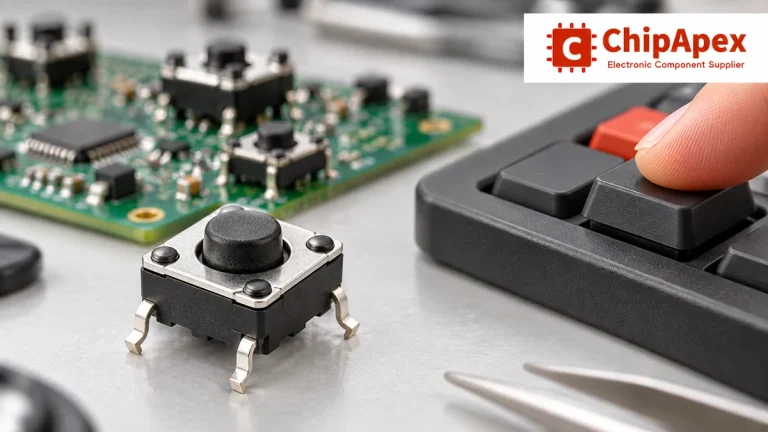
Understand tactile switches, PCB and keyboard differences, four-pin wiring, debounce, force, travel and replacement checks for reliable control inputs.
Read More
See when an inductor behaves linearly, how DC bias and saturation reduce inductance, and which current and temperature curves to check.
Read More
The activity of extra discounts on wholesale prices is in full swing…
Please fill in your contact information and we will send you the latest wholesale price list.






