ChipApex | Global Electronic Components Supplier

SEARCH
Search Product
Search Post
— IC芯片 | 连接器 | 传感器 | 被动器件 —
Search productSearch post
— IC芯片 | 连接器 | 传感器 | 被动器件 —
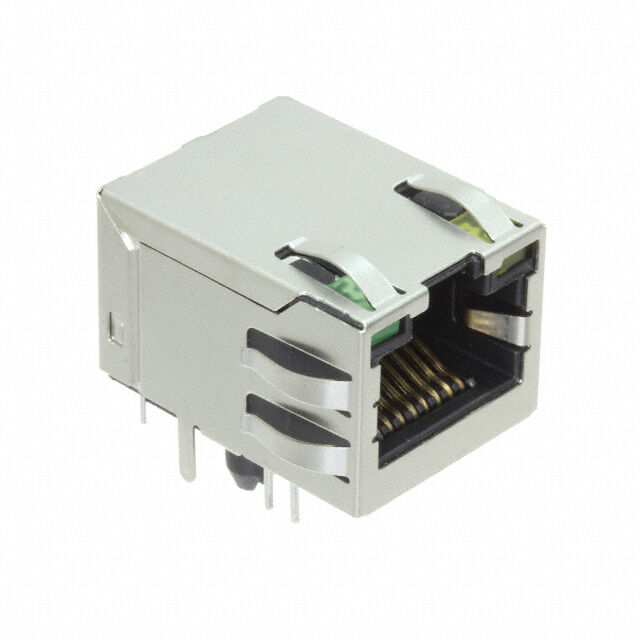
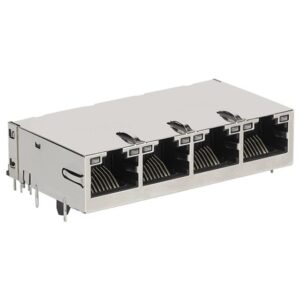
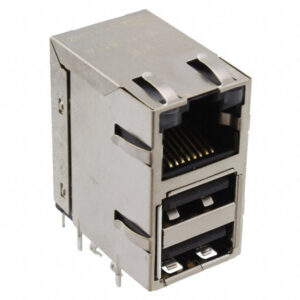
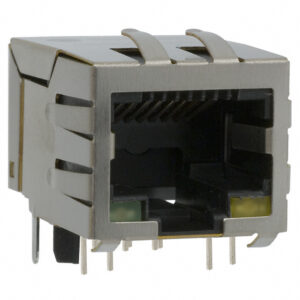
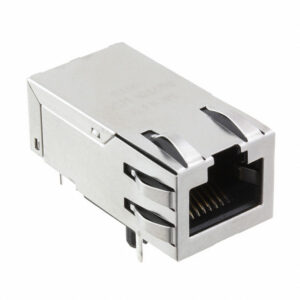
The RJ45 connector—short for Registered Jack 45—is the most widely used interface for Ethernet networking, found in devices ranging from home routers to industrial switches. It uses an 8P8C (8 Position, 8 Contact) configuration standardized by ANSI/TIA-1096-A, with typical pinouts following T-568A or T-568B wiring schemes. While similar in appearance to the smaller RJ11 telephone connector, RJ45 supports more conductors and higher data rates, making it the standard for LAN transmission across Cat5e, Cat6, and Cat6a cabling. These jacks support high-speed Ethernet protocols defined by IEEE 802.3, including 10/100/1000Base-T and multi-gigabit applications. When integrated with magnetics—meaning the inclusion of built-in transformers and common-mode chokes—RJ45 jacks provide enhanced signal conditioning, isolation, and EMI (electromagnetic interference) suppression, which are essential for reliable, standards-compliant Ethernet communication. Choosing an RJ45 jack with integrated magnetics offers several key advantages over non-magnetic versions. First and foremost, they eliminate the need for external magnetics on the PCB, saving valuable board space and simplifying layout—especially important in compact or high-density designs. These magnetics provide galvanic isolation (typically 1500 Vrms or higher) between the device and the network, protecting sensitive circuits from voltage transients and ground loops. They also improve signal integrity, especially at higher transmission speeds or over longer cable runs, by filtering noise and compensating for impedance mismatches. In applications supporting PoE (Power over Ethernet), jacks with integrated magnetics ensure compatibility with IEEE 802.3af, at, or bt standards, delivering power safely alongside data.
Learn how a JFET works and how to compare bias, leakage, noise and pinout. Review practical selection questions for high-impedance analog circuits.
Read More
ON Semiconductor (onsemi), a global leader in intelligent power and sensing technologies, has announced plans to implement price adjustments for select product lines, effective…
Read More
May 4, 2026 — The global power semiconductor market is grappling with a worsening supply crunch, as lead times for key components have extended…
Read More
Compare Pt100 and Pt1000 RTDs, two-, three- and four-wire connections, excitation and self-heating. Build an error budget from element to reported temperature.
Read More
Recently, a survey by the Electronic Components Industry Association (ECIA) revealed that the sales sentiment of global electronic components remained optimistic in the third…
Read More
Understand voltage controlled oscillator tuning, phase noise and PLL operation. Check supply noise, output loading and requirements before selection.
Read More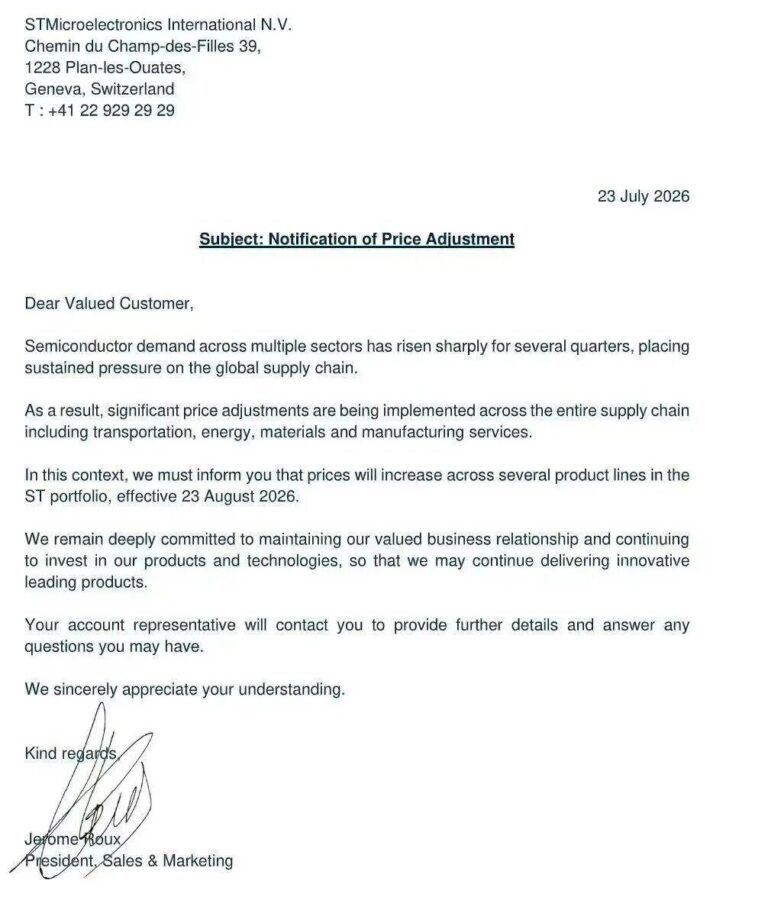
Geneva, Switzerland – August 20, 2026 – Global leading semiconductor manufacturer STMicroelectronics (ST) has officially issued a new global price adjustment notice to global…
Read More
Compare RC, crystal and MEMS oscillator circuits. Check ppm, jitter, load capacitance, startup margin and output compatibility before choosing a clock source.
Read More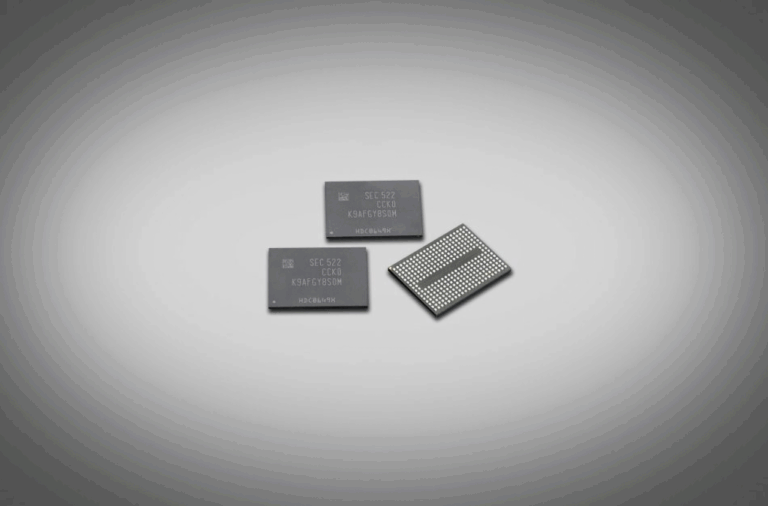
Date: May 13, 2026 The global memory industry is facing an unprecedented supply crunch in legacy MLC NAND Flash. Leading manufacturers including Samsung Electronics…
Read More
In the world of electronics, memory components play a critical role in system performance—and DRAM (Dynamic Random-Access Memory) is one of the most widely…
Read More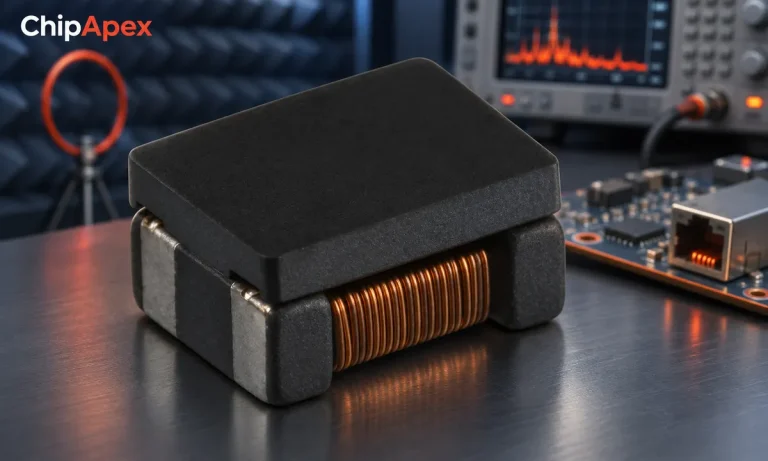
Select a common mode choke using noise frequency, current, insulation and signal integrity. Understand impedance curves, layout and filter limitations.
Read More
As the backbone of modern technology, electronic components are undergoing revolutionary changes, driven by advancements in materials science, miniaturization, and smart manufacturing. From ultra-efficient…
Read More
The activity of extra discounts on wholesale prices is in full swing…
Please fill in your contact information and we will send you the latest wholesale price list.