 ChipApex | Global Electronic Components Supplier

SEARCH
Search Product
Search Post
— IC芯片 | 连接器 | 传感器 | 被动器件 —
Search productSearch post
— IC芯片 | 连接器 | 传感器 | 被动器件 —
Consult the customer manager about the wholesale price.
consultation hotline:86-132-6715-2157
email:[email protected]
Contact the product manager for consultation. One-stop consultation is available.
Do you want a lower wholesale price? Please send us your inquiry and we will reply immediately.
18QHTF21-24.999-OE is listed in the Oscillators range at ChipApex. The manufacturer field lists Mercury Electronics Ind. Co. Ltd. Its product description is 24.999 MHz XO 1.8V 2.0X1.6 MM OE. Review the specifications below when checking this part for your BOM.
The 18QHTF21-24.999-OE is a standard crystal oscillator (XO) manufactured by Mercury Electronics Ind. Co. Ltd. It operates at a frequency of 24.999 MHz and utilizes LVCMOS output logic. The device functions with a supply voltage of 1.8V and includes enable/disable control capabilities. It is housed in a compact 4-SMD, No Lead package, designed for surface-mount applications requiring precise timing signals.
Verify the specific frequency tolerance and load capacitance requirements against the official datasheet before procurement. Ensure the 1.8V supply voltage aligns with the target system design. Confirm that the LVCMOS output levels are compatible with the receiving logic inputs to prevent signal integrity issues during operation.
Select this component when a stable 24.999 MHz reference is required for LVCMOS-compatible circuits. Consider the 1.8V operating voltage and the need for active enable/disable control. The 4-SMD package size should be evaluated against available PCB real estate and thermal dissipation requirements for the specific application environment.
This part belongs to the 18QHTF21 series of standard crystal oscillators from Mercury Electronics. The series typically offers various frequencies within a compact SMD form factor. The manufacturer specializes in quartz crystal products, providing frequency control solutions for electronic industries.
Direct substitutes must match the 24.999 MHz frequency, 1.8V supply, LVCMOS output, and 4-SMD package dimensions. Verify pinout compatibility and electrical specifications with alternative manufacturers to ensure functional equivalence without circuit modification.
Explore related parts through Crystals, Oscillators, Resonators, all product categories, ChipApex homepage.
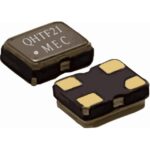 18QHTF21-24.999-OE
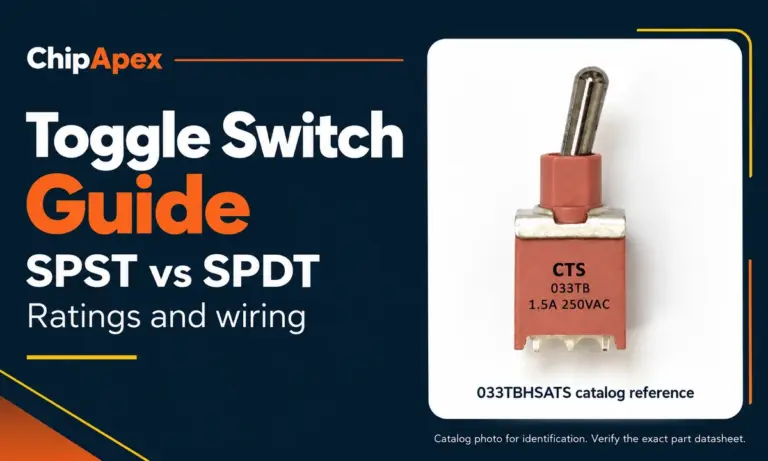
Compare SPST and SPDT toggle switches, understand AC/DC ratings, and follow wiring examples. Check contact action, mounting and parts in the ChipApex catalog.
Read More
Select a bridge rectifier by reverse voltage, capacitor charging current, startup surge and cooling. Work through a stated DC voltage and ripple example.
Read More
18QHTF21-24.999-OE is listed in the Oscillators range at ChipApex. The manufacturer field lists Mercury Electronics Ind. Co. Ltd. Its product description is 24.999 MHz…
Read More
18QHTF21-24.999-OE is listed in the Oscillators range at ChipApex. The manufacturer field lists Mercury Electronics Ind. Co. Ltd. Its product description is 24.999 MHz…
Read More
18QHTF21-24.999-OE is listed in the Oscillators range at ChipApex. The manufacturer field lists Mercury Electronics Ind. Co. Ltd. Its product description is 24.999 MHz…
Read More
18QHTF21-24.999-OE is listed in the Oscillators range at ChipApex. The manufacturer field lists Mercury Electronics Ind. Co. Ltd. Its product description is 24.999 MHz…
Read More
18QHTF21-24.999-OE is listed in the Oscillators range at ChipApex. The manufacturer field lists Mercury Electronics Ind. Co. Ltd. Its product description is 24.999 MHz…
Read More
Learn how a diode conducts, how to identify anode and cathode, and when to choose rectifier, TVS, Zener or photodiode types for a circuit.
Read More
18QHTF21-24.999-OE is listed in the Oscillators range at ChipApex. The manufacturer field lists Mercury Electronics Ind. Co. Ltd. Its product description is 24.999 MHz…
Read More
18QHTF21-24.999-OE is listed in the Oscillators range at ChipApex. The manufacturer field lists Mercury Electronics Ind. Co. Ltd. Its product description is 24.999 MHz…
Read More
18QHTF21-24.999-OE is listed in the Oscillators range at ChipApex. The manufacturer field lists Mercury Electronics Ind. Co. Ltd. Its product description is 24.999 MHz…
Read More
Learn what an integrated circuit is, how ICs work, the main types and the specs to check before choosing a part for your design…
Read More
The activity of extra discounts on wholesale prices is in full swing…
Please fill in your contact information and we will send you the latest wholesale price list.





