 ChipApex | Global Electronic Components Supplier

SEARCH
Search Product
Search Post
— IC芯片 | 连接器 | 传感器 | 被动器件 —
Search productSearch post
— IC芯片 | 连接器 | 传感器 | 被动器件 —
Consult the customer manager about the wholesale price.
consultation hotline:86-132-6715-2157
email:[email protected]
Contact the product manager for consultation. One-stop consultation is available.
Do you want a lower wholesale price? Please send us your inquiry and we will reply immediately.
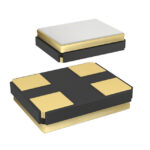
402F16011CJR is listed in the Crystals range at ChipApex. The manufacturer field lists CTS-Frequency Controls. Its product description is CRYSTAL 16.0000MHZ 9PF SMD. Review the specifications below when checking this part for your BOM.
The 402F16011CJR is a surface-mount quartz crystal manufactured by CTS-Frequency Controls. It operates at a fundamental frequency of 16 MHz with a frequency stability and tolerance of ±10ppm. The component features a load capacitance of 9pF and an equivalent series resistance (ESR) of 120 Ohms. It utilizes a 4-SMD, No Lead package with dimensions of 2.00mm x 1.60mm and a maximum height of 0.55mm. The device supports base harmonic operation and functions within a temperature range of -20°C to +70°C.
Verify the specific suffix 'CJR' against official CTS documentation to confirm packaging quantity and tape-and-reel specifications. Ensure the target circuit design matches the 9pF load capacitance requirement. Confirm that the ±10ppm stability meets system requirements across the specified -20°C to +70°C operating range before finalizing procurement.
Select this component when a 16 MHz fundamental frequency crystal is required in a small surface-mount form factor. The 120 Ohm ESR value must be compatible with the oscillator circuit's drive level constraints. Consider the ±10ppm tolerance relative to system clock accuracy needs. Verify that the 4-SMD package fits within the available PCB real estate constraints.
This part belongs to the CTS 402 Series of surface-mount crystals. The series offers various frequencies and packages designed for general-purpose timing applications. The 402F16011CJR specifically addresses the need for a 16 MHz reference in compact electronic designs requiring stable frequency generation within standard industrial temperature limits.
Direct substitutes include 402F16011CAR and 402F16011CDT from CTS-Frequency Controls. These alternatives share identical electrical parameters and mechanical dimensions. Verify package compatibility and RoHS status when swapping between suffix variants.
Explore related parts through Crystals, Oscillators, Resonators, all product categories, ChipApex homepage.
 402F16011CJR

402F16011CJR is listed in the Crystals range at ChipApex. The manufacturer field lists CTS-Frequency Controls. Its product description is CRYSTAL 16.0000MHZ 9PF SMD. Review…
Read More
402F16011CJR is listed in the Crystals range at ChipApex. The manufacturer field lists CTS-Frequency Controls. Its product description is CRYSTAL 16.0000MHZ 9PF SMD. Review…
Read More
402F16011CJR is listed in the Crystals range at ChipApex. The manufacturer field lists CTS-Frequency Controls. Its product description is CRYSTAL 16.0000MHZ 9PF SMD. Review…
Read More
Understand UART protocol framing, baud rate and electrical interfaces. Learn 8N1 timing, TX/RX wiring, buffering and practical troubleshooting steps.
Read More
Understand load cell sensor output, bridge wiring and calibration. Learn how mV/V sensitivity, mechanics and ADC noise affect measurement accuracy.
Read More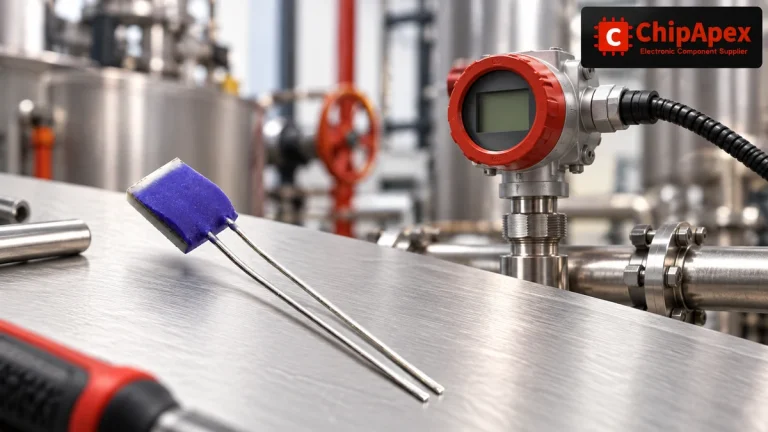
Compare Pt100 and Pt1000 RTDs, two-, three- and four-wire connections, excitation and self-heating. Build an error budget from element to reported temperature.
Read More
Compare RC, crystal and MEMS oscillator circuits. Check ppm, jitter, load capacitance, startup margin and output compatibility before choosing a clock source.
Read More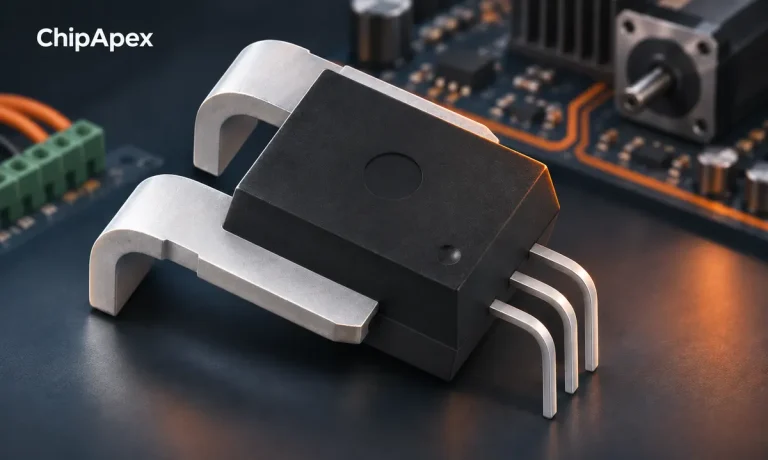
Compare Hall, shunt, current transformer and Rogowski sensing. Check AC/DC capability, accuracy, isolation, heat and response before selecting a sensor.
Read More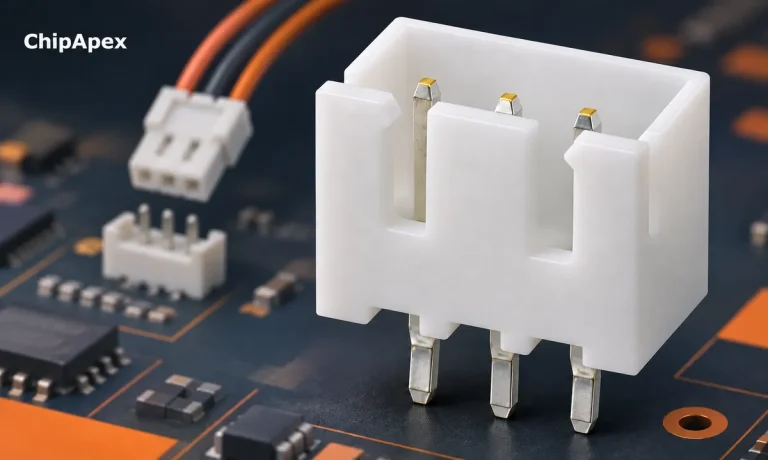
Choose a pin header by pitch, mating geometry, current rating and mounting. Learn why matching pin count and spacing does not guarantee compatibility.
Read More
402F16011CJR is listed in the Crystals range at ChipApex. The manufacturer field lists CTS-Frequency Controls. Its product description is CRYSTAL 16.0000MHZ 9PF SMD. Review…
Read More
402F16011CJR is listed in the Crystals range at ChipApex. The manufacturer field lists CTS-Frequency Controls. Its product description is CRYSTAL 16.0000MHZ 9PF SMD. Review…
Read More
See when an inductor behaves linearly, how DC bias and saturation reduce inductance, and which current and temperature curves to check.
Read More
The activity of extra discounts on wholesale prices is in full swing…
Please fill in your contact information and we will send you the latest wholesale price list.





