 ChipApex | Global Electronic Components Supplier

SEARCH
Search Product
Search Post
— IC芯片 | 连接器 | 传感器 | 被动器件 —
Search productSearch post
— IC芯片 | 连接器 | 传感器 | 被动器件 —
Consult the customer manager about the wholesale price.
consultation hotline:86-132-6715-2157
email:[email protected]
Contact the product manager for consultation. One-stop consultation is available.
Do you want a lower wholesale price? Please send us your inquiry and we will reply immediately.
DST20100C is listed in the Diode Arrays range at ChipApex. The manufacturer field lists Littelfuse Inc.. Its product description is DIODE ARR SCHOT 100V 10A TO220AB. Review the specifications below when checking this part for your BOM.
The Littelfuse DST20100C is a dual Schottky barrier rectifier in a TO-220AB common cathode package. It provides a total average forward current of 20A, with 10A per leg at a case temperature of 120°C. The device features a peak repetitive reverse voltage of 100V and a junction temperature range from -55°C to +150°C. Forward voltage drop reaches a maximum of 0.75V at 10A and 25°C. Thermal resistance from junction to case is 2.8°C/W per leg.
Verify the specific ordering suffix against the manufacturer's official datasheet to confirm the exact packing mode and marking requirements. Confirm that the component meets RoHS compliance standards as specified in the documentation. Ensure thermal management solutions are adequate for the rated junction temperature and thermal resistance parameters during operation.
Select this component for applications requiring low forward voltage drop and high-frequency switching capabilities. The common cathode configuration allows for efficient use in circuits needing two independent rectifying paths. Evaluate the thermal resistance and ambient operating conditions to ensure the junction temperature remains within the specified limits under load.
This part belongs to the Littelfuse DST series of ultra-low voltage Schottky barrier rectifiers. The series is designed to meet commercial and industrial application requirements by offering high temperature performance, low leakage current, and low forward voltage characteristics suitable for modern power electronics.
Consult official Littelfuse substitution guides or cross-reference databases for verified equivalent parts. Ensure any replacement maintains the same electrical ratings, package dimensions, and pinout configuration.
The thermal resistance from junction to case is 2.8°C/W per leg.
The peak one-cycle non-repetitive surge current is 150A per leg for an 8.3ms half-sine pulse.
Yes, the DST20100C is lead-free and RoHS compliant.
Explore related parts through Rectifiers, Diodes, Discrete Semiconductor Products, all product categories.
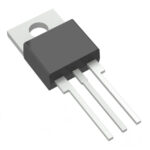 DST20100C
DST20100C is listed in the Diode Arrays range at ChipApex. The manufacturer field lists Littelfuse Inc.. Its product description is DIODE ARR SCHOT 100V…
Read More
DST20100C is listed in the Diode Arrays range at ChipApex. The manufacturer field lists Littelfuse Inc.. Its product description is DIODE ARR SCHOT 100V…
Read More
Compare thermistors, RTDs, thermocouples and temperature ICs. Learn how range, accuracy, response, interfaces and mounting affect component selection.
Read More
DST20100C is listed in the Diode Arrays range at ChipApex. The manufacturer field lists Littelfuse Inc.. Its product description is DIODE ARR SCHOT 100V…
Read More
DST20100C is listed in the Diode Arrays range at ChipApex. The manufacturer field lists Littelfuse Inc.. Its product description is DIODE ARR SCHOT 100V…
Read More
Learn what an integrated circuit is, how ICs work, the main types and the specs to check before choosing a part for your design…
Read More
DST20100C is listed in the Diode Arrays range at ChipApex. The manufacturer field lists Littelfuse Inc.. Its product description is DIODE ARR SCHOT 100V…
Read More
DST20100C is listed in the Diode Arrays range at ChipApex. The manufacturer field lists Littelfuse Inc.. Its product description is DIODE ARR SCHOT 100V…
Read More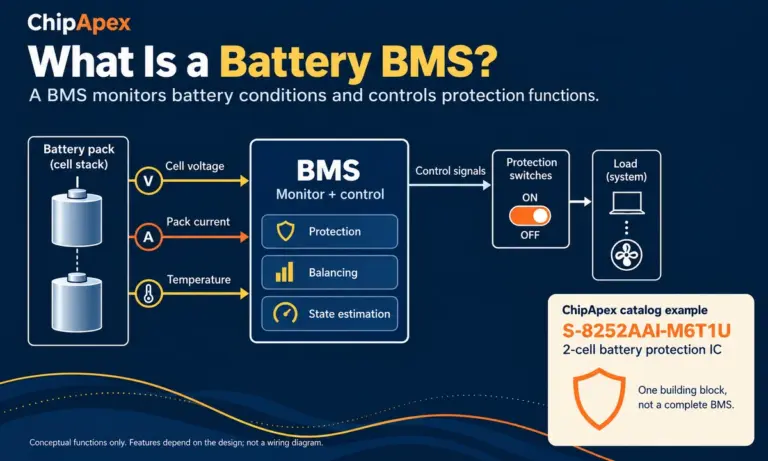
Learn what a battery BMS does, how protection differs from charging, and which pack specifications to check when sourcing BMS components through ChipApex.
Read More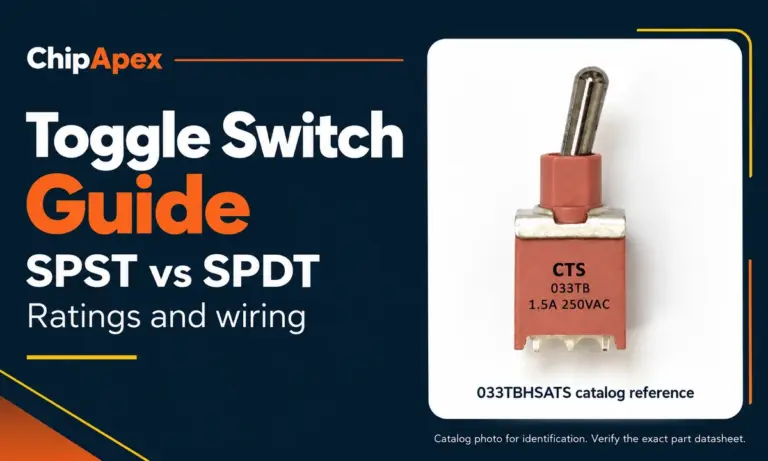
Compare SPST and SPDT toggle switches, understand AC/DC ratings, and follow wiring examples. Check contact action, mounting and parts in the ChipApex catalog.
Read More
DST20100C is listed in the Diode Arrays range at ChipApex. The manufacturer field lists Littelfuse Inc.. Its product description is DIODE ARR SCHOT 100V…
Read More
See when an inductor behaves linearly, how DC bias and saturation reduce inductance, and which current and temperature curves to check.
Read More
The activity of extra discounts on wholesale prices is in full swing…
Please fill in your contact information and we will send you the latest wholesale price list.





