ChipApex | Global Electronic Components Supplier

SEARCH
Search Product
Search Post
— IC芯片 | 连接器 | 传感器 | 被动器件 —
Search productSearch post
— IC芯片 | 连接器 | 传感器 | 被动器件 —
Consult the customer manager about the wholesale price.
consultation hotline:86-132-6715-2157
email:[email protected]
Contact the product manager for consultation. One-stop consultation is available.
Do you want a lower wholesale price? Please send us your inquiry and we will reply immediately.
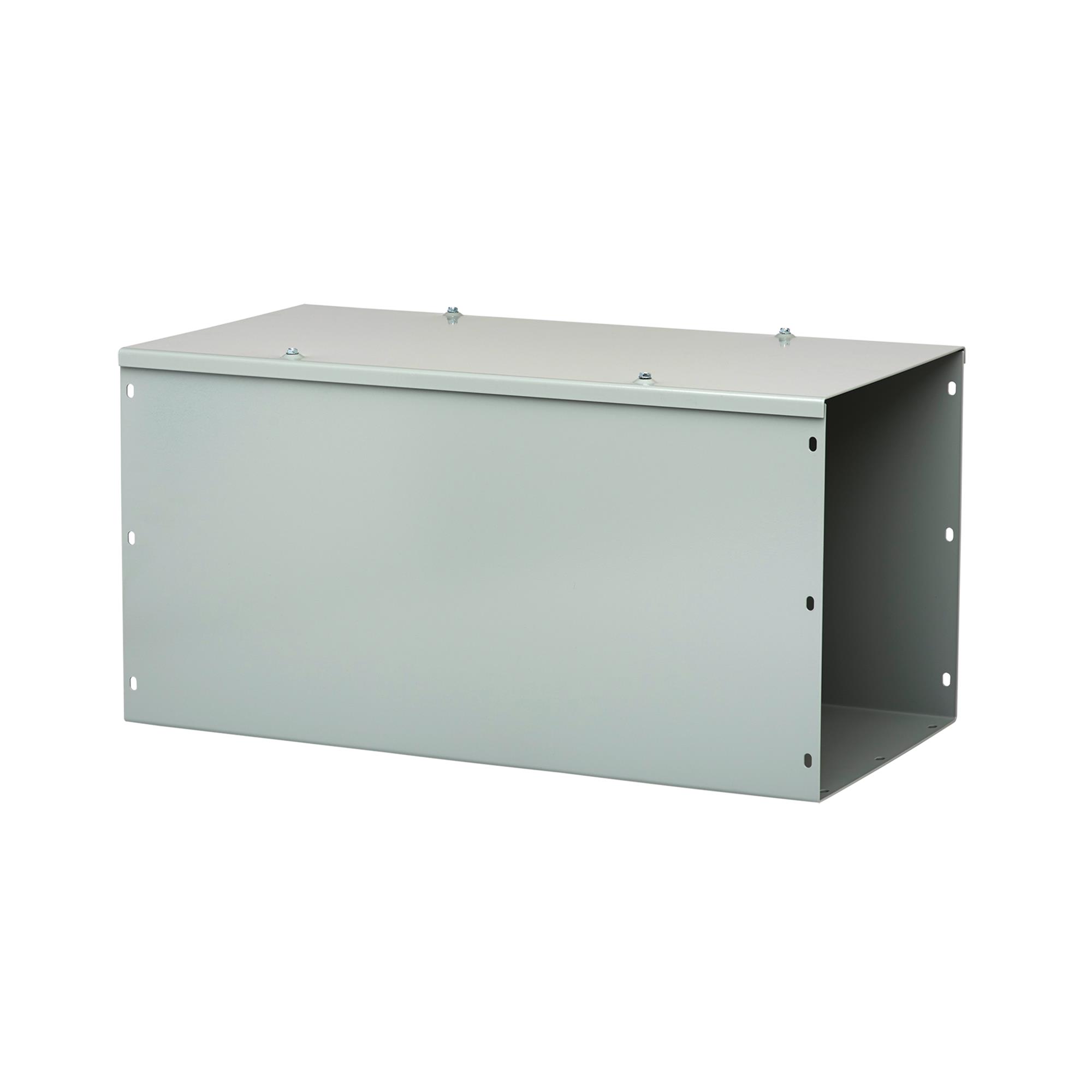
The Hoffman F44G18 is a Type 1 straight section wireway designed for indoor electrical installations. It features a 4-inch by 4-inch cross-section and an 18-inch length. Constructed from 14/16 gauge steel, the unit includes a hinged cover for easy access. The exterior finish is ANSI 61 gray polyester powder paint. This component complies with UL 870 standards and is intended for enclosing wires and cables in raceway runs without pre-punched knockouts.
Verify that the specific order matches the F44G18 part number to ensure the correct 4x4 inch dimensions and 18-inch length. Confirm the requirement for a hinged cover and Type 1 rating aligns with project specifications. Check for UL 870 compliance documentation if required by local codes. Ensure no knockouts are needed, as this model does not include them. Validate material thickness requirements against structural load needs.
Select this model when a straight wireway segment with a hinged cover is required for indoor use. The 4x4 inch size accommodates moderate cable volumes. The lay-in design simplifies installation compared to side-access units. Consider the gray finish for aesthetic consistency in visible areas. Verify that the absence of knockouts meets the entry point requirements for the specific installation site.
This component belongs to the Hoffman NEMA Type 1 wireway family. It serves as a straight section within larger raceway assemblies. The product line offers various lengths and cross-section sizes. The F44G18 specifically addresses applications needing quick cable insertion via a top-hinged mechanism. It complements elbows, tees, and reducers in complete wiring systems.
Direct substitutes must match the 4x4 inch cross-section, 18-inch length, and hinged cover configuration. Verify compatibility with existing mounting hardware and adjacent wireway sections. Ensure the replacement maintains Type 1 protection ratings and UL 870 listing. Cross-reference manufacturer catalogs for equivalent lay-in designs with identical dimensional tolerances.
 F44G18

On September 22nd, it was reported that Samsung Electronics, the South Korean tech giant, had successfully passed NVIDIA’s certification test for its 12-layer HBM3E…
Read More
In the world of electronics, memory components play a critical role in system performance—and DRAM (Dynamic Random-Access Memory) is one of the most widely…
Read More
WILMINGTON, Mass. – August 11, 2026 — Analog Devices, Inc. (NASDAQ: ADI), the global leading supplier of high-performance analog, mixed-signal and digital signal processing…
Read More
Understand RF attenuator dB values, fixed and programmable types, impedance, power limits and noise tradeoffs before choosing parts for an RF signal path.
Read More
The global memory market is entering an unprecedented supply-constrained phase as soaring demand from artificial intelligence (AI) infrastructure collides with strategic capacity reallocations by…
Read More
Understand tactile switches, PCB and keyboard differences, four-pin wiring, debounce, force, travel and replacement checks for reliable control inputs.
Read More
Embedded Integrated Circuit Modules: The Backbone of Modern Technology Embedded Integrated Circuit Modules (EICMs) have become an indispensable part of modern technology. Serving as…
Read More
In an era dominated by AI accelerators with terabytes of HBM memory and consumer devices racing toward LPDDR5X bandwidth, it’s easy to wonder: why…
Read More
See how a MEMS gyroscope measures angular rate, why its angle estimate drifts, and which range, noise, interface and temperature specs to compare.
Read More
Recently, global semiconductor manufacturers have been constantly making moves in aspects such as technological cooperation, product manufacturing processes, and market layout, demonstrating the rapid…
Read More
Learn the relay definition, coil and contact operation, NO and NC forms, load ratings and suppression choices. Compare mechanical, reed and solid-state types.
Read More
Learn how a diode conducts, how to identify anode and cathode, and when to choose rectifier, TVS, Zener or photodiode types for a circuit.
Read More
The activity of extra discounts on wholesale prices is in full swing…
Please fill in your contact information and we will send you the latest wholesale price list.