 ChipApex | Global Electronic Components Supplier

SEARCH
Search Product
Search Post
— IC芯片 | 连接器 | 传感器 | 被动器件 —
Search productSearch post
— IC芯片 | 连接器 | 传感器 | 被动器件 —
Consult the customer manager about the wholesale price.
consultation hotline:86-132-6715-2157
email:[email protected]
Contact the product manager for consultation. One-stop consultation is available.
Do you want a lower wholesale price? Please send us your inquiry and we will reply immediately.
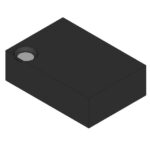
ISL9003AIRUHZ-T is listed in the Voltage Regulators - Linear, Low Drop Out (LDO) Regulators range at ChipApex. The manufacturer field lists Intersil. Its product description is IC REG LIN 2.75V 150MA 6-UTDFN. Review the specifications below when checking this part for your BOM.
The ISL9003AIRUHZ-T is a single-output low dropout regulator from the Intersil ISL9003A series, housed in a 6-lead µTDFN package. It delivers a continuous output current of 150 mA with a fixed output voltage of 1.5 V. The device operates within an input voltage range of 2.3 V to 6.5 V and maintains a typical dropout voltage of 200 mV at full load. It features extremely low quiescent current of 31 µA and high power supply rejection ratio exceeding 90 dB at 1 kHz. The unit ensures stable operation with ceramic capacitors between 1 µF and 4.7 µF and provides accuracy of ±1.8% across the operating temperature range of -40°C to +85°C.
Verify component authenticity through authorized channels due to potential availability constraints. Confirm package marking and datasheet revision alignment during intake inspection. Ensure proper ESD handling protocols are followed given the small form factor. Validate thermal performance under maximum load conditions prior to final assembly integration.
Select this component when a compact single-channel LDO with low noise and high PSRR is required. It is suitable for battery-powered systems where low quiescent current extends operational life. Choose this part over adjustable regulators if a fixed 1.5 V rail is needed. Consider the µTDFN package size constraints against available PCB real estate.
This component belongs to the ISL9003A family of low-noise LDOs designed for portable electronics. It complements other Intersil power management solutions by providing clean voltage rails for sensitive analog and RF circuits. The series emphasizes low standby current and fast transient response capabilities.
Public confirmed substitute part numbers: None identified.
Explore related parts through Power Management (PMIC), Integrated Circuits (ICs), all product categories, ChipApex homepage.
 ISL9003AIRUHZ-T
Learn what data acquisition means, from sensors and conditioning to sampling and storage. Review channel timing, wiring, calibration and data quality.
Read More
Select MOV varistors by continuous voltage, clamping behavior, surge waveform and repetition. Check thermal disconnection, fuse coordination and replacements.
Read More
Compare gas sensor technologies, cross-sensitivity and calibration needs. Define the gas, range and environment before choosing a sensing component.
Read More
Learn how a diode conducts, how to identify anode and cathode, and when to choose rectifier, TVS, Zener or photodiode types for a circuit.
Read More
ISL9003AIRUHZ-T is listed in the Voltage Regulators - Linear, Low Drop Out (LDO) Regulators range at ChipApex. The manufacturer field lists Intersil. Its product…
Read More
ISL9003AIRUHZ-T is listed in the Voltage Regulators - Linear, Low Drop Out (LDO) Regulators range at ChipApex. The manufacturer field lists Intersil. Its product…
Read More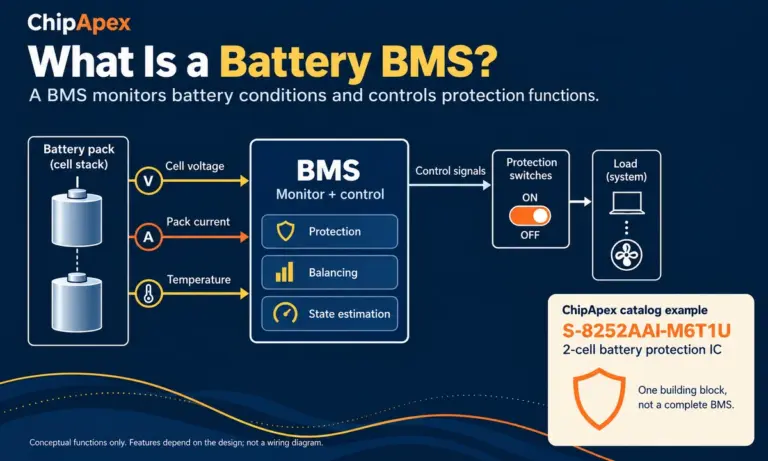
Learn what a battery BMS does, how protection differs from charging, and which pack specifications to check when sourcing BMS components through ChipApex.
Read More
ISL9003AIRUHZ-T is listed in the Voltage Regulators - Linear, Low Drop Out (LDO) Regulators range at ChipApex. The manufacturer field lists Intersil. Its product…
Read More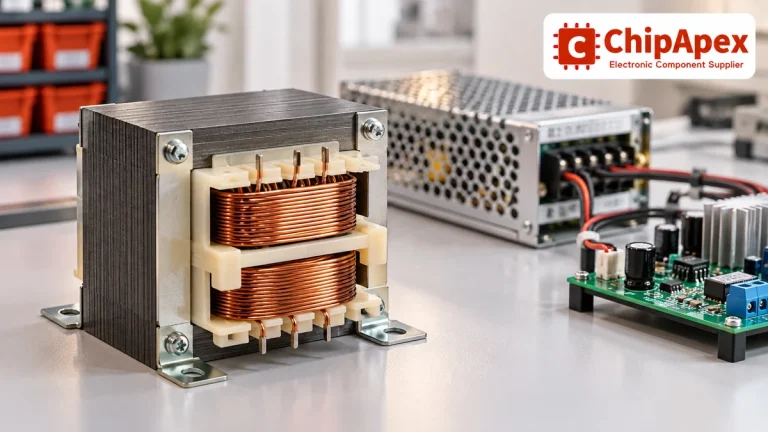
Select power transformers by input frequency, secondary VA, rectifier load, isolation, regulation and inrush. Build a clearer specification for your next RFQ.
Read More
ISL9003AIRUHZ-T is listed in the Voltage Regulators - Linear, Low Drop Out (LDO) Regulators range at ChipApex. The manufacturer field lists Intersil. Its product…
Read More
ISL9003AIRUHZ-T is listed in the Voltage Regulators - Linear, Low Drop Out (LDO) Regulators range at ChipApex. The manufacturer field lists Intersil. Its product…
Read More
Choose a vibration sensor for machine monitoring. Compare sensing methods, bandwidth, noise and mounting, then define the signal-chain requirements.
Read More
The activity of extra discounts on wholesale prices is in full swing…
Please fill in your contact information and we will send you the latest wholesale price list.




