 ChipApex | Global Electronic Components Supplier

SEARCH
Search Product
Search Post
— IC芯片 | 连接器 | 传感器 | 被动器件 —
Search productSearch post
— IC芯片 | 连接器 | 传感器 | 被动器件 —
Consult the customer manager about the wholesale price.
consultation hotline:86-132-6715-2157
email:[email protected]
Contact the product manager for consultation. One-stop consultation is available.
Do you want a lower wholesale price? Please send us your inquiry and we will reply immediately.
ISPLSI 2128VE-180LB208 is listed in the Complex Programmable Logic Devices range at ChipApex. The manufacturer field lists Lattice Semiconductor Corporation. Its product description is IC CPLD 128MC 5NS 208FPBGA. Review the specifications below when checking this part for your BOM.
The ispLSI 2128VE-180LB208 is a high-density, in-system programmable logic device from Lattice Semiconductor. It features 6000 PLD gates, 128 registers, and 128 I/O pins housed in a 208-ball fpBGA package. The device utilizes E2CMOS technology with a maximum operating frequency of 250 MHz and a propagation delay of 4.0 ns. It operates at 3.3V, supports IEEE 1149.1 boundary scan testing, and offers non-volatile reprogrammability via the Boundary Scan TAP.
Verify that the specific ordering suffix LB208 corresponds to the 208-ball fpBGA package variant. Confirm the -180 speed grade matches the required timing constraints for the target design. Ensure compatibility with Lattice Diamond or Radiant software tools for programming and configuration.
Select this device when designs require high pin counts (128 I/Os) and moderate logic density (6000 gates). The -180 speed grade provides a balance between performance and power consumption. Consider the fpBGA package for space-constrained applications requiring robust solder joint reliability.
This component belongs to the ispLSI 2128VE family, which is electrically and pinout compatible with the older ispLSI 2128V series. It serves as a drop-in replacement for legacy designs while offering enhanced in-system programmability and lower voltage operation capabilities.
Direct functional replacements include other variants within the ispLSI 2128VE family, such as the -250 speed grade for higher performance requirements. Legacy equivalents like the ispLSI 2128V are compatible but lack ISP features.
Explore related parts through Embedded, Integrated Circuits (ICs), all product categories, ChipApex homepage.
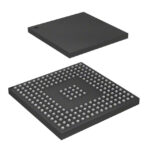 ISPLSI 2128VE-180LB208
ISPLSI 2128VE-180LB208 is listed in the Complex Programmable Logic Devices range at ChipApex. The manufacturer field lists Lattice Semiconductor Corporation. Its product description is…
Read More
ISPLSI 2128VE-180LB208 is listed in the Complex Programmable Logic Devices range at ChipApex. The manufacturer field lists Lattice Semiconductor Corporation. Its product description is…
Read More
Learn why PTC resistance rises with temperature, how it differs from NTC, and which ratings matter for sensing and protection.
Read More
Choose an AC to DC converter by input range, output demand, isolation, efficiency and thermal derating. Compare architectures and check installation needs.
Read More
ISPLSI 2128VE-180LB208 is listed in the Complex Programmable Logic Devices range at ChipApex. The manufacturer field lists Lattice Semiconductor Corporation. Its product description is…
Read More
ISPLSI 2128VE-180LB208 is listed in the Complex Programmable Logic Devices range at ChipApex. The manufacturer field lists Lattice Semiconductor Corporation. Its product description is…
Read More
Select a bridge rectifier by reverse voltage, capacitor charging current, startup surge and cooling. Work through a stated DC voltage and ripple example.
Read More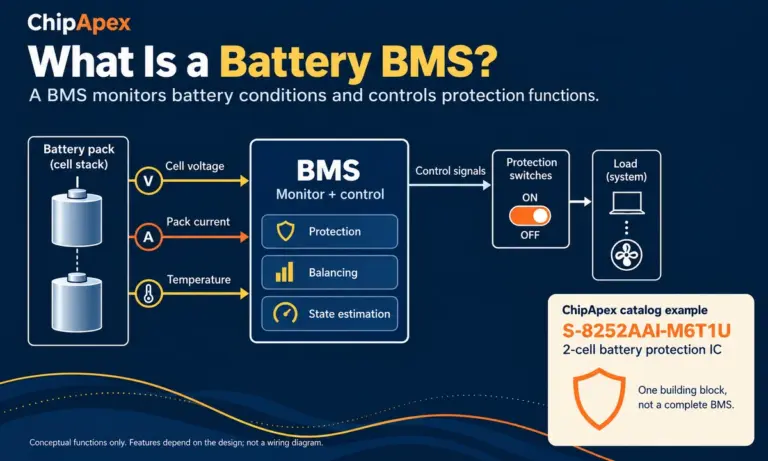
Learn what a battery BMS does, how protection differs from charging, and which pack specifications to check when sourcing BMS components through ChipApex.
Read More
ISPLSI 2128VE-180LB208 is listed in the Complex Programmable Logic Devices range at ChipApex. The manufacturer field lists Lattice Semiconductor Corporation. Its product description is…
Read More
ISPLSI 2128VE-180LB208 is listed in the Complex Programmable Logic Devices range at ChipApex. The manufacturer field lists Lattice Semiconductor Corporation. Its product description is…
Read More
Compare RC, crystal and MEMS oscillator circuits. Check ppm, jitter, load capacitance, startup margin and output compatibility before choosing a clock source.
Read More
Choose a DIP switch by contact type, coded positions, footprint and signal ratings. Check logic polarity, assembly conditions and PCB configuration behavior.
Read More
The activity of extra discounts on wholesale prices is in full swing…
Please fill in your contact information and we will send you the latest wholesale price list.






