 ChipApex | Global Electronic Components Supplier

SEARCH
Search Product
Search Post
— IC芯片 | 连接器 | 传感器 | 被动器件 —
Search productSearch post
— IC芯片 | 连接器 | 传感器 | 被动器件 —
Consult the customer manager about the wholesale price.
consultation hotline:86-132-6715-2157
email:[email protected]
Contact the product manager for consultation. One-stop consultation is available.
Do you want a lower wholesale price? Please send us your inquiry and we will reply immediately.
LM2670SD-ADJ is listed in the Voltage Regulators - DC DC Switching Regulators range at ChipApex. The manufacturer field lists Texas Instruments. Its product description is IC REG BUCK ADJ 3A 14VSON. Review the specifications below when checking this part for your BOM.
The LM2670SD-ADJ/NOPB is a SIMPLE SWITCHER high-efficiency 3A step-down voltage regulator from Texas Instruments. It operates with an input voltage range of 8V to 40V and provides an adjustable output voltage between 1.2V and 37V. The device features a fixed switching frequency of 260kHz and includes internal compensation for minimal external component requirements. It utilizes a 14-pin VSON package and supports operation temperatures from -40°C to +125°C.
Verify the complete part number suffix, specifically /NOPB, to confirm lead-free compliance and specific packaging configuration. Confirm the 'SD' suffix corresponds to the 14-VSON package variant rather than other package options within the LM2670 family. Cross-reference the manufacturer datasheet revision to ensure compatibility with current design specifications.
Select this component when a 3A continuous output current is required from an 8V to 40V input source. The adjustable output version allows flexibility in setting the target voltage via external resistors. Ensure the application requires synchronous rectification for higher efficiency compared to non-synchronous buck converters in similar current ranges.
This component belongs to the LM267x SIMPLE SWITCHER family of monolithic DC-DC converters. It shares architectural similarities with the LM2673 and LM2679 but is distinguished by its 3A current rating and integrated synchronous rectifier. The family is designed for high-efficiency step-down conversion with minimal external circuitry.
LM2670SDX-ADJ/NOPB is the reel-packaged equivalent of the tube variant. LM2670SD-ADJ without the NOPB suffix indicates older manufacturing versions which may differ in RoHS compliance.
Explore related parts through Power Management (PMIC), Integrated Circuits (ICs), all product categories, ChipApex homepage.
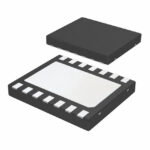 LM2670SD-ADJ

LM2670SD-ADJ is listed in the Voltage Regulators - DC DC Switching Regulators range at ChipApex. The manufacturer field lists Texas Instruments. Its product description…
Read More
Compare RC, crystal and MEMS oscillator circuits. Check ppm, jitter, load capacitance, startup margin and output compatibility before choosing a clock source.
Read More
Compare Pt100 and Pt1000 RTDs, two-, three- and four-wire connections, excitation and self-heating. Build an error budget from element to reported temperature.
Read More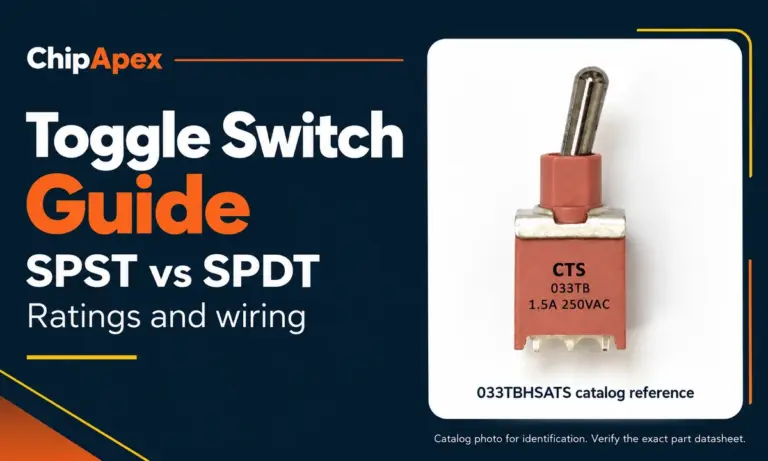
Compare SPST and SPDT toggle switches, understand AC/DC ratings, and follow wiring examples. Check contact action, mounting and parts in the ChipApex catalog.
Read More
LM2670SD-ADJ is listed in the Voltage Regulators - DC DC Switching Regulators range at ChipApex. The manufacturer field lists Texas Instruments. Its product description…
Read More
LM2670SD-ADJ is listed in the Voltage Regulators - DC DC Switching Regulators range at ChipApex. The manufacturer field lists Texas Instruments. Its product description…
Read More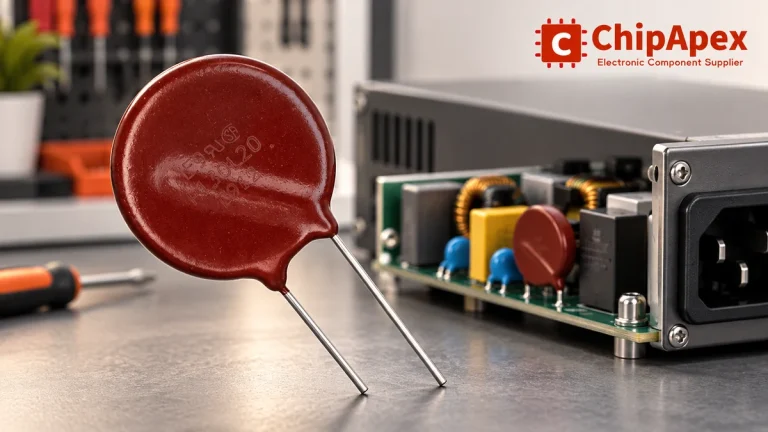
Select MOV varistors by continuous voltage, clamping behavior, surge waveform and repetition. Check thermal disconnection, fuse coordination and replacements.
Read More
LM2670SD-ADJ is listed in the Voltage Regulators - DC DC Switching Regulators range at ChipApex. The manufacturer field lists Texas Instruments. Its product description…
Read More
LM2670SD-ADJ is listed in the Voltage Regulators - DC DC Switching Regulators range at ChipApex. The manufacturer field lists Texas Instruments. Its product description…
Read More
LM2670SD-ADJ is listed in the Voltage Regulators - DC DC Switching Regulators range at ChipApex. The manufacturer field lists Texas Instruments. Its product description…
Read More
See how a MEMS gyroscope measures angular rate, why its angle estimate drifts, and which range, noise, interface and temperature specs to compare.
Read More
Learn why PTC resistance rises with temperature, how it differs from NTC, and which ratings matter for sensing and protection.
Read More
The activity of extra discounts on wholesale prices is in full swing…
Please fill in your contact information and we will send you the latest wholesale price list.





