 ChipApex | Global Electronic Components Supplier

SEARCH
Search Product
Search Post
— IC芯片 | 连接器 | 传感器 | 被动器件 —
Search productSearch post
— IC芯片 | 连接器 | 传感器 | 被动器件 —
Consult the customer manager about the wholesale price.
consultation hotline:86-132-6715-2157
email:[email protected]
Contact the product manager for consultation. One-stop consultation is available.
Do you want a lower wholesale price? Please send us your inquiry and we will reply immediately.
M2S150T-1FCG1152I is listed in the Soc System On Chip range at ChipApex. The manufacturer field lists Microchip Technology. Its product description is IC SOC CORTEX-M3 166MHZ 1152BGA. Review the specifications below when checking this part for your BOM.
The M2S150T-1FCG1152I is a SmartFusion 2 System-on-Chip FPGA manufactured by Microchip Technology. It integrates an ARM Cortex-M3 microcontroller subsystem with a 150K logic element FPGA fabric. The device operates within a junction temperature range of -40°C to 100°C and utilizes a 1152-pin FCBGA package. Key electrical specifications include a DC core supply voltage (VDD) ranging from 1.14 V to 1.26 V, with a typical value of 1.2 V. Power supplies for charge pumps (VPP/VPPNVM) operate between 3.15 V and 3.45 V.
Verify the specific suffix 'I' confirms the industrial temperature grade (-40°C to 100°C). Confirm the package designation 'FCG1152' matches the required 1152-pin FCBGA footprint. Ensure design compliance with the recommended operating conditions for VDD and VPP voltages specified in the datasheet.
Select this model when both MCU capabilities and high-density FPGA logic are required. Compare against the M2GL150 series if the ARM Cortex-M3 subsystem is unnecessary. Verify that the 1152-pin package fits the board layout constraints and thermal requirements for the intended application environment.
This component belongs to the SmartFusion 2 family, which combines flash-based FPGA technology with a hard ARM Cortex-M3 core. It is designed for applications requiring low power consumption, high security, and real-time processing capabilities within a single chip architecture.
M2S150T-1FC1152I: Same density and package, different speed grade or temperature rating.
The maximum junction temperature for the M2S150T-1FCG1152I is 100°C, as it is rated for the industrial temperature grade.
Yes, the 'M2S' prefix indicates it is a SmartFusion 2 SoC FPGA, which integrates an ARM Cortex-M3 microcontroller subsystem.
The typical DC core supply voltage (VDD) is 1.2 V, with an allowable range of 1.14 V to 1.26 V.
Explore related parts through Embedded, Integrated Circuits (ICs), all product categories, ChipApex homepage.
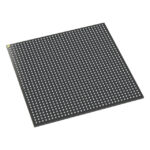 M2S150T-1FCG1152I

Learn why PTC resistance rises with temperature, how it differs from NTC, and which ratings matter for sensing and protection.
Read More
See how a MEMS gyroscope measures angular rate, why its angle estimate drifts, and which range, noise, interface and temperature specs to compare.
Read More
M2S150T-1FCG1152I is listed in the Soc System On Chip range at ChipApex. The manufacturer field lists Microchip Technology. Its product description is IC SOC…
Read More
Choose a DIP switch by contact type, coded positions, footprint and signal ratings. Check logic polarity, assembly conditions and PCB configuration behavior.
Read More
M2S150T-1FCG1152I is listed in the Soc System On Chip range at ChipApex. The manufacturer field lists Microchip Technology. Its product description is IC SOC…
Read More
M2S150T-1FCG1152I is listed in the Soc System On Chip range at ChipApex. The manufacturer field lists Microchip Technology. Its product description is IC SOC…
Read More
M2S150T-1FCG1152I is listed in the Soc System On Chip range at ChipApex. The manufacturer field lists Microchip Technology. Its product description is IC SOC…
Read More
M2S150T-1FCG1152I is listed in the Soc System On Chip range at ChipApex. The manufacturer field lists Microchip Technology. Its product description is IC SOC…
Read More
M2S150T-1FCG1152I is listed in the Soc System On Chip range at ChipApex. The manufacturer field lists Microchip Technology. Its product description is IC SOC…
Read More
M2S150T-1FCG1152I is listed in the Soc System On Chip range at ChipApex. The manufacturer field lists Microchip Technology. Its product description is IC SOC…
Read More
Learn what an IMU measures, how accelerometers and gyroscopes work together, why orientation estimates drift, and what to compare.
Read More
Compare RC, crystal and MEMS oscillator circuits. Check ppm, jitter, load capacitance, startup margin and output compatibility before choosing a clock source.
Read More
The activity of extra discounts on wholesale prices is in full swing…
Please fill in your contact information and we will send you the latest wholesale price list.




