 ChipApex | Global Electronic Components Supplier

SEARCH
Search Product
Search Post
— IC芯片 | 连接器 | 传感器 | 被动器件 —
Search productSearch post
— IC芯片 | 连接器 | 传感器 | 被动器件 —
Consult the customer manager about the wholesale price.
consultation hotline:86-132-6715-2157
email:[email protected]
Contact the product manager for consultation. One-stop consultation is available.
Do you want a lower wholesale price? Please send us your inquiry and we will reply immediately.
MCP111-290E/TO is listed in the Supervisors range at ChipApex. The manufacturer field lists Microchip Technology. Its product description is IC SUPERVISOR 1 CHANNEL TO92-3. Review the specifications below when checking this part for your BOM.
The MCP111-290E/TO is a micropower voltage supervisor manufactured by Microchip Technology. It operates within a supply voltage range of 1V to 5.5V and features a typical reset threshold of 2.93V. The device draws a maximum steady-state supply current of 1.75µA. It provides an active-low, open-drain reset output with a typical delay timer of 120ms. Designed for through-hole mounting, it is housed in a TO-92 package and supports an extended operating temperature range from -40°C to +125°C.
Verify the specific suffix 'TOG' or 'TO' against the manufacturer's datasheet to confirm pinout compatibility and lead-free status. Ensure the selected variant matches the required threshold voltage tolerance and package type for your PCB layout. Confirm AEC-Q100 qualification if automotive reliability standards are mandatory for the target application environment.
Select this component when a simple, low-cost voltage monitor is needed without manual reset or watchdog functionality. Compare the 2.93V threshold against the minimum acceptable logic high level of the downstream microcontroller. Consider the TO-92 package constraints versus surface-mount alternatives like SOT-23 if board space is limited. Verify that the 1.75µA current draw meets strict standby power budgets.
This part belongs to the MCP111 family of micropower voltage supervisors. The series offers various fixed threshold voltages including 1.90V, 2.32V, 2.63V, 2.93V, 3.08V, 4.38V, and 4.63V. Other variants in the family include MCP102, MCP103, MCP121, and MCP131, which differ primarily in output drive strength and internal pull-up configurations.
Compatible substitutes within the same family include MCP111-263E/TO (2.63V threshold) and MCP111-308E/TO (3.08V threshold). Cross-family replacements such as the MCP102 or MCP121 may be used if push-pull outputs or internal pull-ups are preferred, provided the package and electrical characteristics align with the design requirements.
Explore related parts through Power Management (PMIC), Integrated Circuits (ICs), all product categories, ChipApex homepage.
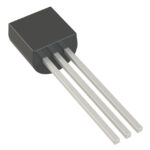 MCP111-290E/TO
MCP111-290E/TO is listed in the Supervisors range at ChipApex. The manufacturer field lists Microchip Technology. Its product description is IC SUPERVISOR 1 CHANNEL TO92-3.…
Read More
MCP111-290E/TO is listed in the Supervisors range at ChipApex. The manufacturer field lists Microchip Technology. Its product description is IC SUPERVISOR 1 CHANNEL TO92-3.…
Read More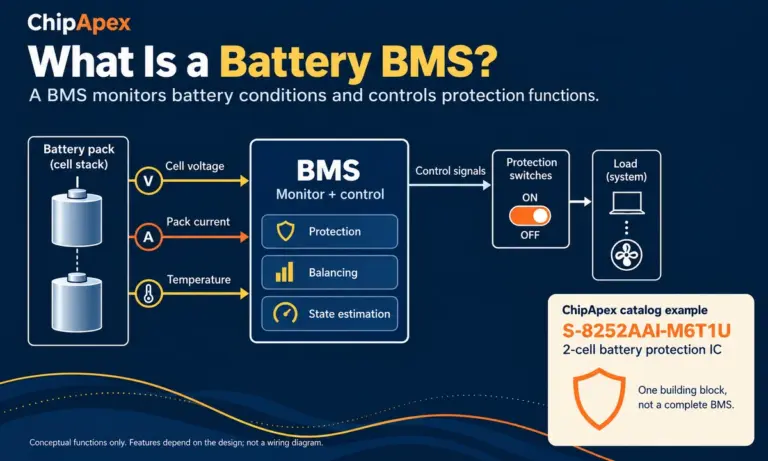
Learn what a battery BMS does, how protection differs from charging, and which pack specifications to check when sourcing BMS components through ChipApex.
Read More
Learn how a pressure transducer converts pressure into voltage, current, or digital output, and compare pressure references and key selection specs.
Read More
MCP111-290E/TO is listed in the Supervisors range at ChipApex. The manufacturer field lists Microchip Technology. Its product description is IC SUPERVISOR 1 CHANNEL TO92-3.…
Read More
MCP111-290E/TO is listed in the Supervisors range at ChipApex. The manufacturer field lists Microchip Technology. Its product description is IC SUPERVISOR 1 CHANNEL TO92-3.…
Read More
Compare Pt100 and Pt1000 RTDs, two-, three- and four-wire connections, excitation and self-heating. Build an error budget from element to reported temperature.
Read More
MCP111-290E/TO is listed in the Supervisors range at ChipApex. The manufacturer field lists Microchip Technology. Its product description is IC SUPERVISOR 1 CHANNEL TO92-3.…
Read More
MCP111-290E/TO is listed in the Supervisors range at ChipApex. The manufacturer field lists Microchip Technology. Its product description is IC SUPERVISOR 1 CHANNEL TO92-3.…
Read More
Choose a DIP switch by contact type, coded positions, footprint and signal ratings. Check logic polarity, assembly conditions and PCB configuration behavior.
Read More
Learn why PTC resistance rises with temperature, how it differs from NTC, and which ratings matter for sensing and protection.
Read More
Understand how a comparator switches at a voltage threshold, why hysteresis prevents chatter, and which output and input specs matter.
Read More
The activity of extra discounts on wholesale prices is in full swing…
Please fill in your contact information and we will send you the latest wholesale price list.





