 ChipApex | Global Electronic Components Supplier

SEARCH
Search Product
Search Post
— IC芯片 | 连接器 | 传感器 | 被动器件 —
Search productSearch post
— IC芯片 | 连接器 | 传感器 | 被动器件 —
Consult the customer manager about the wholesale price.
consultation hotline:86-132-6715-2157
email:[email protected]
Contact the product manager for consultation. One-stop consultation is available.
Do you want a lower wholesale price? Please send us your inquiry and we will reply immediately.
NCA9595PW-Q100J is listed in the I/o Expanders range at ChipApex. The manufacturer field lists Nexperia USA Inc.. Its product description is I2C. Review the specifications below when checking this part for your BOM.
The NCA9595PW-Q100J is a low-voltage 16-bit I/O expander designed for I²C-bus and SMBus applications. It provides General Purpose Input/Output expansion with an interrupt output, configuration registers, and programmable pull-up resistors. The device operates within a wide voltage range of 1.65 V to 5.5 V and supports Fast-mode communication up to 400 kHz. It features Schmitt-trigger inputs, noise filters, and 5 V tolerant I/Os. Packaged in a TSSOP24 (SOT355-1) format, it is qualified to AEC-Q100 Grade 1 standards for automotive use across temperatures from -40 °C to +125 °C.
Verify the component matches the specific Nexperia part number NCA9595PW-Q100J. Confirm the package type is TSSOP24 and that the device holds valid AEC-Q100 Grade 1 certification. Ensure the operating temperature range meets the required -40 °C to +125 °C specification for the intended application environment.
Select this component when expanding microcontroller I/O capacity via I²C or SMBus interfaces is required. It is suitable for designs needing configurable pull-ups and interrupt-driven input monitoring. Consider its 5 V tolerance if interfacing with higher voltage logic levels while maintaining a lower core supply voltage.
This device belongs to the Nexperia NCA9595-Q100 series of low-voltage I/O expanders. It is specifically engineered for automotive electronics, offering robust performance under varying thermal conditions. The product integrates multiple configuration registers to manage input/output directions and polarity inversion efficiently.
Direct substitutes include other Nexperia I/O expanders within the same family that share identical pinouts and register maps. Verify compatibility regarding the TSSOP24 package dimensions and the specific AEC-Q100 grade requirements before substitution.
At power-on reset, all I/O pins default to high-impedance input states. The internal pull-up resistors are enabled by default but can be disabled via the configuration pull-up registers.
The slave address is determined by three hardware address pins: A0, A1, and A2. These pins can be connected to VCC or GND to select one of eight possible addresses.
No. An interrupt is generated only by rising or falling edges of port inputs when they are configured in Input mode. Changing an I/O from output to input may cause false interrupts if the pin state does not match the input register.
Explore related parts through Interface, Integrated Circuits (ICs), all product categories, ChipApex homepage.
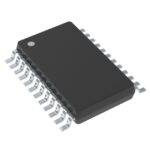 NCA9595PW-Q100J
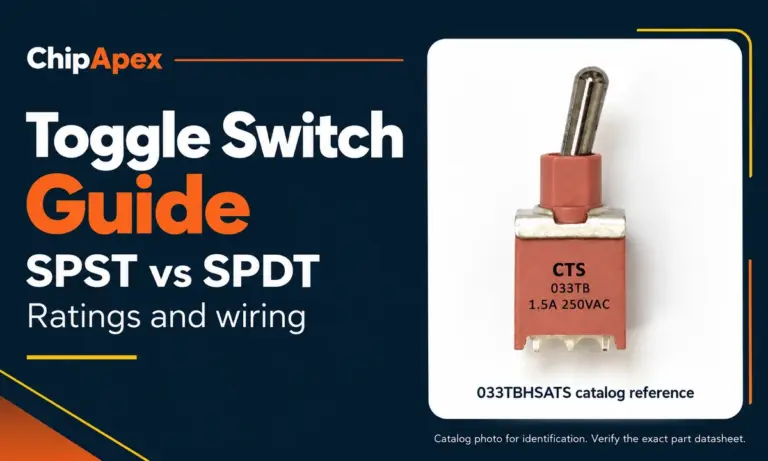
Compare SPST and SPDT toggle switches, understand AC/DC ratings, and follow wiring examples. Check contact action, mounting and parts in the ChipApex catalog.
Read More
NCA9595PW-Q100J is listed in the I/o Expanders range at ChipApex. The manufacturer field lists Nexperia USA Inc.. Its product description is I2C. Review the…
Read More
NCA9595PW-Q100J is listed in the I/o Expanders range at ChipApex. The manufacturer field lists Nexperia USA Inc.. Its product description is I2C. Review the…
Read More
NCA9595PW-Q100J is listed in the I/o Expanders range at ChipApex. The manufacturer field lists Nexperia USA Inc.. Its product description is I2C. Review the…
Read More
NCA9595PW-Q100J is listed in the I/o Expanders range at ChipApex. The manufacturer field lists Nexperia USA Inc.. Its product description is I2C. Review the…
Read More
Learn why PTC resistance rises with temperature, how it differs from NTC, and which ratings matter for sensing and protection.
Read More
NCA9595PW-Q100J is listed in the I/o Expanders range at ChipApex. The manufacturer field lists Nexperia USA Inc.. Its product description is I2C. Review the…
Read More
NCA9595PW-Q100J is listed in the I/o Expanders range at ChipApex. The manufacturer field lists Nexperia USA Inc.. Its product description is I2C. Review the…
Read More
NCA9595PW-Q100J is listed in the I/o Expanders range at ChipApex. The manufacturer field lists Nexperia USA Inc.. Its product description is I2C. Review the…
Read More
NCA9595PW-Q100J is listed in the I/o Expanders range at ChipApex. The manufacturer field lists Nexperia USA Inc.. Its product description is I2C. Review the…
Read More
NCA9595PW-Q100J is listed in the I/o Expanders range at ChipApex. The manufacturer field lists Nexperia USA Inc.. Its product description is I2C. Review the…
Read More
Learn how a diode conducts, how to identify anode and cathode, and when to choose rectifier, TVS, Zener or photodiode types for a circuit.
Read More
The activity of extra discounts on wholesale prices is in full swing…
Please fill in your contact information and we will send you the latest wholesale price list.





