 ChipApex | Global Electronic Components Supplier

SEARCH
Search Product
Search Post
— IC芯片 | 连接器 | 传感器 | 被动器件 —
Search productSearch post
— IC芯片 | 连接器 | 传感器 | 被动器件 —
Consult the customer manager about the wholesale price.
consultation hotline:86-132-6715-2157
email:[email protected]
Contact the product manager for consultation. One-stop consultation is available.
Do you want a lower wholesale price? Please send us your inquiry and we will reply immediately.
NX5DV330DS,112 is listed in the Analog Switches - Special Purpose range at ChipApex. The manufacturer field lists NXP USA Inc.. Its product description is IC VIDEO MUX/DEMUX 1X2 16SSOP. Review the specifications below when checking this part for your BOM.
The NX5DV330DS,112 is a quad 1-of-2 high-speed TTL-compatible video multiplexer/demultiplexer manufactured by NXP Semiconductors. It operates within a supply voltage range of 4.0 V to 5.5 V and supports an ambient temperature range from −40 °C to +85 °C. The device features four independent input/output ports (nY0, nY1) and a common port (nZ), controlled by a digital select input (S) and an active LOW enable input (E). Key electrical parameters include a maximum ON resistance of 10 Ω at 5.5 V, a typical turn-on time of 4.0 ns, and a maximum turn-off time of 6.0 ns. The component is housed in a 16-lead SSOP plastic shrink small outline package with a body width of 3.9 mm and a lead pitch of 0.635 mm.
Verify the specific ordering suffix
Select this component when a quad 1-of-2 video switch with low ON resistance and minimal propagation delay is required. Ensure the design accommodates the 16-lead SSOP package dimensions and operates within the specified 4.0 V to 5.5 V supply voltage range. Verify that the application requires TTL-compatible logic levels and can handle the specified thermal derating characteristics above 60 °C.
The NX5DV330 series includes variants such as NX5DV330D (SO16), NX5DV330PW (TSSOP16), and NX5DV330BQ (DHVQFN16). These parts share identical functional specifications but differ in package type and physical footprint. The DS suffix specifically denotes the SSOP16 package variant, which offers a compact form factor suitable for space-constrained printed circuit board designs compared to the wider SO16 option.
Direct pin-to-pin replacements within the same family include NX5DV330D,112 and NX5DV330PW,112. Verify package compatibility before substitution. Other manufacturers' quad video switches may require schematic redesign due to differing pinouts or electrical characteristics.
Explore related parts through Interface, Integrated Circuits (ICs), all product categories, ChipApex homepage.
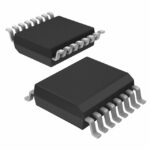 NX5DV330DS,112
NX5DV330DS,112 is listed in the Analog Switches - Special Purpose range at ChipApex. The manufacturer field lists NXP USA Inc.. Its product description is…
Read More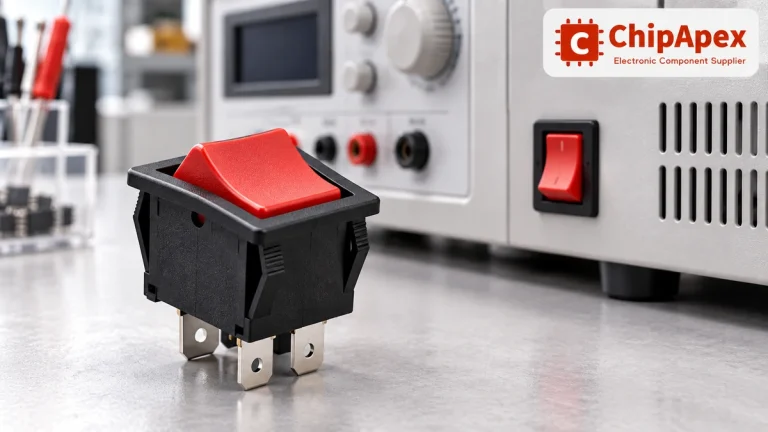
Choose a rocker switch by AC/DC ratings, contact arrangement, illumination, panel fit and sealing. Get practical checks for engineering and component sourcing.
Read More
NX5DV330DS,112 is listed in the Analog Switches - Special Purpose range at ChipApex. The manufacturer field lists NXP USA Inc.. Its product description is…
Read More
NX5DV330DS,112 is listed in the Analog Switches - Special Purpose range at ChipApex. The manufacturer field lists NXP USA Inc.. Its product description is…
Read More
Understand how a comparator switches at a voltage threshold, why hysteresis prevents chatter, and which output and input specs matter.
Read More
NX5DV330DS,112 is listed in the Analog Switches - Special Purpose range at ChipApex. The manufacturer field lists NXP USA Inc.. Its product description is…
Read More
See how a MEMS gyroscope measures angular rate, why its angle estimate drifts, and which range, noise, interface and temperature specs to compare.
Read More
Learn how a JFET works and how to compare bias, leakage, noise and pinout. Review practical selection questions for high-impedance analog circuits.
Read More
NX5DV330DS,112 is listed in the Analog Switches - Special Purpose range at ChipApex. The manufacturer field lists NXP USA Inc.. Its product description is…
Read More
Understand thermal fuse operation, Tf, Th and Tm, electrical ratings and mounting. Check temperature limits and replacement requirements for your design.
Read More
NX5DV330DS,112 is listed in the Analog Switches - Special Purpose range at ChipApex. The manufacturer field lists NXP USA Inc.. Its product description is…
Read More
Learn what an IMU measures, how accelerometers and gyroscopes work together, why orientation estimates drift, and what to compare.
Read More
The activity of extra discounts on wholesale prices is in full swing…
Please fill in your contact information and we will send you the latest wholesale price list.





