 ChipApex | Global Electronic Components Supplier

SEARCH
Search Product
Search Post
— IC芯片 | 连接器 | 传感器 | 被动器件 —
Search productSearch post
— IC芯片 | 连接器 | 传感器 | 被动器件 —
Consult the customer manager about the wholesale price.
consultation hotline:86-132-6715-2157
email:[email protected]
Contact the product manager for consultation. One-stop consultation is available.
Do you want a lower wholesale price? Please send us your inquiry and we will reply immediately.
PZS1127BES_R1_00001 is listed in the Single Zener Diodes range at ChipApex. The manufacturer field lists Panjit International Inc.. Its product description is DIODE ZENER 27V 150MW SOD523. Review the specifications below when checking this part for your BOM.
The PZS1127BES_R1_00001 is a silicon Zener diode manufactured by Panjit International Inc. in the SOD-523 surface-mount package. It features a nominal Zener voltage of 27 V with a tolerance range of 25.7 V to 28.4 V at a test current of 0.05 mA. The device supports a maximum power dissipation of 150 mW and operates within a junction temperature range of -55°C to +150°C. Maximum reverse leakage current is specified as 0.01 µA at a reverse voltage of 20.4 V.
Verify the specific part number against official manufacturer documentation to confirm electrical tolerances and thermal characteristics. Ensure compatibility with standard SOD-523 footprint layouts during PCB design. Confirm compliance with environmental directives relevant to the target deployment region before finalizing procurement specifications.
Select this component when a precise 27 V reference is required in space-constrained designs utilizing the SOD-523 form factor. Evaluate the low leakage current specification for high-impedance circuit requirements. Consider the thermal resistance parameters for heat dissipation management in densely packed assemblies.
This component belongs to the PZS11xxxBES series, which encompasses various Zener voltage options ranging from 3.9 V to 43 V. All variants share identical mechanical dimensions, packaging configurations, and general electrical characteristics defined by the series datasheet. The suffix indicates reel packaging for automated surface-mount assembly processes.
Substitute parts must match the 27 V nominal Zener voltage, SOD-523 package type, and 150 mW power rating. Verify that alternative manufacturers provide equivalent leakage current limits and thermal resistance values to ensure circuit performance parity.
Explore related parts through Zener, Diodes, Discrete Semiconductor Products, all product categories.
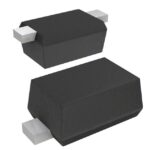 PZS1127BES_R1_00001
Choose an ADC converter by resolution, sample rate, noise and input design. Review practical tradeoffs and prepare component requirements for ChipApex.
Read More
Learn how a diode conducts, how to identify anode and cathode, and when to choose rectifier, TVS, Zener or photodiode types for a circuit.
Read More
PZS1127BES_R1_00001 is listed in the Single Zener Diodes range at ChipApex. The manufacturer field lists Panjit International Inc.. Its product description is DIODE ZENER…
Read More
Compare Pt100 and Pt1000 RTDs, two-, three- and four-wire connections, excitation and self-heating. Build an error budget from element to reported temperature.
Read More
Learn how to use ferrite beads for noise filtering. Check impedance, DC bias, placement, resonance and load-step behavior before selecting a part.
Read More
PZS1127BES_R1_00001 is listed in the Single Zener Diodes range at ChipApex. The manufacturer field lists Panjit International Inc.. Its product description is DIODE ZENER…
Read More
Learn what an IMU measures, how accelerometers and gyroscopes work together, why orientation estimates drift, and what to compare.
Read More
PZS1127BES_R1_00001 is listed in the Single Zener Diodes range at ChipApex. The manufacturer field lists Panjit International Inc.. Its product description is DIODE ZENER…
Read More
Understand voltage controlled oscillator tuning, phase noise and PLL operation. Check supply noise, output loading and requirements before selection.
Read More
Learn how a JFET works and how to compare bias, leakage, noise and pinout. Review practical selection questions for high-impedance analog circuits.
Read More
PZS1127BES_R1_00001 is listed in the Single Zener Diodes range at ChipApex. The manufacturer field lists Panjit International Inc.. Its product description is DIODE ZENER…
Read More
Learn how a TRIAC switches AC loads. Understand triggering, latching, holding current, phase control and thermal limits before choosing a component.
Read More
The activity of extra discounts on wholesale prices is in full swing…
Please fill in your contact information and we will send you the latest wholesale price list.




