 ChipApex | Global Electronic Components Supplier

SEARCH
Search Product
Search Post
— IC芯片 | 连接器 | 传感器 | 被动器件 —
Search productSearch post
— IC芯片 | 连接器 | 传感器 | 被动器件 —
Consult the customer manager about the wholesale price.
consultation hotline:86-132-6715-2157
email:[email protected]
Contact the product manager for consultation. One-stop consultation is available.
Do you want a lower wholesale price? Please send us your inquiry and we will reply immediately.
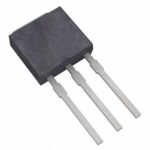
Q8006VH3 is listed in the Triacs range at ChipApex. The manufacturer field lists Littelfuse Inc.. Its product description is TRIAC ALTERNISTOR 800V 6A TO251. Review the specifications below when checking this part for your BOM.
The Q8006VH3 is an Alternistor TRIAC manufactured by Littelfuse Inc., designed for high-reliability applications. It features a maximum off-state voltage of 800 V and an on-state RMS current rating of 6 A. The device is housed in a TO-251AA (VPAK-3) plastic package with three pins, classified as R-PSIP-T3. Key electrical parameters include a gate trigger voltage maximum of 1.3 V and a gate trigger current maximum of 10 mA. The holding current is specified at 15 mA, with critical rates of rise for commutation voltage at 20 V/us and off-state voltage at 50 V/us.
Verify the component authenticity through official Littelfuse channels or authorized distributors. Confirm the specific ordering suffix matches the required package and compliance specifications. Ensure the received part number corresponds exactly to Q8006VH3 to avoid functional mismatches. Check datasheet revisions for any updates to mechanical dimensions or electrical characteristics prior to integration.
Select this component when an 800 V blocking voltage and 6 A continuous current handling are required. The snubberless feature reduces external component count compared to standard TRIACs. Consider the TO-251AA package for through-hole mounting constraints. Evaluate thermal management requirements based on the 6 A RMS rating and ambient operating conditions.
This device belongs to the Alternistor family of TRIACs, which are optimized for snubberless operation. It serves as a power switching element in AC control applications. The manufacturer Littelfuse Inc. produces this series for industrial and consumer electronics markets requiring robust thyristor solutions.
Public confirmed substitute part numbers include Q8006VH4TP. Verify pinout compatibility and electrical ratings before substitution.
The maximum DC gate trigger voltage is 1.3 V.
No, it is designed as a snubberless Alternistor TRIAC.
Explore related parts through Thyristors, Discrete Semiconductor Products, all product categories, ChipApex homepage.
 Q8006VH3

Q8006VH3 is listed in the Triacs range at ChipApex. The manufacturer field lists Littelfuse Inc.. Its product description is TRIAC ALTERNISTOR 800V 6A TO251.…
Read More
Q8006VH3 is listed in the Triacs range at ChipApex. The manufacturer field lists Littelfuse Inc.. Its product description is TRIAC ALTERNISTOR 800V 6A TO251.…
Read More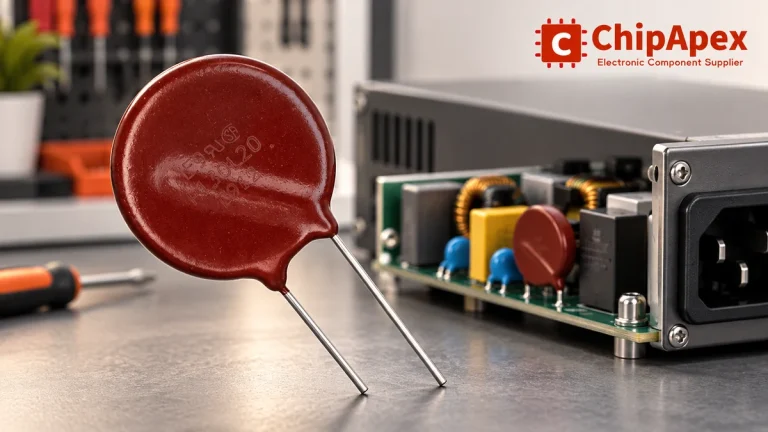
Select MOV varistors by continuous voltage, clamping behavior, surge waveform and repetition. Check thermal disconnection, fuse coordination and replacements.
Read More
Q8006VH3 is listed in the Triacs range at ChipApex. The manufacturer field lists Littelfuse Inc.. Its product description is TRIAC ALTERNISTOR 800V 6A TO251.…
Read More
Learn how a pressure transducer converts pressure into voltage, current, or digital output, and compare pressure references and key selection specs.
Read More
Q8006VH3 is listed in the Triacs range at ChipApex. The manufacturer field lists Littelfuse Inc.. Its product description is TRIAC ALTERNISTOR 800V 6A TO251.…
Read More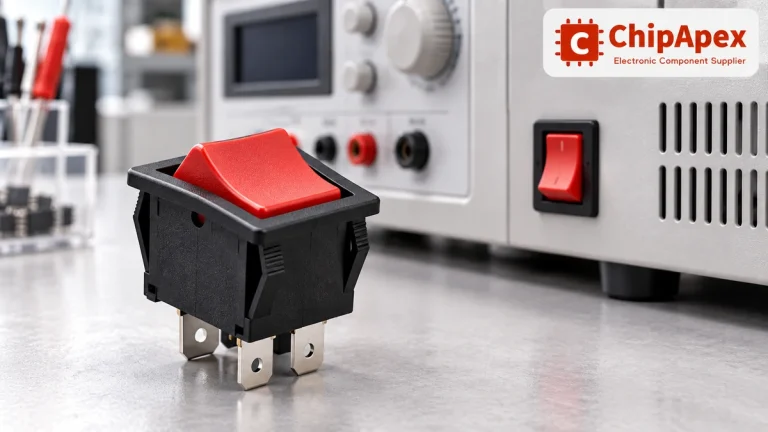
Choose a rocker switch by AC/DC ratings, contact arrangement, illumination, panel fit and sealing. Get practical checks for engineering and component sourcing.
Read More
Q8006VH3 is listed in the Triacs range at ChipApex. The manufacturer field lists Littelfuse Inc.. Its product description is TRIAC ALTERNISTOR 800V 6A TO251.…
Read More
Q8006VH3 is listed in the Triacs range at ChipApex. The manufacturer field lists Littelfuse Inc.. Its product description is TRIAC ALTERNISTOR 800V 6A TO251.…
Read More
Q8006VH3 is listed in the Triacs range at ChipApex. The manufacturer field lists Littelfuse Inc.. Its product description is TRIAC ALTERNISTOR 800V 6A TO251.…
Read More
See when an inductor behaves linearly, how DC bias and saturation reduce inductance, and which current and temperature curves to check.
Read More
Learn why PTC resistance rises with temperature, how it differs from NTC, and which ratings matter for sensing and protection.
Read More
The activity of extra discounts on wholesale prices is in full swing…
Please fill in your contact information and we will send you the latest wholesale price list.





