 ChipApex | Global Electronic Components Supplier

SEARCH
Search Product
Search Post
— IC芯片 | 连接器 | 传感器 | 被动器件 —
Search productSearch post
— IC芯片 | 连接器 | 传感器 | 被动器件 —
Consult the customer manager about the wholesale price.
consultation hotline:86-132-6715-2157
email:[email protected]
Contact the product manager for consultation. One-stop consultation is available.
Do you want a lower wholesale price? Please send us your inquiry and we will reply immediately.
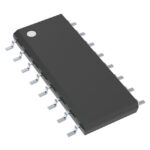
SN74AS174DRG4 is listed in the Flip Flops range at ChipApex. The manufacturer field lists Texas Instruments. Its product description is IC FF D-TYPE SNGL 6BIT 16SOIC. Review the specifications below when checking this part for your BOM.
The SN74AS174DRG4 is a hex D-type positive-edge-triggered flip-flop manufactured by Texas Instruments. It features six independent circuits in a single package, providing main reset functionality for synchronous data storage. The device operates within a supply voltage range of 4.5V to 5.5V and supports a maximum clock frequency of 100 MHz. It utilizes Schottky TTL logic technology to achieve high-speed performance with a typical propagation delay of 10 ns at 5V with a 50 pF load. The component is housed in a 16-pin Small Outline Integrated Circuit (SOIC) package designed for surface-mount applications.
Verify the specific suffix 'G4' against the manufacturer's current product status documentation to confirm availability and compliance details. Ensure that the required operating temperature range aligns with the industrial specifications defined in the official datasheet. Cross-reference the pinout configuration with the target PCB layout to prevent interface mismatches during integration.
Select this component when system requirements demand high-speed operation provided by Schottky TTL technology rather than standard CMOS alternatives. Consider the 16-pin SOIC package constraints regarding board space and thermal dissipation capabilities. Evaluate the power consumption characteristics associated with Schottky logic levels against the overall system power budget before finalizing the design choice.
This part belongs to the SN74AS series, representing a high-speed variant of the industry-standard 74xx logic family. The 'AS' designation indicates the use of Advanced Schottky technology, which offers superior speed compared to standard or low-power variants. The 'DRG4' suffix specifies the tape-and-reel packaging format and RoHS compliance status within the Texas Instruments product lineup.
Public confirmed substitute part numbers are not available in the provided documentation.
Explore related parts through Logic, Integrated Circuits (ICs), all product categories, ChipApex homepage.
 SN74AS174DRG4

SN74AS174DRG4 is listed in the Flip Flops range at ChipApex. The manufacturer field lists Texas Instruments. Its product description is IC FF D-TYPE SNGL…
Read More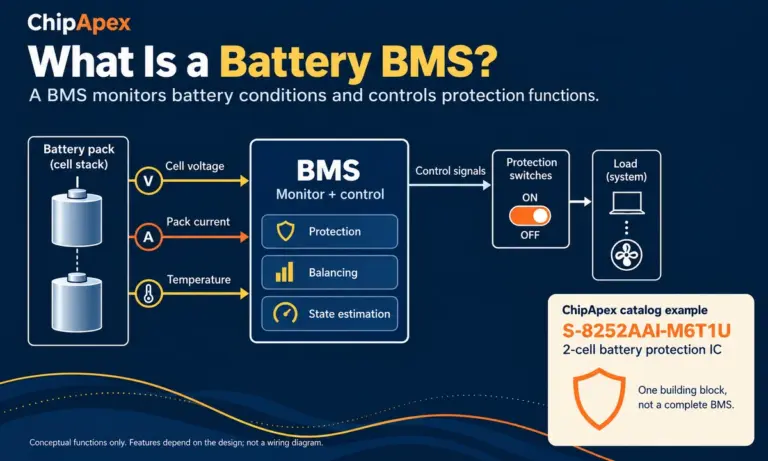
Learn what a battery BMS does, how protection differs from charging, and which pack specifications to check when sourcing BMS components through ChipApex.
Read More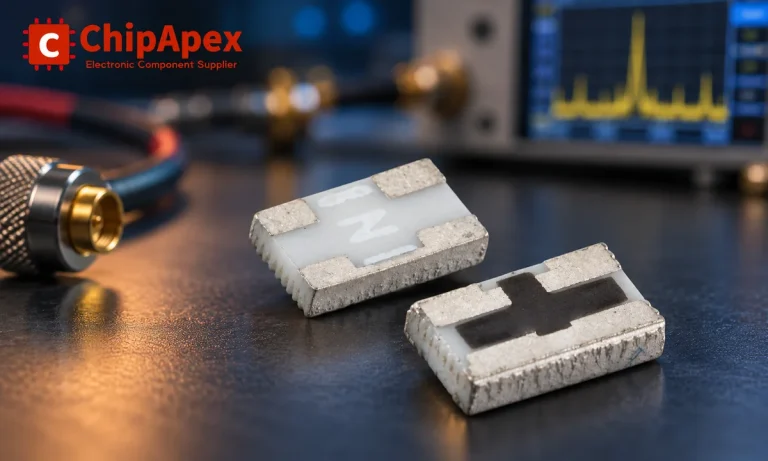
Understand RF attenuator dB values, fixed and programmable types, impedance, power limits and noise tradeoffs before choosing parts for an RF signal path.
Read More
SN74AS174DRG4 is listed in the Flip Flops range at ChipApex. The manufacturer field lists Texas Instruments. Its product description is IC FF D-TYPE SNGL…
Read More
Understand how a comparator switches at a voltage threshold, why hysteresis prevents chatter, and which output and input specs matter.
Read More
SN74AS174DRG4 is listed in the Flip Flops range at ChipApex. The manufacturer field lists Texas Instruments. Its product description is IC FF D-TYPE SNGL…
Read More
SN74AS174DRG4 is listed in the Flip Flops range at ChipApex. The manufacturer field lists Texas Instruments. Its product description is IC FF D-TYPE SNGL…
Read More
SN74AS174DRG4 is listed in the Flip Flops range at ChipApex. The manufacturer field lists Texas Instruments. Its product description is IC FF D-TYPE SNGL…
Read More
SN74AS174DRG4 is listed in the Flip Flops range at ChipApex. The manufacturer field lists Texas Instruments. Its product description is IC FF D-TYPE SNGL…
Read More
SN74AS174DRG4 is listed in the Flip Flops range at ChipApex. The manufacturer field lists Texas Instruments. Its product description is IC FF D-TYPE SNGL…
Read More
SN74AS174DRG4 is listed in the Flip Flops range at ChipApex. The manufacturer field lists Texas Instruments. Its product description is IC FF D-TYPE SNGL…
Read More
See when an inductor behaves linearly, how DC bias and saturation reduce inductance, and which current and temperature curves to check.
Read More
The activity of extra discounts on wholesale prices is in full swing…
Please fill in your contact information and we will send you the latest wholesale price list.





