 ChipApex | Global Electronic Components Supplier

SEARCH
Search Product
Search Post
— IC芯片 | 连接器 | 传感器 | 被动器件 —
Search productSearch post
— IC芯片 | 连接器 | 传感器 | 被动器件 —
Consult the customer manager about the wholesale price.
consultation hotline:86-132-6715-2157
email:[email protected]
Contact the product manager for consultation. One-stop consultation is available.
Do you want a lower wholesale price? Please send us your inquiry and we will reply immediately.
SN74AUC1G125DBVR is listed in the Buffers, Drivers, Receivers, Transceivers range at ChipApex. The manufacturer field lists Texas Instruments. Its product description is IC BUF NON-INVERT 2.7V SOT23-5. Review the specifications below when checking this part for your BOM.
The SN74AUC1G125DBVR is a single bus buffer gate with 3-state output from the AUC logic family. It operates within a supply voltage range of 0.8 V to 2.7 V and is optimized for 1.65-V to 1.95-V operation. The device features over-voltage tolerant I/Os supporting up to 3.6 V independent of VCC, an Ioff feature for partial power down mode, and low power consumption with a maximum ICC of 10 µA. It is housed in a SOT-23-5 package.
Verify the specific ordering suffix 'DBVR' corresponds to the SOT-23-5 package and tape-and-reel carrier configuration. Confirm that the component meets RoHS compliance standards and matches the manufacturer's current production status before finalizing procurement specifications.
Select this component for applications requiring ultra-low voltage operation and high-speed signal buffering. Ensure the design accommodates the 0.8-V to 2.7-V supply range and utilizes the Ioff feature if partial power down functionality is required for system power management.
This device belongs to the Texas Instruments SN74AUC1G125 series, which is part of the AUC logic family designed for speed and optimized for sub-1-V little logic devices. The series includes variants available in SOT-23, SC70, and NanoFree DSBGA packages to suit different footprint constraints.
SN74AUC1G125DCKR (SC70 package)
The Ioff circuitry disables all outputs when the supply pin is held at 0 V, preventing damaging current backflow through the device during partial power-down states.
Input signals must transition quickly; specifically, the rate should be faster than 10 ns/V when operating between 1.65 V and 1.95 V to prevent excessive power consumption.
Explore related parts through Logic, Integrated Circuits (ICs), all product categories, ChipApex homepage.
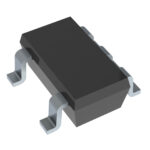 SN74AUC1G125DBVR
SN74AUC1G125DBVR is listed in the Buffers, Drivers, Receivers, Transceivers range at ChipApex. The manufacturer field lists Texas Instruments. Its product description is IC BUF…
Read More
Understand RF attenuator dB values, fixed and programmable types, impedance, power limits and noise tradeoffs before choosing parts for an RF signal path.
Read More
Compare Pt100 and Pt1000 RTDs, two-, three- and four-wire connections, excitation and self-heating. Build an error budget from element to reported temperature.
Read More
Learn what data acquisition means, from sensors and conditioning to sampling and storage. Review channel timing, wiring, calibration and data quality.
Read More
SN74AUC1G125DBVR is listed in the Buffers, Drivers, Receivers, Transceivers range at ChipApex. The manufacturer field lists Texas Instruments. Its product description is IC BUF…
Read More
SN74AUC1G125DBVR is listed in the Buffers, Drivers, Receivers, Transceivers range at ChipApex. The manufacturer field lists Texas Instruments. Its product description is IC BUF…
Read More
Choose logic inverter ICs by thresholds, supply, output drive and delay. Compare standard and Schmitt-trigger inputs, power sequencing and replacement checks.
Read More
SN74AUC1G125DBVR is listed in the Buffers, Drivers, Receivers, Transceivers range at ChipApex. The manufacturer field lists Texas Instruments. Its product description is IC BUF…
Read More
Find out when a bare shock switch needs a pull resistor, when an MCU internal pull-up is enough, and why sensor modules and piezo…
Read More
SN74AUC1G125DBVR is listed in the Buffers, Drivers, Receivers, Transceivers range at ChipApex. The manufacturer field lists Texas Instruments. Its product description is IC BUF…
Read More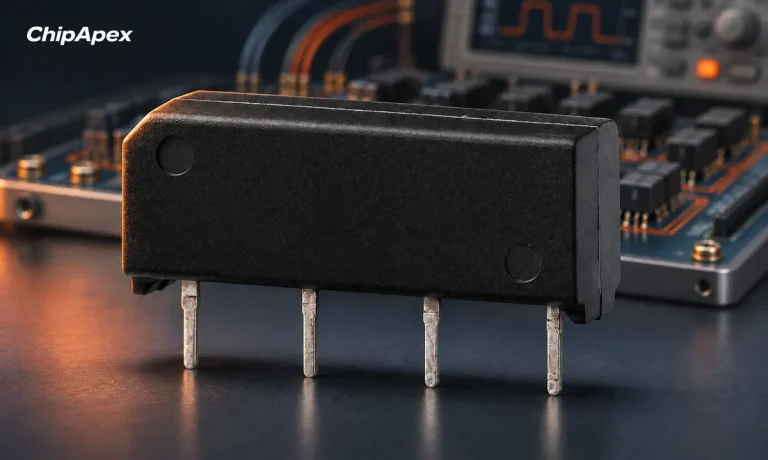
Choose a reed relay for signal switching. Understand hot and cold switching, leakage, contact resistance, isolation and measurement settling requirements.
Read More
Compare RC, crystal and MEMS oscillator circuits. Check ppm, jitter, load capacitance, startup margin and output compatibility before choosing a clock source.
Read More
The activity of extra discounts on wholesale prices is in full swing…
Please fill in your contact information and we will send you the latest wholesale price list.





