 ChipApex | Global Electronic Components Supplier

SEARCH
Search Product
Search Post
— IC芯片 | 连接器 | 传感器 | 被动器件 —
Search productSearch post
— IC芯片 | 连接器 | 传感器 | 被动器件 —
Consult the customer manager about the wholesale price.
consultation hotline:86-132-6715-2157
email:[email protected]
Contact the product manager for consultation. One-stop consultation is available.
Do you want a lower wholesale price? Please send us your inquiry and we will reply immediately.
SN74HC165QPWRQ1 is listed in the Shift Registers range at ChipApex. The manufacturer field lists Texas Instruments. Its product description is IC SHIFT REGISTER 8BIT 16-TSSOP. Review the specifications below when checking this part for your BOM.
The SN74HC165QPWRQ1 is an automotive-grade, 8-bit parallel-load shift register from Texas Instruments' HC logic family. It converts eight parallel data inputs into a serial output stream. The device operates within a supply voltage range of 2 V to 6 V and supports a wide operating temperature range from -40°C to +125°C. It features propagation delays of 150 ns, 30 ns, and 26 ns under specified conditions. Packaged in a 16-pin TSSOP, it holds AEC-Q100 qualification for automotive applications.
Verify the specific suffix Q1 confirms AEC-Q100 automotive qualification status before integration. Confirm the TSSOP-16 package dimensions match your PCB footprint requirements. Ensure the 2 V to 6 V supply voltage aligns with your system's power rails. Check for RoHS compliance documentation if required by your manufacturing standards. Validate that the serial/parallel-to-serial functionality meets your interface protocol needs.
Select this component when an 8-bit parallel load shift register is required for automotive environments. The HC series offers standard CMOS performance suitable for general-purpose logic applications. Consider the TSSOP-16 package if space constraints allow for surface-mount assembly. Verify that the 2 V to 6 V operating range covers your minimum and maximum supply voltages across all operating temperatures.
This part belongs to the SN74HC165 family of 8-bit shift registers. The QPWRQ1 designation indicates an automotive-grade version manufactured in a TSSOP package. It shares functional similarities with other HC165 variants but includes specific qualifications for automotive reliability. The family is designed for high-density digital signal processing tasks.
Yes, the device includes a dedicated clock inhibit input that pauses the shifting operation while maintaining the current state of the register.
It utilizes High-speed CMOS (HC) logic technology, providing fast switching speeds and low power consumption.
Explore related parts through Logic, Integrated Circuits (ICs), all product categories, ChipApex homepage.
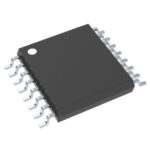 SN74HC165QPWRQ1
Learn how a JFET works and how to compare bias, leakage, noise and pinout. Review practical selection questions for high-impedance analog circuits.
Read More
SN74HC165QPWRQ1 is listed in the Shift Registers range at ChipApex. The manufacturer field lists Texas Instruments. Its product description is IC SHIFT REGISTER 8BIT…
Read More
SN74HC165QPWRQ1 is listed in the Shift Registers range at ChipApex. The manufacturer field lists Texas Instruments. Its product description is IC SHIFT REGISTER 8BIT…
Read More
SN74HC165QPWRQ1 is listed in the Shift Registers range at ChipApex. The manufacturer field lists Texas Instruments. Its product description is IC SHIFT REGISTER 8BIT…
Read More
SN74HC165QPWRQ1 is listed in the Shift Registers range at ChipApex. The manufacturer field lists Texas Instruments. Its product description is IC SHIFT REGISTER 8BIT…
Read More
Learn the relay definition, coil and contact operation, NO and NC forms, load ratings and suppression choices. Compare mechanical, reed and solid-state types.
Read More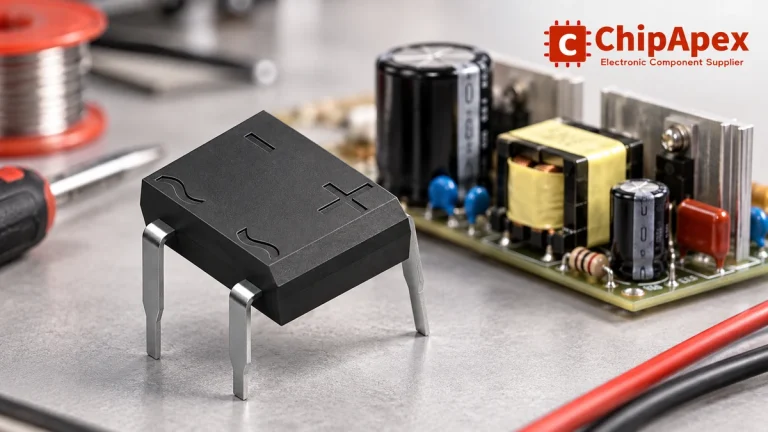
Select a bridge rectifier by reverse voltage, capacitor charging current, startup surge and cooling. Work through a stated DC voltage and ripple example.
Read More
SN74HC165QPWRQ1 is listed in the Shift Registers range at ChipApex. The manufacturer field lists Texas Instruments. Its product description is IC SHIFT REGISTER 8BIT…
Read More
Learn how rectifiers convert AC to DC, compare half-wave and bridge circuits, and select voltage, current, recovery and thermal ratings for your design.
Read More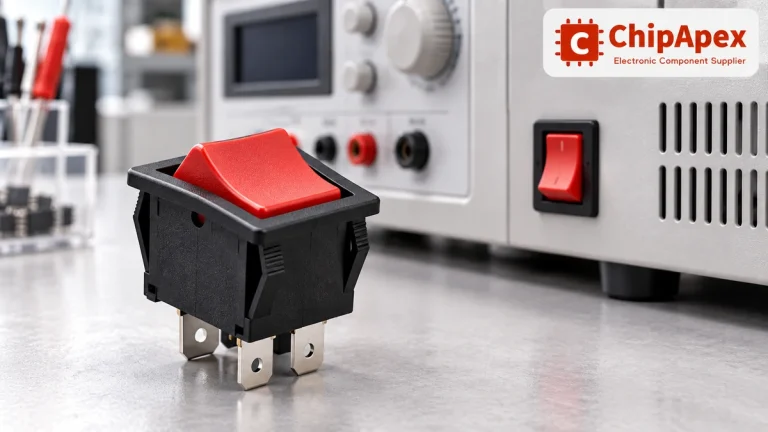
Choose a rocker switch by AC/DC ratings, contact arrangement, illumination, panel fit and sealing. Get practical checks for engineering and component sourcing.
Read More
Choose a DIP switch by contact type, coded positions, footprint and signal ratings. Check logic polarity, assembly conditions and PCB configuration behavior.
Read More
Compare RC, crystal and MEMS oscillator circuits. Check ppm, jitter, load capacitance, startup margin and output compatibility before choosing a clock source.
Read More
The activity of extra discounts on wholesale prices is in full swing…
Please fill in your contact information and we will send you the latest wholesale price list.





