 ChipApex | Global Electronic Components Supplier

SEARCH
Search Product
Search Post
— IC芯片 | 连接器 | 传感器 | 被动器件 —
Search productSearch post
— IC芯片 | 连接器 | 传感器 | 被动器件 —
Consult the customer manager about the wholesale price.
consultation hotline:86-132-6715-2157
email:[email protected]
Contact the product manager for consultation. One-stop consultation is available.
Do you want a lower wholesale price? Please send us your inquiry and we will reply immediately.
SN74LV273APWE4 is listed in the Flip Flops range at ChipApex. The manufacturer field lists Texas Instruments. Its product description is IC FF D-TYPE SNGL 8BIT 20TSSOP. Review the specifications below when checking this part for your BOM.
The SN74LV273APWE4 is an octal D-type flip-flop from Texas Instruments' LV logic series. It features a TSSOP-20 surface-mount package and operates within a 2V to 5.5V supply range. The device provides non-inverting outputs with CMOS input and output types. Key electrical parameters include a maximum propagation delay of 22.1 ns, high-level output current of -12 mA, and low-level output current of 12 mA. It supports a wide operating temperature range from -40°C to +125°C.
Verify the specific suffix 'PWE4' against the manufacturer's official documentation to confirm pinout compatibility and tape-and-reel specifications. Ensure the ordering part number matches the exact package variant required for your PCB footprint. Cross-reference the RoHS status and environmental compliance details directly with the latest datasheet provided by Texas Instruments before finalizing procurement orders.
Select this component when a wide 2V to 5.5V operating voltage range is required for system flexibility. Choose the SN74LV273APWE4 for designs needing mixed-mode voltage compatibility at all ports. Consider this part for applications demanding robust latch protection and partial power-down capabilities via Ioff support. Verify that the TSSOP-20 package dimensions align with your assembly constraints.
This device belongs to the SN74LV273A family of octal D-type flip-flops designed for low-voltage CMOS applications. It offers eight independent D-type flip-flops with positive-edge triggering and a clear function. The LV series is characterized by its ability to operate over a broad voltage spectrum while maintaining high-speed performance suitable for industrial and consumer electronics.
SN74LV273ADWRG4
Yes, the device supports mixed-mode voltage operation on all ports.
The latch performance exceeds 250mA, complying with JESD17 standards.
Explore related parts through Logic, Integrated Circuits (ICs), all product categories, ChipApex homepage.
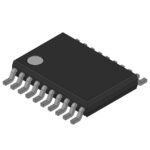 SN74LV273APWE4
SN74LV273APWE4 is listed in the Flip Flops range at ChipApex. The manufacturer field lists Texas Instruments. Its product description is IC FF D-TYPE SNGL…
Read More
SN74LV273APWE4 is listed in the Flip Flops range at ChipApex. The manufacturer field lists Texas Instruments. Its product description is IC FF D-TYPE SNGL…
Read More
SN74LV273APWE4 is listed in the Flip Flops range at ChipApex. The manufacturer field lists Texas Instruments. Its product description is IC FF D-TYPE SNGL…
Read More
Understand tactile switches, PCB and keyboard differences, four-pin wiring, debounce, force, travel and replacement checks for reliable control inputs.
Read More
Find out when a bare shock switch needs a pull resistor, when an MCU internal pull-up is enough, and why sensor modules and piezo…
Read More
SN74LV273APWE4 is listed in the Flip Flops range at ChipApex. The manufacturer field lists Texas Instruments. Its product description is IC FF D-TYPE SNGL…
Read More
SN74LV273APWE4 is listed in the Flip Flops range at ChipApex. The manufacturer field lists Texas Instruments. Its product description is IC FF D-TYPE SNGL…
Read More
SN74LV273APWE4 is listed in the Flip Flops range at ChipApex. The manufacturer field lists Texas Instruments. Its product description is IC FF D-TYPE SNGL…
Read More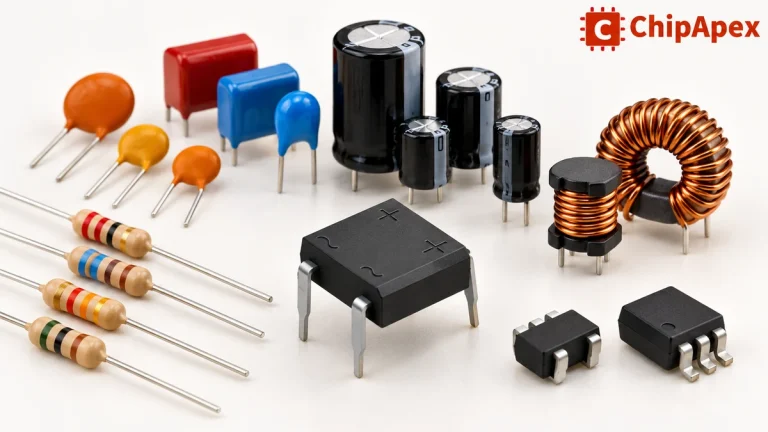
Explore electronic component types, functions, packages and datasheets. Learn selection, replacement and BOM checks before ordering parts for your PCB.
Read More
SN74LV273APWE4 is listed in the Flip Flops range at ChipApex. The manufacturer field lists Texas Instruments. Its product description is IC FF D-TYPE SNGL…
Read More
SN74LV273APWE4 is listed in the Flip Flops range at ChipApex. The manufacturer field lists Texas Instruments. Its product description is IC FF D-TYPE SNGL…
Read More
See when an inductor behaves linearly, how DC bias and saturation reduce inductance, and which current and temperature curves to check.
Read More
The activity of extra discounts on wholesale prices is in full swing…
Please fill in your contact information and we will send you the latest wholesale price list.





