 ChipApex | Global Electronic Components Supplier

SEARCH
Search Product
Search Post
— IC芯片 | 连接器 | 传感器 | 被动器件 —
Search productSearch post
— IC芯片 | 连接器 | 传感器 | 被动器件 —
Consult the customer manager about the wholesale price.
consultation hotline:86-132-6715-2157
email:[email protected]
Contact the product manager for consultation. One-stop consultation is available.
Do you want a lower wholesale price? Please send us your inquiry and we will reply immediately.
SN74LVC7001ABQAR is listed in the Inverter Gates range at ChipApex. The manufacturer field lists Texas Instruments. Its product description is QUADRUPLE TWO-INPUT 1.2V TO 3.6V. Review the specifications below when checking this part for your BOM.
The SN74LVC7001ABQAR is a quad two-input AND gate with Schmitt-trigger inputs from the LVC series. It operates within a supply voltage range of 1.1V to 3.6V and features 5.5V tolerant input pins. The device provides balanced CMOS push-pull outputs capable of sourcing and sinking currents up to 24mA at 3V. It includes ESD protection exceeding 2000V (HBM) and latch-up performance over 250mA per JESD 17. Propagation delay ranges from 5.6ns to 12ns depending on load and voltage. It is housed in a 14-pin WQFN package.
Verify the specific BQA package suffix matches the required footprint. Confirm RoHS compliance and lead finish details against project specifications. Ensure the operating temperature range aligns with environmental requirements. Check documentation for any recent revisions affecting pinout or electrical characteristics.
Select this component when low voltage operation below 1.8V is required alongside high noise immunity. The Schmitt-trigger inputs are essential for slow-rise-time signals. Verify that the 5.5V input tolerance is necessary for system interfacing. Consider thermal resistance values if multiple gates are active simultaneously.
This part belongs to the SN74LVC7001A family, which offers quad AND gates with Schmitt triggers. The ABQAR variant specifically denotes the WQFN-14 package configuration. It complements other LVC series logic devices requiring similar functionality but different packaging or gate types.
SN74LVC7001APWR serves as a direct functional replacement using the TSSOP-14 package. Both share identical electrical characteristics and pinouts. Verify package dimensions and thermal properties differ between WQFN and TSSOP options.
Explore related parts through Logic, Integrated Circuits (ICs), all product categories, ChipApex homepage.
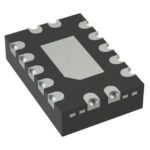 SN74LVC7001ABQAR

Compare RC, crystal and MEMS oscillator circuits. Check ppm, jitter, load capacitance, startup margin and output compatibility before choosing a clock source.
Read More
SN74LVC7001ABQAR is listed in the Inverter Gates range at ChipApex. The manufacturer field lists Texas Instruments. Its product description is QUADRUPLE TWO-INPUT 1.2V TO…
Read More
SN74LVC7001ABQAR is listed in the Inverter Gates range at ChipApex. The manufacturer field lists Texas Instruments. Its product description is QUADRUPLE TWO-INPUT 1.2V TO…
Read MoreSN74LVC7001ABQAR is listed in the Inverter Gates range at ChipApex. The manufacturer field lists Texas Instruments. Its product description is QUADRUPLE TWO-INPUT 1.2V TO…
Read More
Learn how a diode conducts, how to identify anode and cathode, and when to choose rectifier, TVS, Zener or photodiode types for a circuit.
Read More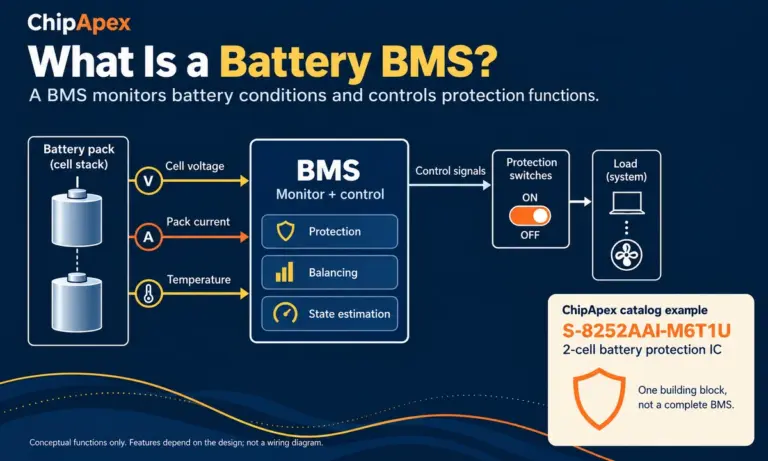
Learn what a battery BMS does, how protection differs from charging, and which pack specifications to check when sourcing BMS components through ChipApex.
Read More
SN74LVC7001ABQAR is listed in the Inverter Gates range at ChipApex. The manufacturer field lists Texas Instruments. Its product description is QUADRUPLE TWO-INPUT 1.2V TO…
Read More
SN74LVC7001ABQAR is listed in the Inverter Gates range at ChipApex. The manufacturer field lists Texas Instruments. Its product description is QUADRUPLE TWO-INPUT 1.2V TO…
Read More
SN74LVC7001ABQAR is listed in the Inverter Gates range at ChipApex. The manufacturer field lists Texas Instruments. Its product description is QUADRUPLE TWO-INPUT 1.2V TO…
Read More
SN74LVC7001ABQAR is listed in the Inverter Gates range at ChipApex. The manufacturer field lists Texas Instruments. Its product description is QUADRUPLE TWO-INPUT 1.2V TO…
Read More
Understand motor controller types, driver functions, startup current, feedback and braking. Use practical checks to match control electronics to your motor.
Read More
Compare gas sensor technologies, cross-sensitivity and calibration needs. Define the gas, range and environment before choosing a sensing component.
Read More
The activity of extra discounts on wholesale prices is in full swing…
Please fill in your contact information and we will send you the latest wholesale price list.





