 ChipApex | Global Electronic Components Supplier

SEARCH
Search Product
Search Post
— IC芯片 | 连接器 | 传感器 | 被动器件 —
Search productSearch post
— IC芯片 | 连接器 | 传感器 | 被动器件 —
Consult the customer manager about the wholesale price.
consultation hotline:86-132-6715-2157
email:[email protected]
Contact the product manager for consultation. One-stop consultation is available.
Do you want a lower wholesale price? Please send us your inquiry and we will reply immediately.
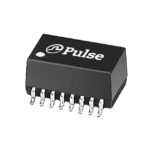
ST7011QNL is listed in the Pulse Transformers range at ChipApex. The manufacturer field lists Pulse Electronics. Its product description is PULSE XFMR 1CT:1.414CT 1CT:1CT. Review the specifications below when checking this part for your BOM.
The ST7011QNL is a surface mount LAN transformer from Pulse Electronics designed for 10Base-T applications. It features a non-PoE configuration with an inductance of 175µH and a DC resistance of 0.9 Ohms. The component supports a maximum DC current of 150 mA and has a power rating of 2 W. It utilizes a 1CT:1.414CT turns ratio for the transmitter and 1CT:1CT for the receiver, ensuring compatibility with standard Ethernet physical layer interfaces.
Verify the specific suffix 'QNL' against official manufacturer documentation to confirm the exact packaging format and reel specifications. Ensure the component meets RoHS3 compliance requirements for your target market. Cross-reference the 175µH inductance value with your circuit design constraints before finalizing procurement orders.
Select this component when designing for legacy 10Base-T Ethernet standards rather than higher-speed variants. Confirm that the 150 mA maximum DC current rating aligns with the power budget of the connected PHY chip. Validate that the surface mount footprint dimensions fit within the available board space constraints.
This part belongs to the Pulse Electronics LAN transformer family, which provides isolation and impedance matching for Ethernet signals. The ST7011 series typically includes variants for different speeds such as 10/100/1000 Base-T. The QNL suffix indicates a specific tape-and-reel packaging option suitable for high-volume manufacturing environments.
Public confirmed substitute part numbers are not available in the provided documentation. Verify compatibility with alternative components by comparing pin configurations, electrical parameters, and mechanical dimensions.
Explore related parts through Transformers, all product categories, ChipApex homepage.
 ST7011QNL

Compare RC, crystal and MEMS oscillator circuits. Check ppm, jitter, load capacitance, startup margin and output compatibility before choosing a clock source.
Read More
Learn the relay definition, coil and contact operation, NO and NC forms, load ratings and suppression choices. Compare mechanical, reed and solid-state types.
Read More
See how a MEMS gyroscope measures angular rate, why its angle estimate drifts, and which range, noise, interface and temperature specs to compare.
Read More
ST7011QNL is listed in the Pulse Transformers range at ChipApex. The manufacturer field lists Pulse Electronics. Its product description is PULSE XFMR 1CT:1.414CT 1CT:1CT.…
Read More
ST7011QNL is listed in the Pulse Transformers range at ChipApex. The manufacturer field lists Pulse Electronics. Its product description is PULSE XFMR 1CT:1.414CT 1CT:1CT.…
Read More
ST7011QNL is listed in the Pulse Transformers range at ChipApex. The manufacturer field lists Pulse Electronics. Its product description is PULSE XFMR 1CT:1.414CT 1CT:1CT.…
Read More
ST7011QNL is listed in the Pulse Transformers range at ChipApex. The manufacturer field lists Pulse Electronics. Its product description is PULSE XFMR 1CT:1.414CT 1CT:1CT.…
Read More
ST7011QNL is listed in the Pulse Transformers range at ChipApex. The manufacturer field lists Pulse Electronics. Its product description is PULSE XFMR 1CT:1.414CT 1CT:1CT.…
Read More
ST7011QNL is listed in the Pulse Transformers range at ChipApex. The manufacturer field lists Pulse Electronics. Its product description is PULSE XFMR 1CT:1.414CT 1CT:1CT.…
Read More
ST7011QNL is listed in the Pulse Transformers range at ChipApex. The manufacturer field lists Pulse Electronics. Its product description is PULSE XFMR 1CT:1.414CT 1CT:1CT.…
Read More
Understand how a comparator switches at a voltage threshold, why hysteresis prevents chatter, and which output and input specs matter.
Read More
Compare thermistors, RTDs, thermocouples and temperature ICs. Learn how range, accuracy, response, interfaces and mounting affect component selection.
Read More
The activity of extra discounts on wholesale prices is in full swing…
Please fill in your contact information and we will send you the latest wholesale price list.






