 ChipApex | Global Electronic Components Supplier

SEARCH
Search Product
Search Post
— IC芯片 | 连接器 | 传感器 | 被动器件 —
Search productSearch post
— IC芯片 | 连接器 | 传感器 | 被动器件 —
Consult the customer manager about the wholesale price.
consultation hotline:86-132-6715-2157
email:[email protected]
Contact the product manager for consultation. One-stop consultation is available.
Do you want a lower wholesale price? Please send us your inquiry and we will reply immediately.
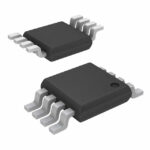
SY100EL16VAKC is listed in the Specialty Logic range at ChipApex. The manufacturer field lists Microchip Technology. Its product description is IC RCVR DIFF 5V/3.3V 8-MSOP. Review the specifications below when checking this part for your BOM.
The SY100EL16VAKCTR is a differential receiver from the SY10/100EL16VA-VF series, manufactured by Microchip Technology. It operates within a VEE range of -3.0V to -5.5V and supports both 3.3V and 5V power supply options. The device features a propagation delay of 250ps and includes internal 75K Ohm input pull-down resistors. It provides QHG and /QHG outputs with significantly higher DC gain compared to standard EL16 variants. The component is housed in an 8-lead MSOP (K8-1) package.
Verify the specific suffix 'KCTR' indicates the 8-lead MSOP tape and reel packaging configuration. Confirm that the commercial temperature grade aligns with system requirements. Ensure the -3.0V to -5.5V operating range matches the target power supply architecture. Cross-reference the ordering code against current manufacturer documentation to confirm availability status.
Select this variant when high voltage gain is required for signal integrity in ECL/PECL environments. The 8-lead MSOP package suits space-constrained layouts. Consider the /EN pin functionality if synchronized glitchless gating is necessary for timing signals. Verify compatibility with existing differential receiver footprints if replacing standard EL16 models.
This component belongs to the SY10/100EL16VA-VF family of enhanced differential receivers. The '100' prefix typically denotes specific performance or manufacturing lot variations within the broader EL16 product line. The VA designation identifies the base feature set including the VBB reference output and high-gain outputs.
SY100EL16VBKCTR
The QHG and /QHG outputs provide a DC gain several times larger than the standard Q and /Q outputs.
The /EN input synchronizes with the data input to provide glitchless gating of the QHG and /QHG outputs without affecting the inverted /Q output.
Explore related parts through Logic, Integrated Circuits (ICs), all product categories, ChipApex homepage.
 SY100EL16VAKC

Find out when a bare shock switch needs a pull resistor, when an MCU internal pull-up is enough, and why sensor modules and piezo…
Read More
Learn how rectifiers convert AC to DC, compare half-wave and bridge circuits, and select voltage, current, recovery and thermal ratings for your design.
Read More
SY100EL16VAKC is listed in the Specialty Logic range at ChipApex. The manufacturer field lists Microchip Technology. Its product description is IC RCVR DIFF 5V/3.3V…
Read More
SY100EL16VAKC is listed in the Specialty Logic range at ChipApex. The manufacturer field lists Microchip Technology. Its product description is IC RCVR DIFF 5V/3.3V…
Read More
SY100EL16VAKC is listed in the Specialty Logic range at ChipApex. The manufacturer field lists Microchip Technology. Its product description is IC RCVR DIFF 5V/3.3V…
Read More
Understand how oscillators generate timing signals, how they differ from crystals, and which frequency, output and stability specs matter when choosing one.
Read More
Learn how an analog front end conditions sensor signals. Compare gain, noise, filtering, ADC settling and integration options before selecting components.
Read More
SY100EL16VAKC is listed in the Specialty Logic range at ChipApex. The manufacturer field lists Microchip Technology. Its product description is IC RCVR DIFF 5V/3.3V…
Read More
Compare thermistors, RTDs, thermocouples and temperature ICs. Learn how range, accuracy, response, interfaces and mounting affect component selection.
Read More
SY100EL16VAKC is listed in the Specialty Logic range at ChipApex. The manufacturer field lists Microchip Technology. Its product description is IC RCVR DIFF 5V/3.3V…
Read More
SY100EL16VAKC is listed in the Specialty Logic range at ChipApex. The manufacturer field lists Microchip Technology. Its product description is IC RCVR DIFF 5V/3.3V…
Read More
Learn why PTC resistance rises with temperature, how it differs from NTC, and which ratings matter for sensing and protection.
Read More
The activity of extra discounts on wholesale prices is in full swing…
Please fill in your contact information and we will send you the latest wholesale price list.







