 ChipApex | Global Electronic Components Supplier

SEARCH
Search Product
Search Post
— IC芯片 | 连接器 | 传感器 | 被动器件 —
Search productSearch post
— IC芯片 | 连接器 | 传感器 | 被动器件 —
Consult the customer manager about the wholesale price.
consultation hotline:86-132-6715-2157
email:[email protected]
Contact the product manager for consultation. One-stop consultation is available.
Do you want a lower wholesale price? Please send us your inquiry and we will reply immediately.
TLV1822DDFR is listed in the Comparators range at ChipApex. The manufacturer field lists Texas Instruments. Its product description is DUAL, MICROPOWER HIGH-VOLTAGE OP. Review the specifications below when checking this part for your BOM.
The TLV1822DDFR is a dual-channel analog comparator from the Texas Instruments TLV182x family, housed in an 8-pin SOIC package. It features rail-to-rail inputs and open-drain outputs capable of being pulled up to 40V independent of the supply voltage. The device operates on a wide supply range of 2.4V to 40V with a quiescent current of 5µA per channel. Key electrical specifications include a typical propagation delay of 420ns, input offset voltage of 500µV, and input bias current of 150fA. It includes a Power-On Reset (POR) feature and supports temperatures from -40°C to +125°C.
Verify the specific ordering suffix matches the required package type, as the TLV1822 family is available in multiple packages including SOIC, TSSOP, VSSOP, WSON, and SOT-23. Confirm that the open-drain output configuration aligns with system requirements, as the push-pull variant corresponds to the TLV181x series. Ensure external pull-up resistor values are selected to meet rise-time and power dissipation targets within the 40V limit.
Select the TLV1822DDFR when an open-drain output is required for logic level translation or wired-OR configurations. This part is appropriate for designs needing high-voltage tolerance on the output side while maintaining low power consumption. Compare against the TLV1812 if a push-pull output capable of sourcing current is preferred instead of an open-drain sink-only topology.
The TLV1822DDFR belongs to the TLV181x/TLV182x family of 40V rail-to-rail input comparators. This family provides options for both push-pull (TLV181x) and open-drain (TLV182x) outputs. The DD FR suffix indicates an 8-pin SOIC package with tape-and-reel packaging. These devices are designed for applications requiring high voltage tolerance and low power consumption.
The TLV1812 offers a similar form factor but with a push-pull output stage instead of open-drain. Other members of the TLV18xx family share the same core electrical characteristics but differ in channel count or package type.
Explore related parts through Linear, Integrated Circuits (ICs), all product categories, ChipApex homepage.
 TLV1822DDFR
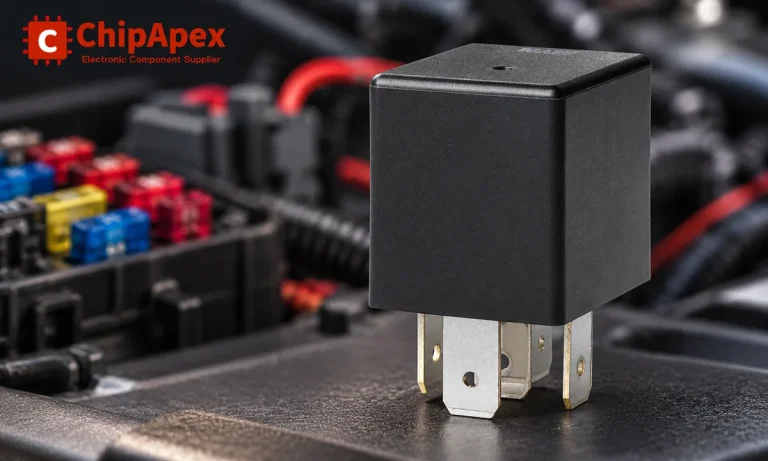
Learn the relay definition, coil and contact operation, NO and NC forms, load ratings and suppression choices. Compare mechanical, reed and solid-state types.
Read More
TLV1822DDFR is listed in the Comparators range at ChipApex. The manufacturer field lists Texas Instruments. Its product description is DUAL, MICROPOWER HIGH-VOLTAGE OP. Review…
Read More
TLV1822DDFR is listed in the Comparators range at ChipApex. The manufacturer field lists Texas Instruments. Its product description is DUAL, MICROPOWER HIGH-VOLTAGE OP. Review…
Read More
TLV1822DDFR is listed in the Comparators range at ChipApex. The manufacturer field lists Texas Instruments. Its product description is DUAL, MICROPOWER HIGH-VOLTAGE OP. Review…
Read More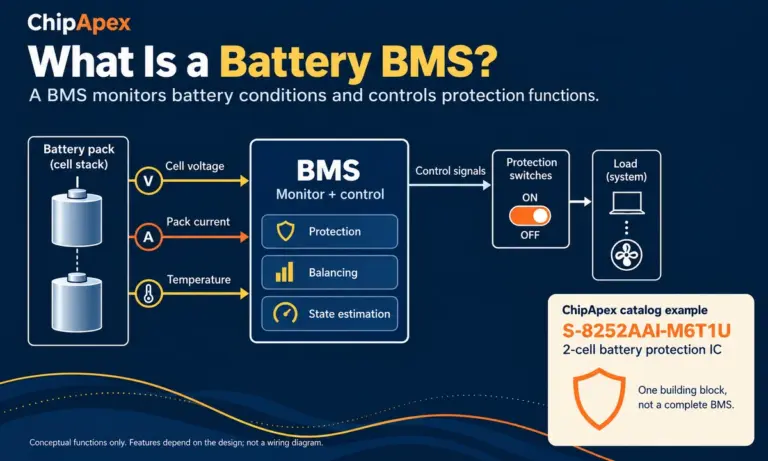
Learn what a battery BMS does, how protection differs from charging, and which pack specifications to check when sourcing BMS components through ChipApex.
Read More
TLV1822DDFR is listed in the Comparators range at ChipApex. The manufacturer field lists Texas Instruments. Its product description is DUAL, MICROPOWER HIGH-VOLTAGE OP. Review…
Read More
Select MOV varistors by continuous voltage, clamping behavior, surge waveform and repetition. Check thermal disconnection, fuse coordination and replacements.
Read More
TLV1822DDFR is listed in the Comparators range at ChipApex. The manufacturer field lists Texas Instruments. Its product description is DUAL, MICROPOWER HIGH-VOLTAGE OP. Review…
Read More
Understand how oscillators generate timing signals, how they differ from crystals, and which frequency, output and stability specs matter when choosing one.
Read More
Learn why PTC resistance rises with temperature, how it differs from NTC, and which ratings matter for sensing and protection.
Read More
Compare Pt100 and Pt1000 RTDs, two-, three- and four-wire connections, excitation and self-heating. Build an error budget from element to reported temperature.
Read More
Learn how a diode conducts, how to identify anode and cathode, and when to choose rectifier, TVS, Zener or photodiode types for a circuit.
Read More
The activity of extra discounts on wholesale prices is in full swing…
Please fill in your contact information and we will send you the latest wholesale price list.




