 ChipApex | Global Electronic Components Supplier

SEARCH
Search Product
Search Post
— IC芯片 | 连接器 | 传感器 | 被动器件 —
Search productSearch post
— IC芯片 | 连接器 | 传感器 | 被动器件 —
Consult the customer manager about the wholesale price.
consultation hotline:86-132-6715-2157
email:[email protected]
Contact the product manager for consultation. One-stop consultation is available.
Do you want a lower wholesale price? Please send us your inquiry and we will reply immediately.
UCC28085PW is listed in the AC DC Converters, Offline Switchers range at ChipApex. The manufacturer field lists Texas Instruments. Its product description is IC OFFLINE SW PUSH-PULL 8TSSOP. Review the specifications below when checking this part for your BOM.
The UCC28085PW is an obsolete current-mode push-pull switching controller from Texas Instruments, designed for offline converters. It supports half-bridge and push-pull topologies with a switching frequency range of 50 kHz to 1 MHz. The device features a maximum duty cycle of 49% and provides two outputs with a drive current of 1 A. It operates within a supply voltage range of 8.5 V to 14 V and functions at temperatures between -40°C and +85°C. The component is housed in an 8-pin TSSOP package.
This specific part number is officially marked as obsolete by the manufacturer and is no longer in active production. Procurement should focus on verified distributors holding remaining stock or authorized substitute components. Verify lot dates and authenticity carefully due to the discontinued status. Ensure replacement parts meet all original electrical specifications before integration.
Select this component only if legacy compatibility is required or for non-critical prototyping where obsolescence does not impact long-term availability. For new designs, evaluate modern equivalents that offer improved efficiency or extended temperature ranges. Confirm that the 8-pin TSSOP footprint matches the target PCB layout constraints and thermal requirements.
The UCC28085 belongs to the UCC2808x family of current-mode controllers. It shares functional similarities with the UCC28089 but differs in package type and specific feature sets. This series targets high-frequency offline power conversion needs, providing robust control loops for isolated DC-DC applications requiring precise duty cycle management.
No, the UCC28085PW is listed as obsolete and is no longer manufactured by Texas Instruments.
The device supports a switching frequency range up to 1 MHz.
Explore related parts through Power Management (PMIC), Integrated Circuits (ICs), all product categories, ChipApex homepage.
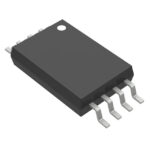 UCC28085PW

Learn how rectifiers convert AC to DC, compare half-wave and bridge circuits, and select voltage, current, recovery and thermal ratings for your design.
Read More
UCC28085PW is listed in the AC DC Converters, Offline Switchers range at ChipApex. The manufacturer field lists Texas Instruments. Its product description is IC…
Read More
UCC28085PW is listed in the AC DC Converters, Offline Switchers range at ChipApex. The manufacturer field lists Texas Instruments. Its product description is IC…
Read More
UCC28085PW is listed in the AC DC Converters, Offline Switchers range at ChipApex. The manufacturer field lists Texas Instruments. Its product description is IC…
Read More
Compare thermistors, RTDs, thermocouples and temperature ICs. Learn how range, accuracy, response, interfaces and mounting affect component selection.
Read More
Choose a DIP switch by contact type, coded positions, footprint and signal ratings. Check logic polarity, assembly conditions and PCB configuration behavior.
Read More
Choose an AC to DC converter by input range, output demand, isolation, efficiency and thermal derating. Compare architectures and check installation needs.
Read More
UCC28085PW is listed in the AC DC Converters, Offline Switchers range at ChipApex. The manufacturer field lists Texas Instruments. Its product description is IC…
Read More
UCC28085PW is listed in the AC DC Converters, Offline Switchers range at ChipApex. The manufacturer field lists Texas Instruments. Its product description is IC…
Read More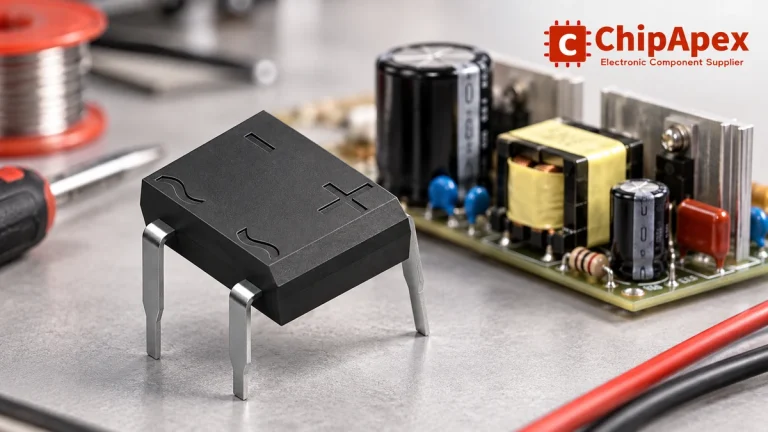
Select a bridge rectifier by reverse voltage, capacitor charging current, startup surge and cooling. Work through a stated DC voltage and ripple example.
Read More
UCC28085PW is listed in the AC DC Converters, Offline Switchers range at ChipApex. The manufacturer field lists Texas Instruments. Its product description is IC…
Read More
Understand how oscillators generate timing signals, how they differ from crystals, and which frequency, output and stability specs matter when choosing one.
Read More
The activity of extra discounts on wholesale prices is in full swing…
Please fill in your contact information and we will send you the latest wholesale price list.





