 ChipApex | Global Electronic Components Supplier

SEARCH
Search Product
Search Post
— IC芯片 | 连接器 | 传感器 | 被动器件 —
Search productSearch post
— IC芯片 | 连接器 | 传感器 | 被动器件 —
Consult the customer manager about the wholesale price.
consultation hotline:86-132-6715-2157
email:[email protected]
Contact the product manager for consultation. One-stop consultation is available.
Do you want a lower wholesale price? Please send us your inquiry and we will reply immediately.
XC6503A18APR-G is listed in the Voltage Regulators - Linear, Low Drop Out (LDO) Regulators range at ChipApex. The manufacturer field lists Torex Semiconductor Ltd. Its product description is IC REG LIN 1.85V 500MA SOT89-5. Review the specifications below when checking this part for your BOM.
The XC6503A18APR-G is a fixed-output low-dropout regulator manufactured by Torex Semiconductor. It provides a stable 1.8 V output with a maximum continuous current of 500 mA. The device operates within an input voltage range of 1.7 V to 6 V and maintains a typical dropout voltage of 290 mV at full load. Quiescent current is specified at 15 uA, ensuring efficient power management. It features a typical power supply rejection ratio of 55 dB and includes overcurrent and thermal protection circuits. The component is housed in a compact SOT-89-3 package suitable for surface mount applications.
Verify the specific suffix 'A' indicates the correct package variant and temperature grade during procurement. Confirm that the 1.8 V output voltage aligns with target circuit requirements. Ensure compatibility with SOT-89-3 footprint constraints in the final assembly design.
Select this regulator when a fixed 1.8 V rail is required with high current capability. Consider the capless feature to reduce bill of materials and board space. Evaluate the 15 uA quiescent current against system standby power budgets. Verify input voltage stability remains above the minimum threshold for proper regulation.
This component belongs to the XC6503 series of high-speed LDO regulators from Torex Semiconductor. The series is characterized by its ability to operate without external capacitors while maintaining stability. The XC6503A18APR-G represents a specific voltage variant within this family, designed for applications demanding precise voltage regulation and compact form factors.
XC6503B18APR-G
No, the device is designed as a capless LDO regulator and does not require an external output capacitor for stability.
The maximum input voltage rating for the XC6503A18APR-G is 6 V.
Explore related parts through Power Management (PMIC), Integrated Circuits (ICs), all product categories, ChipApex homepage.
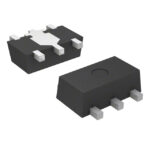 XC6503A18APR-G
XC6503A18APR-G is listed in the Voltage Regulators - Linear, Low Drop Out (LDO) Regulators range at ChipApex. The manufacturer field lists Torex Semiconductor Ltd.…
Read More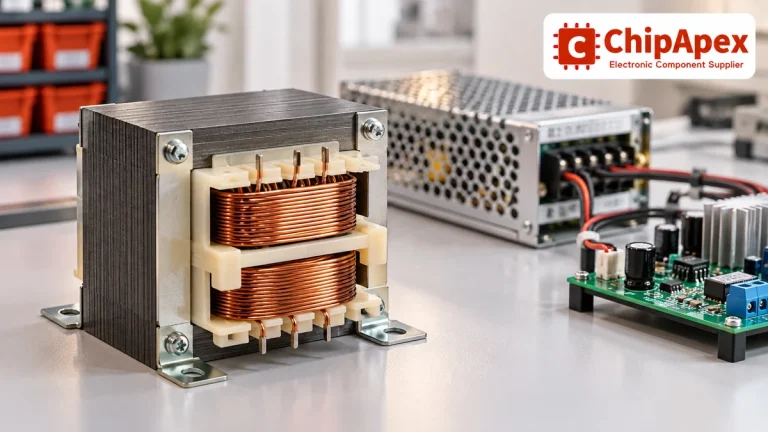
Select power transformers by input frequency, secondary VA, rectifier load, isolation, regulation and inrush. Build a clearer specification for your next RFQ.
Read More
XC6503A18APR-G is listed in the Voltage Regulators - Linear, Low Drop Out (LDO) Regulators range at ChipApex. The manufacturer field lists Torex Semiconductor Ltd.…
Read More
Learn how a pressure transducer converts pressure into voltage, current, or digital output, and compare pressure references and key selection specs.
Read More
XC6503A18APR-G is listed in the Voltage Regulators - Linear, Low Drop Out (LDO) Regulators range at ChipApex. The manufacturer field lists Torex Semiconductor Ltd.…
Read More
XC6503A18APR-G is listed in the Voltage Regulators - Linear, Low Drop Out (LDO) Regulators range at ChipApex. The manufacturer field lists Torex Semiconductor Ltd.…
Read More
Learn how a diode conducts, how to identify anode and cathode, and when to choose rectifier, TVS, Zener or photodiode types for a circuit.
Read More
XC6503A18APR-G is listed in the Voltage Regulators - Linear, Low Drop Out (LDO) Regulators range at ChipApex. The manufacturer field lists Torex Semiconductor Ltd.…
Read More
XC6503A18APR-G is listed in the Voltage Regulators - Linear, Low Drop Out (LDO) Regulators range at ChipApex. The manufacturer field lists Torex Semiconductor Ltd.…
Read More
XC6503A18APR-G is listed in the Voltage Regulators - Linear, Low Drop Out (LDO) Regulators range at ChipApex. The manufacturer field lists Torex Semiconductor Ltd.…
Read More
Understand tactile switches, PCB and keyboard differences, four-pin wiring, debounce, force, travel and replacement checks for reliable control inputs.
Read More
See when an inductor behaves linearly, how DC bias and saturation reduce inductance, and which current and temperature curves to check.
Read More
The activity of extra discounts on wholesale prices is in full swing…
Please fill in your contact information and we will send you the latest wholesale price list.




