 ChipApex | Global Electronic Components Supplier

SEARCH
Search Product
Search Post
— IC芯片 | 连接器 | 传感器 | 被动器件 —
Search productSearch post
— IC芯片 | 连接器 | 传感器 | 被动器件 —
Consult the customer manager about the wholesale price.
consultation hotline:86-132-6715-2157
email:[email protected]
Contact the product manager for consultation. One-stop consultation is available.
Do you want a lower wholesale price? Please send us your inquiry and we will reply immediately.
Phoenix Contact model 1405838 is a standard plug-in header connector designed for secure electrical interconnections within industrial control cabinets. The component features a nominal current rating of 12 A and a rated voltage of 300 V, ensuring reliable signal and power transmission under standard operating conditions. It utilizes a pitch dimension of 5.08 mm to accommodate conductors with cross-sectional areas ranging from 0.5 mm² to 2.5 mm². The assembly includes a detachable housing and an integrated marking field to facilitate systematic cable identification and maintenance procedures.
Verify the specific product code against official Phoenix Contact catalogs to confirm pin count and color coding options. Ensure compatibility with existing mating plugs and mounting rail systems before finalizing orders. Cross-reference technical drawings for precise dimensional requirements to avoid integration issues during installation.
Select this connector based on the required current capacity and wire gauge specifications for the target application. Consider the environmental conditions such as temperature range and potential exposure to chemicals when evaluating the suitability of the polycarbonate housing. Verify that the terminal pitch matches the design constraints of the printed circuit board or busbar system.
This component belongs to the Phoenix Contact standard series of plug-in headers, widely utilized in industrial automation environments. These connectors are engineered to meet rigorous safety standards and provide consistent performance across various control cabinet applications. The series offers a comprehensive range of configurations to support diverse wiring needs.
Consult official Phoenix Contact documentation for verified substitute part numbers. Ensure any replacement maintains identical electrical ratings, mechanical dimensions, and connection technology to guarantee functional equivalence without requiring design modifications.
 1405838

See how a MEMS gyroscope measures angular rate, why its angle estimate drifts, and which range, noise, interface and temperature specs to compare.
Read More
On October 1, 2025 local time, OpenAI, an artificial intelligence research company, announced the establishment of a cooperative relationship with Samsung Electronics and SK…
Read More
TOKYO, April 15, 2026 – Taiyo Yuden Co., Ltd. (TAIYO YUDEN), a leading global manufacturer of passive electronic components, has officially notified its worldwide…
Read More
Recently, the global electronic component market has witnessed a series of new developments. The strategic layouts and market collaborations of major enterprises are constantly…
Read More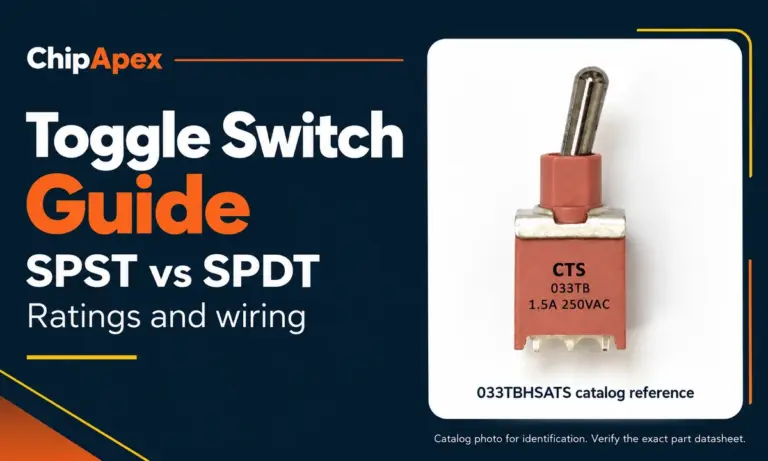
Compare SPST and SPDT toggle switches, understand AC/DC ratings, and follow wiring examples. Check contact action, mounting and parts in the ChipApex catalog.
Read More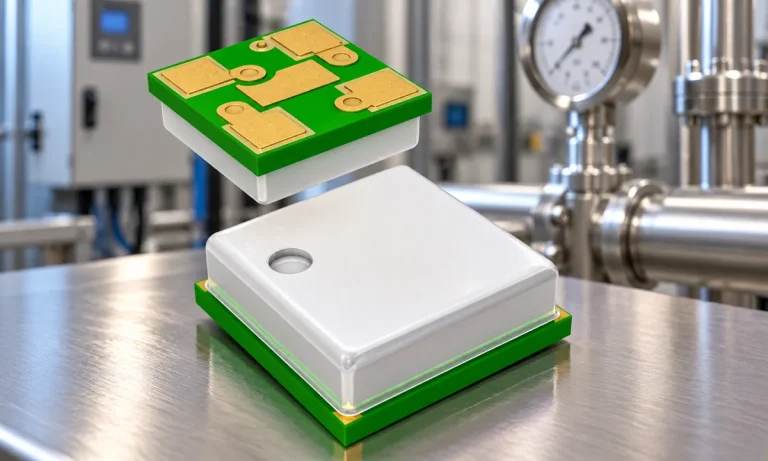
Learn how a pressure transducer converts pressure into voltage, current, or digital output, and compare pressure references and key selection specs.
Read More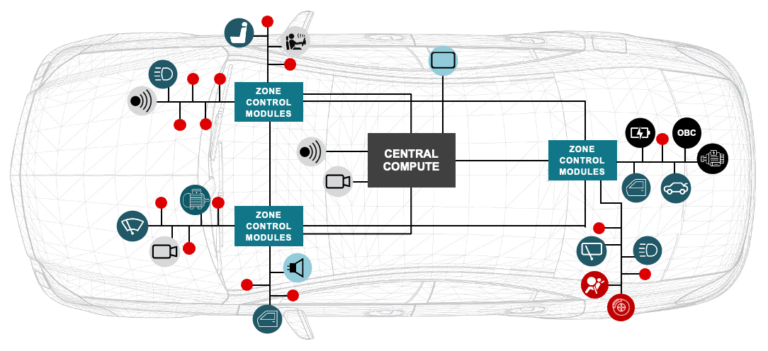
Las Vegas, January 6, 2026 — At the Consumer Electronics Show (CES) 2026, Texas Instruments (TI) (NASDAQ: TXN) announced a suite of next-generation semiconductor…
Read More
WILMINGTON, Mass. – August 11, 2026 — Analog Devices, Inc. (NASDAQ: ADI), the global leading supplier of high-performance analog, mixed-signal and digital signal processing…
Read More
Choose a DIP switch by contact type, coded positions, footprint and signal ratings. Check logic polarity, assembly conditions and PCB configuration behavior.
Read More
If you’ve spent any time staring at a schematic, you’ve seen the triangle. Two inputs, one output, and a gain symbol that looks deceptively…
Read More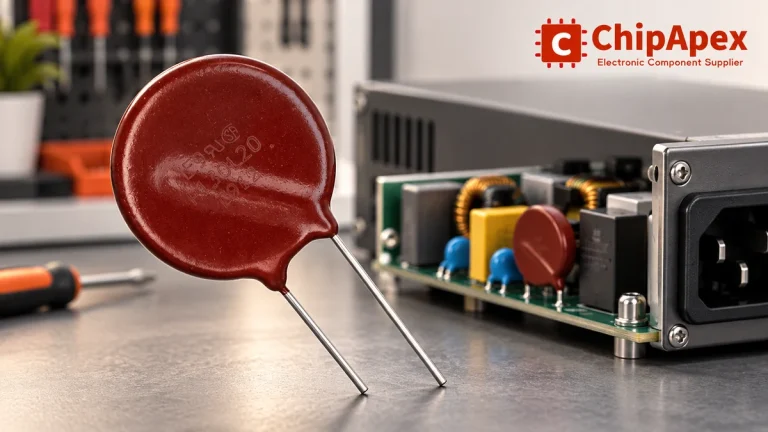
Select MOV varistors by continuous voltage, clamping behavior, surge waveform and repetition. Check thermal disconnection, fuse coordination and replacements.
Read More
Compare RC, crystal and MEMS oscillator circuits. Check ppm, jitter, load capacitance, startup margin and output compatibility before choosing a clock source.
Read More
The activity of extra discounts on wholesale prices is in full swing…
Please fill in your contact information and we will send you the latest wholesale price list.




