 ChipApex | Global Electronic Components Supplier

SEARCH
Search Product
Search Post
— IC芯片 | 连接器 | 传感器 | 被动器件 —
Search productSearch post
— IC芯片 | 连接器 | 传感器 | 被动器件 —
Consult the customer manager about the wholesale price.
consultation hotline:86-132-6715-2157
email:[email protected]
Contact the product manager for consultation. One-stop consultation is available.
Do you want a lower wholesale price? Please send us your inquiry and we will reply immediately.
18QHTF21-38.200-OE is listed in the Oscillators range at ChipApex. The manufacturer field lists Mercury Electronics Ind. Co. Ltd. Its product description is 38.2 MHz XO 1.8V 2.0X1.6 MM OE. Review the specifications below when checking this part for your BOM.
The 18QHTF21-38.200-OE is a clock oscillator manufactured by Mercury Electronics Ind. Co. Ltd, designed for precise timing applications in electronic circuits. This component operates at a nominal frequency of 38.200 MHz and utilizes an OE (Output Enable) logic interface to manage signal output states. It is housed in a compact SMD-4 package with dimensions of 2.0mm x 1.6mm, suitable for space-constrained designs. The device supports a supply voltage range typical for low-voltage digital systems, ensuring reliable performance across various industrial and consumer electronics environments.
Verify the specific ordering suffix 'OE' confirms the output enable functionality when sourcing this component. Ensure compatibility with the target supply voltage and load requirements before procurement. Cross-reference the manufacturer's latest datasheet to confirm pinout configuration and thermal characteristics for your specific application environment.
Select this oscillator when a small form factor and integrated enable control are required. Consider the operating temperature range and stability specifications relative to your system's environmental conditions. Evaluate the trade-off between size and performance metrics against alternative packages if space permits larger components.
This part belongs to Mercury Electronics' 18QHTF series of clock oscillators, known for their reliability in frequency control applications. The series offers various frequencies and packages, catering to diverse timing needs in modern electronics manufacturing.
Check for direct substitutes within the same series offering identical pinouts and electrical characteristics. Verify that any replacement maintains the same output enable feature and package dimensions to ensure mechanical compatibility.
Explore related parts through Crystals, Oscillators, Resonators, all product categories, ChipApex homepage.
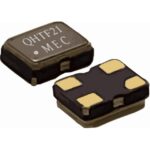 18QHTF21-38.200-OE
18QHTF21-38.200-OE is listed in the Oscillators range at ChipApex. The manufacturer field lists Mercury Electronics Ind. Co. Ltd. Its product description is 38.2 MHz…
Read More
18QHTF21-38.200-OE is listed in the Oscillators range at ChipApex. The manufacturer field lists Mercury Electronics Ind. Co. Ltd. Its product description is 38.2 MHz…
Read More
18QHTF21-38.200-OE is listed in the Oscillators range at ChipApex. The manufacturer field lists Mercury Electronics Ind. Co. Ltd. Its product description is 38.2 MHz…
Read More
Select a bridge rectifier by reverse voltage, capacitor charging current, startup surge and cooling. Work through a stated DC voltage and ripple example.
Read More
18QHTF21-38.200-OE is listed in the Oscillators range at ChipApex. The manufacturer field lists Mercury Electronics Ind. Co. Ltd. Its product description is 38.2 MHz…
Read More
Learn why PTC resistance rises with temperature, how it differs from NTC, and which ratings matter for sensing and protection.
Read More
18QHTF21-38.200-OE is listed in the Oscillators range at ChipApex. The manufacturer field lists Mercury Electronics Ind. Co. Ltd. Its product description is 38.2 MHz…
Read More
Understand RF attenuator dB values, fixed and programmable types, impedance, power limits and noise tradeoffs before choosing parts for an RF signal path.
Read More18QHTF21-38.200-OE is listed in the Oscillators range at ChipApex. The manufacturer field lists Mercury Electronics Ind. Co. Ltd. Its product description is 38.2 MHz…
Read More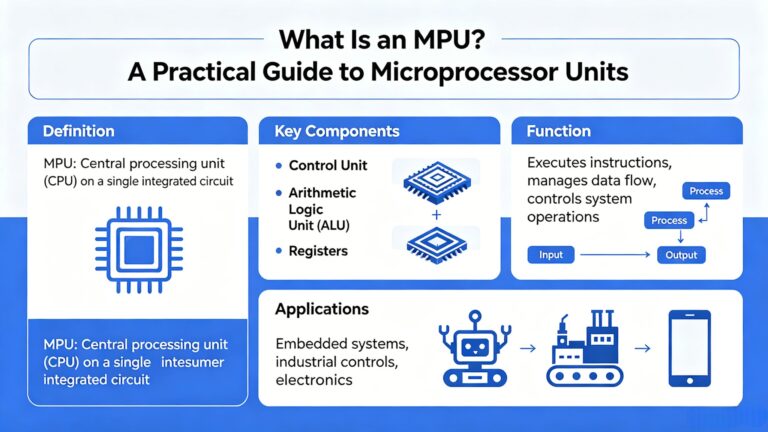
18QHTF21-38.200-OE is listed in the Oscillators range at ChipApex. The manufacturer field lists Mercury Electronics Ind. Co. Ltd. Its product description is 38.2 MHz…
Read More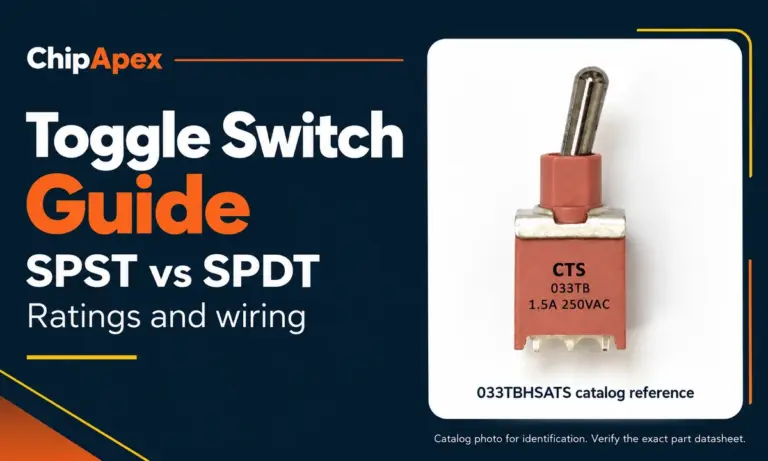
Compare SPST and SPDT toggle switches, understand AC/DC ratings, and follow wiring examples. Check contact action, mounting and parts in the ChipApex catalog.
Read More
Understand how oscillators generate timing signals, how they differ from crystals, and which frequency, output and stability specs matter when choosing one.
Read More
The activity of extra discounts on wholesale prices is in full swing…
Please fill in your contact information and we will send you the latest wholesale price list.




