 ChipApex | Global Electronic Components Supplier

SEARCH
Search Product
Search Post
— IC芯片 | 连接器 | 传感器 | 被动器件 —
Search productSearch post
— IC芯片 | 连接器 | 传感器 | 被动器件 —
Consult the customer manager about the wholesale price.
consultation hotline:86-132-6715-2157
email:[email protected]
Contact the product manager for consultation. One-stop consultation is available.
Do you want a lower wholesale price? Please send us your inquiry and we will reply immediately.
1N2129A is listed in the Single Diodes range at ChipApex. The manufacturer field lists GeneSiC Semiconductor. Its product description is DIODE STANDARD 100V 60A DO5. Review the specifications below when checking this part for your BOM.
The GeneSiC Semiconductor 1N2129A is a silicon standard recovery rectifier diode housed in a DO-5 (DO-203AB) stud mount package. It features a repetitive peak reverse voltage of 100 V and supports a continuous forward current of 60 A. The device operates within a junction temperature range of -55 °C to 150 °C, with a thermal resistance from junction to case of 0.65 °C/W. Standard polarity designates the stud as the cathode.
Verify the specific part marking against the datasheet to confirm the 100 V rating and standard polarity configuration. Ensure the mounting surface meets the required thermal interface specifications for the 0.65 °C/W junction-to-case resistance. Confirm that the application environment remains within the specified -55 °C to 150 °C operating temperature limits to maintain device reliability.
Select this component when a robust stud-mount rectifier is required for high-current applications. The 60 A continuous rating and 100 V blocking voltage suit medium-voltage designs. Consider the DO-5 package dimensions for mechanical integration and verify that the heat sink design can effectively manage the thermal resistance to prevent junction overheating during operation.
This component belongs to the 1N2128A through 1N2131AR series of silicon standard recovery diodes. All variants share identical physical packages and thermal characteristics, differing primarily in their voltage ratings which range from 50 V to 200 V. This series provides standardized solutions for general-purpose rectification tasks requiring reliable performance under varying thermal conditions.
Direct substitutes include other 1N2129A units from different manufacturers or compatible parts within the same 1N2128A-1N2131AR family that match the 100 V rating and 60 A current capacity. Verify pinout compatibility, specifically that the stud functions as the cathode, before implementation.
Explore related parts through Rectifiers, Diodes, Discrete Semiconductor Products, all product categories.
 1N2129A

Learn how a diode conducts, how to identify anode and cathode, and when to choose rectifier, TVS, Zener or photodiode types for a circuit.
Read More
1N2129A is listed in the Single Diodes range at ChipApex. The manufacturer field lists GeneSiC Semiconductor. Its product description is DIODE STANDARD 100V 60A…
Read More
Learn what data acquisition means, from sensors and conditioning to sampling and storage. Review channel timing, wiring, calibration and data quality.
Read More
See how a MEMS gyroscope measures angular rate, why its angle estimate drifts, and which range, noise, interface and temperature specs to compare.
Read More
1N2129A is listed in the Single Diodes range at ChipApex. The manufacturer field lists GeneSiC Semiconductor. Its product description is DIODE STANDARD 100V 60A…
Read More
Select a common mode choke using noise frequency, current, insulation and signal integrity. Understand impedance curves, layout and filter limitations.
Read More
Learn why PTC resistance rises with temperature, how it differs from NTC, and which ratings matter for sensing and protection.
Read More
Learn how rectifiers convert AC to DC, compare half-wave and bridge circuits, and select voltage, current, recovery and thermal ratings for your design.
Read More
1N2129A is listed in the Single Diodes range at ChipApex. The manufacturer field lists GeneSiC Semiconductor. Its product description is DIODE STANDARD 100V 60A…
Read More
1N2129A is listed in the Single Diodes range at ChipApex. The manufacturer field lists GeneSiC Semiconductor. Its product description is DIODE STANDARD 100V 60A…
Read More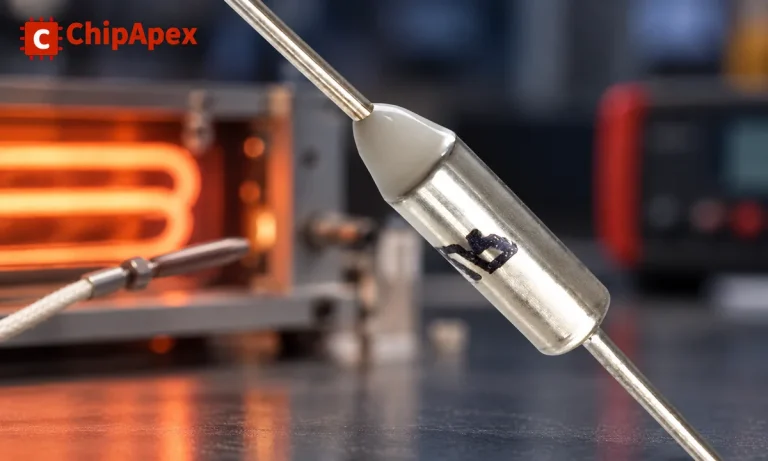
Understand thermal fuse operation, Tf, Th and Tm, electrical ratings and mounting. Check temperature limits and replacement requirements for your design.
Read More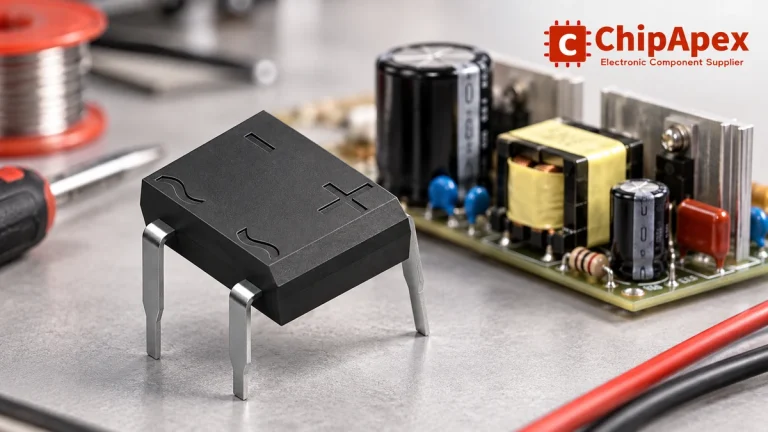
Select a bridge rectifier by reverse voltage, capacitor charging current, startup surge and cooling. Work through a stated DC voltage and ripple example.
Read More
The activity of extra discounts on wholesale prices is in full swing…
Please fill in your contact information and we will send you the latest wholesale price list.





