ChipApex | Global Electronic Components Supplier

SEARCH
Search Product
Search Post
— IC芯片 | 连接器 | 传感器 | 被动器件 —
Search productSearch post
— IC芯片 | 连接器 | 传感器 | 被动器件 —
Consult the customer manager about the wholesale price.
consultation hotline:86-132-6715-2157
email:[email protected]
Contact the product manager for consultation. One-stop consultation is available.
Do you want a lower wholesale price? Please send us your inquiry and we will reply immediately.
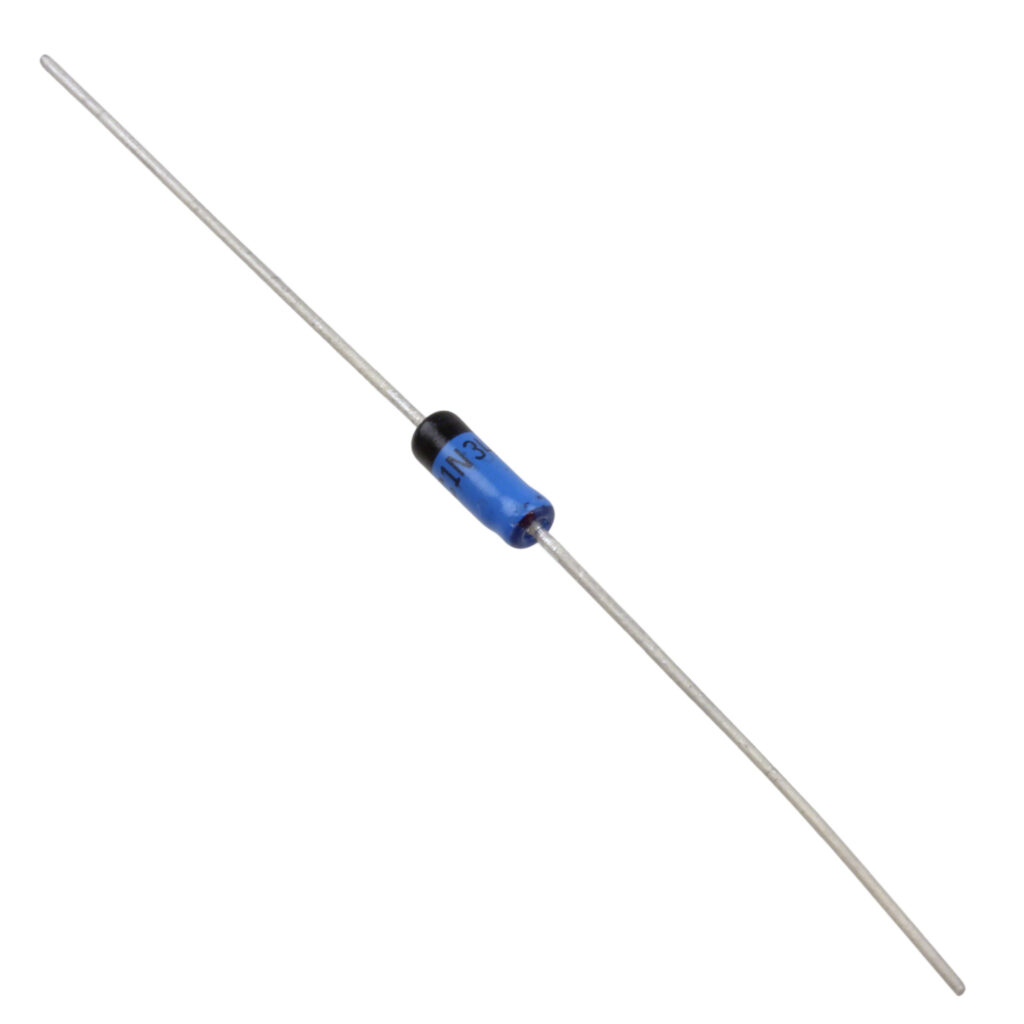
1N4002/54 is listed in the Single Diodes range at ChipApex. The manufacturer field lists Vishay General Semiconductor - Diodes Division. Its product description is DIODE STANDARD 100V 1A DO204AL. Review the specifications below when checking this part for your BOM.
The Vishay General Semiconductor 1N4002/54 is a general-purpose plastic rectifier diode belonging to the 1N4001 through 1N4007 series. It features a maximum repetitive peak reverse voltage of 100 V and a maximum average forward rectified current of 1.0 A at an ambient temperature of 75 °C with 0.375-inch lead length. The device exhibits a maximum instantaneous forward voltage of 1.1 V at 1.0 A and a maximum DC reverse current of 5.0 μA at rated blocking voltage and 25 °C. Peak forward surge current capability reaches 30 A for an 8.3 ms single half sine-wave. The component operates within a junction and storage temperature range of -50 °C to +150 °C.
Verify the specific ordering suffix against the manufacturer's official documentation to confirm package type, tape-and-reel specifications, and compliance status. Confirm availability and lifecycle status directly with authorized distributors or the manufacturer, as supply conditions may vary by region and date.
Select this component for standard low-frequency rectification tasks requiring 100 V reverse blocking capability and 1 A continuous current handling. Ensure thermal management aligns with the specified operating junction temperature limits and derating curves provided in the datasheet.
This part belongs to the widely used 1N400x series of silicon rectifiers manufactured by Vishay General Semiconductor. These devices are housed in the DO-204AL (DO-41) axial leaded package with a molded epoxy body. The series covers reverse voltage ratings from 50 V to 1000 V, providing a standardized solution for various power supply applications.
Other parts within the 1N4001 thru 1N4007 series from Vishay offer identical electrical characteristics except for their reverse voltage ratings. Cross-manufacturer equivalents must be verified for matching current, voltage, and package dimensions.
Explore related parts through Rectifiers, Diodes, Discrete Semiconductor Products, all product categories.
 1N4002/54

See how a MEMS gyroscope measures angular rate, why its angle estimate drifts, and which range, noise, interface and temperature specs to compare.
Read More
Compare RC, crystal and MEMS oscillator circuits. Check ppm, jitter, load capacitance, startup margin and output compatibility before choosing a clock source.
Read More
1N4002/54 is listed in the Single Diodes range at ChipApex. The manufacturer field lists Vishay General Semiconductor - Diodes Division. Its product description is…
Read More
1N4002/54 is listed in the Single Diodes range at ChipApex. The manufacturer field lists Vishay General Semiconductor - Diodes Division. Its product description is…
Read More
Understand how oscillators generate timing signals, how they differ from crystals, and which frequency, output and stability specs matter when choosing one.
Read More
1N4002/54 is listed in the Single Diodes range at ChipApex. The manufacturer field lists Vishay General Semiconductor - Diodes Division. Its product description is…
Read More
Compare thermistors, RTDs, thermocouples and temperature ICs. Learn how range, accuracy, response, interfaces and mounting affect component selection.
Read More
1N4002/54 is listed in the Single Diodes range at ChipApex. The manufacturer field lists Vishay General Semiconductor - Diodes Division. Its product description is…
Read More
1N4002/54 is listed in the Single Diodes range at ChipApex. The manufacturer field lists Vishay General Semiconductor - Diodes Division. Its product description is…
Read More
1N4002/54 is listed in the Single Diodes range at ChipApex. The manufacturer field lists Vishay General Semiconductor - Diodes Division. Its product description is…
Read More
Learn how rectifiers convert AC to DC, compare half-wave and bridge circuits, and select voltage, current, recovery and thermal ratings for your design.
Read More
See when an inductor behaves linearly, how DC bias and saturation reduce inductance, and which current and temperature curves to check.
Read More
The activity of extra discounts on wholesale prices is in full swing…
Please fill in your contact information and we will send you the latest wholesale price list.