ChipApex | Global Electronic Components Supplier

SEARCH
Search Product
Search Post
— IC芯片 | 连接器 | 传感器 | 被动器件 —
Search productSearch post
— IC芯片 | 连接器 | 传感器 | 被动器件 —
Consult the customer manager about the wholesale price.
consultation hotline:86-132-6715-2157
email:[email protected]
Contact the product manager for consultation. One-stop consultation is available.
Do you want a lower wholesale price? Please send us your inquiry and we will reply immediately.
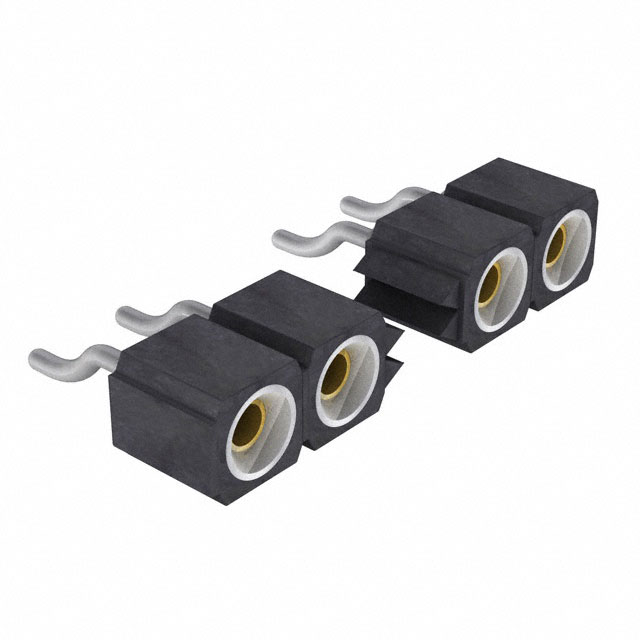
310-87-105-41-205191 is listed in the Headers, Receptacles, Female Sockets range at ChipApex. The manufacturer field lists Preci-Dip. Its product description is CONN SOCKET 5P 0.1 GOLD SMD R/A. Review the specifications below when checking this part for your BOM.
The Preci-Dip 310-87-105-41-205191 is a 5-position socket connector designed for surface mount applications. It features a right-angle orientation with a 0.100-inch (2.54 mm) pitch. The contacts are gold-plated to ensure reliable signal transmission. The housing is constructed from black glass-filled polyester, meeting UL 94 V-0 flammability standards. Rated for 3A current and operating within a temperature range of -55°C to 125°C, this component utilizes female contacts for board-to-board stacking or header mating.
Verify the specific ordering suffix against official Preci-Dip documentation to confirm the exact contact plating thickness and housing material variant. Ensure that the surface mount footprint matches the target PCB design specifications before procurement. Cross-reference the manufacturer part number with authorized distributors to confirm current availability and authenticity.
Select this model when a low-profile, right-angle surface mount socket is required for 5-position interfaces. The 2.54 mm pitch ensures compatibility with standard headers. Consider the thermal and electrical ratings relative to the application environment. Verify mechanical clearance requirements for the right-angle configuration during the layout phase.
This component belongs to the Preci-Dip 310 series, which specializes in high-density rectangular connectors. The series offers various configurations including through-hole and surface mount options. The 310-87-105-41-205191 specifically addresses needs for right-angle surface mounting with robust contact materials.
Direct substitutes include other 5-position right-angle surface mount sockets with identical 2.54 mm pitch and compatible housing dimensions. Verify pinout and mechanical retention methods before substitution.
Explore related parts through Rectangular Connectors, Connectors, Interconnects, all product categories, ChipApex homepage.
 310-87-105-41-205191

Learn the relay definition, coil and contact operation, NO and NC forms, load ratings and suppression choices. Compare mechanical, reed and solid-state types.
Read More
Compare RC, crystal and MEMS oscillator circuits. Check ppm, jitter, load capacitance, startup margin and output compatibility before choosing a clock source.
Read More
310-87-105-41-205191 is listed in the Headers, Receptacles, Female Sockets range at ChipApex. The manufacturer field lists Preci-Dip. Its product description is CONN SOCKET 5P…
Read More
Learn how rectifiers convert AC to DC, compare half-wave and bridge circuits, and select voltage, current, recovery and thermal ratings for your design.
Read More
310-87-105-41-205191 is listed in the Headers, Receptacles, Female Sockets range at ChipApex. The manufacturer field lists Preci-Dip. Its product description is CONN SOCKET 5P…
Read More
See when an inductor behaves linearly, how DC bias and saturation reduce inductance, and which current and temperature curves to check.
Read More
310-87-105-41-205191 is listed in the Headers, Receptacles, Female Sockets range at ChipApex. The manufacturer field lists Preci-Dip. Its product description is CONN SOCKET 5P…
Read More
Choose logic inverter ICs by thresholds, supply, output drive and delay. Compare standard and Schmitt-trigger inputs, power sequencing and replacement checks.
Read More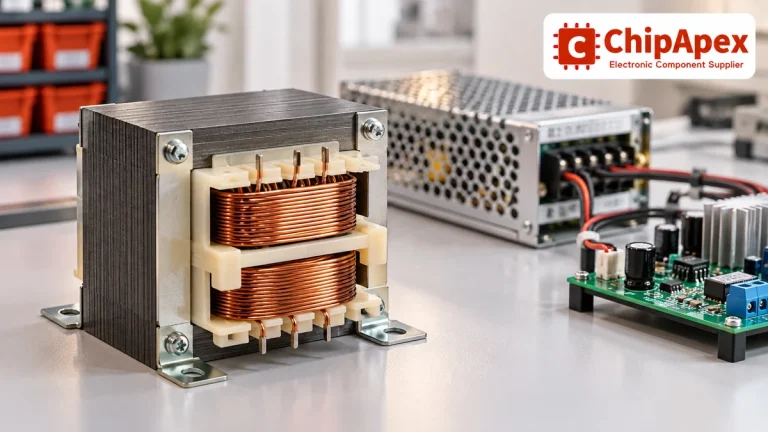
Select power transformers by input frequency, secondary VA, rectifier load, isolation, regulation and inrush. Build a clearer specification for your next RFQ.
Read More
Choose an AC to DC converter by input range, output demand, isolation, efficiency and thermal derating. Compare architectures and check installation needs.
Read More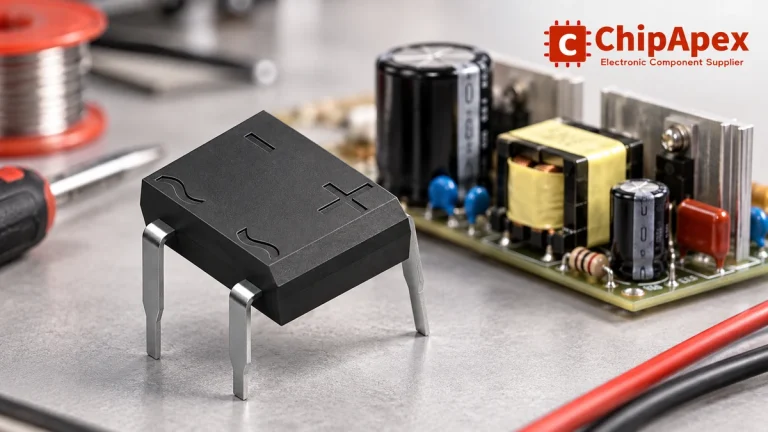
Select a bridge rectifier by reverse voltage, capacitor charging current, startup surge and cooling. Work through a stated DC voltage and ripple example.
Read More
Understand how oscillators generate timing signals, how they differ from crystals, and which frequency, output and stability specs matter when choosing one.
Read More
The activity of extra discounts on wholesale prices is in full swing…
Please fill in your contact information and we will send you the latest wholesale price list.