 ChipApex | Global Electronic Components Supplier

SEARCH
Search Product
Search Post
— IC芯片 | 连接器 | 传感器 | 被动器件 —
Search productSearch post
— IC芯片 | 连接器 | 传感器 | 被动器件 —
Consult the customer manager about the wholesale price.
consultation hotline:86-132-6715-2157
email:[email protected]
Contact the product manager for consultation. One-stop consultation is available.
Do you want a lower wholesale price? Please send us your inquiry and we will reply immediately.
BU25SD2MG-MTR is listed in the Voltage Regulators - Linear, Low Drop Out (LDO) Regulators range at ChipApex. The manufacturer field lists Rohm Semiconductor. Its product description is IC REG LINEAR 2.5V 200MA 5-SSOP. Review the specifications below when checking this part for your BOM.
The BU25SD2MG-MTR is a single-channel, fixed-output CMOS Low Dropout (LDO) voltage regulator manufactured by ROHM Semiconductor. Designed for automotive applications, it delivers a maximum output current of 300 mA with a fixed output voltage of 2.5 V. The device operates within an input voltage range of 1.7 V to 6 V and supports a junction temperature range from -40°C to +150°C. Key electrical specifications include a typical dropout voltage of 240 mV at full load, a ripple rejection ratio of 60 dB, and a quiescent circuit current of 4 µA. It features overcurrent protection and thermal shutdown capabilities.
Verify the specific suffix 'MTR' indicates tape-and-reel packaging when sourcing. Confirm AEC-Q100 Grade 1 qualification status aligns with project requirements. Ensure the fixed 2.5 V output matches system design constraints. Check for RoHS compliance documentation prior to integration.
Select this component for designs requiring low noise and high accuracy in compact SSOP-5 packages. Consider the 300 mA output capability against peak load demands. Evaluate the wide operating temperature range for harsh automotive environments. Compare dropout characteristics against available headroom in the supply rail.
This part belongs to the BUxxSD2 series of general-purpose, high-performance full CMOS regulators. These devices are characterized by low circuit current and excellent noise and load response characteristics. They are specifically engineered for use in automotive audio and navigation equipment where reliability and efficiency are critical.
Direct substitutes within the same family include BU28SD2MG-MTR (2.8 V output), BU30SD2MG-MTR (3.0 V output), and BU33SD2MG-MTR (3.3 V output). Verify that the alternative output voltage meets the target circuit requirements before substitution.
Explore related parts through Power Management (PMIC), Integrated Circuits (ICs), all product categories, ChipApex homepage.
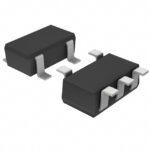 BU25SD2MG-MTR

BU25SD2MG-MTR is listed in the Voltage Regulators - Linear, Low Drop Out (LDO) Regulators range at ChipApex. The manufacturer field lists Rohm Semiconductor. Its…
Read More
Compare Pt100 and Pt1000 RTDs, two-, three- and four-wire connections, excitation and self-heating. Build an error budget from element to reported temperature.
Read More
BU25SD2MG-MTR is listed in the Voltage Regulators - Linear, Low Drop Out (LDO) Regulators range at ChipApex. The manufacturer field lists Rohm Semiconductor. Its…
Read More
BU25SD2MG-MTR is listed in the Voltage Regulators - Linear, Low Drop Out (LDO) Regulators range at ChipApex. The manufacturer field lists Rohm Semiconductor. Its…
Read More
Understand how a comparator switches at a voltage threshold, why hysteresis prevents chatter, and which output and input specs matter.
Read More
BU25SD2MG-MTR is listed in the Voltage Regulators - Linear, Low Drop Out (LDO) Regulators range at ChipApex. The manufacturer field lists Rohm Semiconductor. Its…
Read More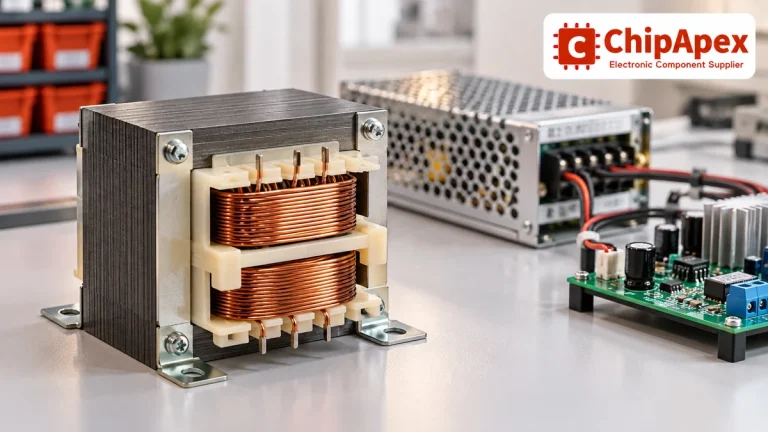
Select power transformers by input frequency, secondary VA, rectifier load, isolation, regulation and inrush. Build a clearer specification for your next RFQ.
Read More
BU25SD2MG-MTR is listed in the Voltage Regulators - Linear, Low Drop Out (LDO) Regulators range at ChipApex. The manufacturer field lists Rohm Semiconductor. Its…
Read More
Compare RC, crystal and MEMS oscillator circuits. Check ppm, jitter, load capacitance, startup margin and output compatibility before choosing a clock source.
Read More
BU25SD2MG-MTR is listed in the Voltage Regulators - Linear, Low Drop Out (LDO) Regulators range at ChipApex. The manufacturer field lists Rohm Semiconductor. Its…
Read More
Choose an AC to DC converter by input range, output demand, isolation, efficiency and thermal derating. Compare architectures and check installation needs.
Read More
See how a MEMS gyroscope measures angular rate, why its angle estimate drifts, and which range, noise, interface and temperature specs to compare.
Read More
The activity of extra discounts on wholesale prices is in full swing…
Please fill in your contact information and we will send you the latest wholesale price list.




